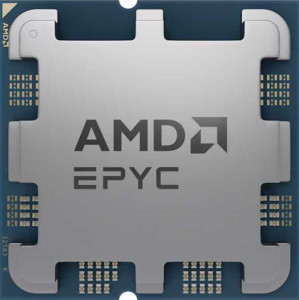
The AMD Epyc 4484PX carries a Thermal Design Power (TDP) of 120W and is built on a 5 nm semiconductor process, reflecting a relatively compact fabrication node for this class of enterprise processor. It supports the PCIe 5.0 interface standard and is fully 64-bit compatible, while it does not include integrated graphics, making a discrete GPU necessary for any display output.
The processor operates across 12 cores at a base clock speed of 4.4 GHz, supporting 24 threads in total, with a turbo clock speed reaching 5.6 GHz for demanding workloads. Cache is organized across three levels: 768 KB of L1, 12 MB of L2 at 1 MB per core, and a substantial 128 MB of L3 cache averaging 10.67 MB per core, providing considerable on-chip memory for data-intensive tasks. The clock multiplier is set at 44, and the multiplier is locked, meaning manual frequency adjustments beyond the default configuration are not supported.
The AMD Epyc 4484PX uses DDR5 memory and supports speeds of up to 5200 MHz across two memory channels, delivering a maximum memory bandwidth of 83.2 GB/s. It also supports ECC memory, which enables error detection and correction to help maintain data integrity in enterprise and server environments.
The processor supports a broad range of instruction sets including MMX, AVX, AVX2, AES, FMA3, F16C, SSE 4.1, and SSE 4.2, covering vectorized math, encryption acceleration, and extended multimedia operations. It also features the NX bit, a hardware-level security mechanism that helps prevent certain classes of malicious code execution by marking memory regions as non-executable.
In PassMark testing, the AMD Epyc 4484PX achieves a multi-threaded score of 50,547, reflecting its throughput across all cores and threads, while its single-threaded score of 4,119 indicates the per-core processing capability measured under the same benchmark.