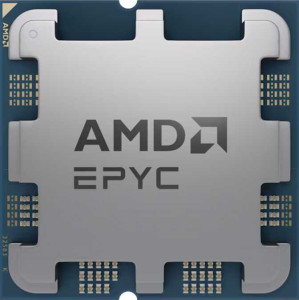
AMD Epyc 4545P specifications and in-depth review

AMD Epyc 4545P

Manufacturer: AMD

The AMD Epyc 4545P is a 16-core, 32-thread enterprise processor designed for workloads that demand a balance of sustained throughput and energy efficiency. Built on a 4nm semiconductor process, it operates at a base clock of 3GHz across all cores and can reach a turbo frequency of 5.4GHz, all within a 65W thermal envelope. Its unlocked multiplier also gives platform builders some room to push performance further when conditions allow.

On the memory side, the Epyc 4545P supports DDR5 at up to 5600MHz across two channels, with a maximum capacity of 192GB and a peak bandwidth of 89.6GB/s. ECC memory support adds a layer of reliability suited to enterprise environments. The processor's cache hierarchy includes 1280KB of L1, 16MB of L2 at 1MB per core, and 64MB of L3 at 4MB per core. It connects via PCIe 5.0 and supports a broad instruction set including AVX2, AES, FMA3, and SSE 4.2. In multi-threaded PassMark testing it scores 55,388, with a single-threaded result of 4,568.

Pros
  • The unlocked clock multiplier gives platform builders the ability to tune clock speeds beyond stock settings, with overclocked PassMark results confirming a measurable performance gain
  • A 64MB L3 cache distributed at 4MB per core provides a substantial fast-access memory pool that helps sustain throughput across all 16 cores
  • ECC memory support adds hardware-level error correction, making the processor suitable for environments where data integrity is critical
  • DDR5 memory support with speeds up to 5600MHz and a peak bandwidth of 89.6 GB/s ensures the memory subsystem keeps pace with demanding workloads
  • The broad instruction set — including AES, AVX2, and FMA3 — enables hardware-accelerated encryption and efficient vectorized computation without relying on software fallbacks
  • A 65W TDP across 16 cores and 32 threads represents a notably contained thermal footprint for an enterprise-class processor
Cons
  • The dual-channel memory configuration limits memory bandwidth scaling compared to platforms with more memory channels
  • No integrated graphics means an additional discrete GPU is always required, adding complexity to system builds where display output is needed
  • The single-threaded PassMark score of 4,568 suggests per-core performance that may not satisfy workloads heavily dependent on single-thread execution speed
  • With only two memory channels, the maximum 89.6 GB/s bandwidth ceiling may become a bottleneck in memory-intensive enterprise workloads
Who is this for?

The Epyc 4545P is well suited to enterprise server and workstation deployments where a balance of multi-threaded throughput and energy efficiency is a priority. Its ECC memory support and 192GB DDR5 capacity make it a practical choice for database servers, virtualization hosts, and data processing environments where memory reliability and headroom matter. The combination of a 65W TDP across 16 cores also makes it appropriate for space- and power-constrained rack deployments, while the unlocked multiplier adds appeal for operators who want to fine-tune clock behavior for specific workloads. The broad instruction set, including AES and AVX2, further suits environments that rely on hardware-accelerated encryption and vectorized computation, such as analytics pipelines or secure data handling applications.

Who is this NOT for?

This processor is not a strong fit for workloads that are heavily dependent on single-threaded execution speed, as its single-threaded PassMark score of 4,568 indicates modest per-core performance that may bottleneck latency-sensitive or single-threaded applications. The absence of integrated graphics makes it entirely unsuitable for any deployment where display output is needed without a discrete GPU, ruling it out for lightweight or cost-sensitive builds where adding a graphics card is impractical. Additionally, the dual-channel memory architecture limits bandwidth scaling, so workloads with extremely high memory throughput demands — such as large-scale in-memory analytics or high-frequency simulation — may find the 89.6 GB/s ceiling restrictive compared to platforms with wider memory channel configurations.

General info:

Thermal Design Power (TDP) 65W
semiconductor size 4 nm
PCI Express (PCIe) version 5
Supports 64-bit
Has integrated graphics

The AMD Epyc 4545P is a 64-bit processor built on a 4nm semiconductor process, operating within a 65W Thermal Design Power (TDP) envelope that reflects its efficiency-oriented design. It supports PCIe 5.0 for high-bandwidth connectivity with compatible peripherals and expansion cards. The processor does not include integrated graphics, meaning a discrete GPU is required for display output.

Performance:

CPU speed 16 x 3 GHz
CPU threads 32 threads
turbo clock speed 5.4GHz
L3 cache 64 MB
L1 cache 1280 KB
L2 cache 16 MB
L2 core 1 MB/core
clock multiplier 30
Has an unlocked multiplier
L3 core 4 MB/core

The Epyc 4545P runs 16 cores at a base clock of 3GHz, handling up to 32 threads simultaneously, with a turbo clock speed reaching 5.4GHz when workloads call for it. The processor carries a clock multiplier of 30 and features an unlocked multiplier, offering flexibility for tuning clock behavior. Its cache layout consists of 1280KB of L1, 16MB of L2 at 1MB per core, and a 64MB L3 cache distributed at 4MB per core — providing a substantial pool of fast-access memory to help keep the cores fed under demanding workloads.

Memory:

Supports ECC memory
maximum memory bandwidth 89.6 GB/s
DDR memory version 5
RAM speed (max) 5600 MHz
maximum memory amount 192GB
memory channels 2

The Epyc 4545P uses a dual-channel DDR5 memory configuration, supporting speeds of up to 5600MHz and a maximum installed capacity of 192GB. Peak memory bandwidth reaches 89.6 GB/s, giving the processor ample throughput for data-intensive workloads. The platform also supports ECC memory, which enables automatic detection and correction of single-bit memory errors — a practical consideration for enterprise and server deployments where data integrity is a priority.

Features:

uses multithreading
instruction sets MMX, F16C, FMA3, AES, AVX, AVX2, SSE 4.1, SSE 4.2
Has NX bit

The Epyc 4545P supports multithreading, allowing each physical core to handle two threads concurrently for improved throughput across parallel workloads. It includes the NX bit, a hardware-level security feature that helps guard against certain classes of malicious code execution. The processor's instruction set support covers MMX, F16C, FMA3, AES, AVX, AVX2, SSE 4.1, and SSE 4.2, providing a broad foundation for tasks ranging from floating-point computation and vectorized data processing to hardware-accelerated encryption.

Benchmarks:

PassMark result 55388
PassMark result (single) 4568
PassMark result (overclocked) 55541

In PassMark testing, the Epyc 4545P achieves a multi-threaded score of 55,388, reflecting its capacity across all cores and threads under sustained load. The single-threaded result stands at 4,568, indicating per-core execution performance. When run in an overclocked configuration, the score rises marginally to 55,541, suggesting the unlocked multiplier yields a modest but measurable gain in this particular benchmark.
Final Verdict

The AMD Epyc 4545P presents a well-rounded profile for enterprise environments that need a dependable balance of multi-threaded capacity and controlled power consumption. Its 16-core, 32-thread configuration paired with DDR5 memory support, ECC capability, and a broad instruction set covering hardware-accelerated encryption and vectorized workloads makes it a practical choice for server, virtualization, and data processing deployments. The 64MB L3 cache and 65W TDP combination is particularly notable, delivering meaningful throughput within a thermal envelope that suits power-conscious or space-constrained installations. Where per-core single-threaded speed or wider memory bandwidth is the dominant requirement, the platform shows its natural boundaries — but for workloads that play to its multi-threaded strengths, the Epyc 4545P is a focused and capable enterprise processor.

Popular Comparisons

AMD Epyc 4545P
AMD Epyc 4545P
VS
AMD Epyc 4465P
AMD Epyc 4465P
AMD Epyc 4545P
AMD Epyc 4545P
VS
AMD Epyc 4244P
AMD Epyc 4244P