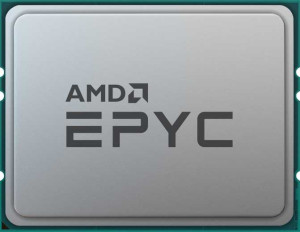
AMD Epyc 4585PX specifications and in-depth review

AMD Epyc 4585PX

Manufacturer: AMD

The AMD Epyc 4585PX is a 16-core, 32-thread processor designed for the enterprise segment, running at a base speed of 4.3GHz across all cores. It is built on a 4nm semiconductor process, which contributes to its ability to reach a turbo frequency of 5.7GHz while operating within a 170W thermal envelope. The chip supports PCIe 5.0 connectivity and carries an unlocked multiplier, giving platform builders flexibility in how they deploy it.

On the memory side, the Epyc 4585PX supports DDR5 at up to 5600MHz across two channels, with a maximum capacity of 192GB and a peak bandwidth of 89.6GB/s. ECC memory support is included, which is a standard requirement in server and workstation environments. The cache hierarchy consists of 1280KB of L1, 16MB of L2 at 1MB per core, and a substantial 128MB of L3 at 8MB per core. The processor supports a broad instruction set including AVX2, FMA3, AES, and F16C, and records a PassMark multi-core score of 71,552 alongside a single-core result of 4,795.

Pros
  • Supports ECC memory, which ensures data integrity in server and workstation environments where reliability is critical
  • The unlocked multiplier allows for frequency adjustments beyond the default clock settings
  • A large 128MB L3 cache at 8MB per core helps reduce memory latency across multi-threaded workloads
  • DDR5 memory support with speeds up to 5600MHz and a maximum capacity of 192GB suits memory-intensive enterprise workloads
  • Hardware-accelerated AES instruction support enables encryption tasks to be handled at the processor level without dedicated hardware
  • NX bit support adds a layer of hardware-based security against certain types of code execution exploits
Cons
  • No integrated graphics means a discrete GPU or remote management card is required for any display output
  • With only two memory channels, memory bandwidth is limited compared to what higher channel-count server platforms can offer
  • A 170W TDP places significant demands on cooling infrastructure, which must be accounted for in system design
  • The single-core PassMark score of 4,795 suggests per-core throughput may be a limiting factor in workloads that do not scale well across multiple threads
Who is this for?

The AMD Epyc 4585PX is well-suited for server and workstation environments that demand reliable, sustained multi-threaded processing. Its support for ECC memory makes it a practical fit for data-sensitive applications such as database hosting, virtualization, and scientific computing, where memory error correction is a baseline requirement. The 16-core, 32-thread configuration combined with a generous 128MB L3 cache also makes it a reasonable choice for workloads that benefit from high core counts and low-latency data access, such as content rendering, simulation tasks, and enterprise application servers. Environments that require hardware-level security features like NX bit support and AES instruction acceleration will also find the chip's feature set aligned with their needs.

Who is this NOT for?

This processor is not a practical choice for general desktop or consumer computing, particularly because it lacks integrated graphics, meaning any display-dependent use case requires a dedicated GPU — adding complexity and hardware overhead to the platform. Users or workloads that rely heavily on single-threaded performance may find the chip's per-core throughput, reflected in its single-core PassMark score of 4,795, insufficient for tasks that do not parallelize well. Additionally, its 170W TDP makes it unsuitable for compact, thermally constrained, or low-power environments where heat dissipation and energy consumption are significant design considerations.

General info:

Thermal Design Power (TDP) 170W
semiconductor size 4 nm
PCI Express (PCIe) version 5
Supports 64-bit
CPU temperature 95 °C
Has integrated graphics

The AMD Epyc 4585PX carries a Thermal Design Power (TDP) of 170W and is rated for a maximum operating temperature of 95°C, reflecting its server-grade thermal requirements. It is manufactured on a 4nm process node and fully supports 64-bit computing. Connectivity is handled through PCIe 5.0, enabling high-bandwidth communication with compatible expansion devices. The processor does not include integrated graphics, which is typical for CPUs targeting dedicated server and workstation platforms.

Performance:

CPU speed 16 x 4.3 GHz
CPU threads 32 threads
turbo clock speed 5.7GHz
L3 cache 128 MB
L1 cache 1280 KB
L2 cache 16 MB
L2 core 1 MB/core
clock multiplier 43
Has an unlocked multiplier
L3 core 8 MB/core

The AMD Epyc 4585PX operates with 16 cores running at a base speed of 4.3GHz each, supported by 32 threads for concurrent workload handling, and can reach a turbo clock speed of 5.7GHz when conditions allow. The processor ships with a clock multiplier of 43 and features an unlocked multiplier, providing flexibility for frequency adjustments. Cache is distributed across three levels: 1280KB of L1, 16MB of L2 at 1MB per core, and a generous 128MB of L3 cache allocated at 8MB per core, giving the chip a substantial pool of fast-access memory to reduce latency across demanding workloads.

Memory:

Supports ECC memory
maximum memory bandwidth 89.6 GB/s
DDR memory version 5
RAM speed (max) 5600 MHz
maximum memory amount 192GB
memory channels 2

The AMD Epyc 4585PX uses a dual-channel DDR5 memory configuration, supporting speeds of up to 5600MHz and a maximum installed capacity of 192GB. Peak memory bandwidth reaches 89.6 GB/s, reflecting the throughput available across the two memory channels. The processor also supports ECC memory, which enables error detection and correction — a standard requirement for server and workstation environments where data integrity is a priority.

Features:

uses multithreading
instruction sets MMX, F16C, FMA3, AES, AVX, AVX2, SSE 4.1, SSE 4.2
Has NX bit

The AMD Epyc 4585PX supports multithreading, allowing each physical core to handle two threads simultaneously for more efficient parallel processing. The processor includes the NX bit, a hardware-level security feature that helps prevent certain classes of malicious code execution by marking memory regions as non-executable. On the instruction set side, it supports a broad range of extensions including MMX, SSE 4.1, SSE 4.2, AVX, AVX2, FMA3, F16C, and AES, covering vectorized computation, floating-point operations, and hardware-accelerated encryption.

Benchmarks:

PassMark result 71552
PassMark result (single) 4795
PassMark result (overclocked) 71663

In PassMark testing, the AMD Epyc 4585PX achieves a multi-core score of 71,552, with the overclocked result coming in marginally higher at 71,663, indicating very little performance headroom is gained through overclocking. The single-core PassMark score stands at 4,795, reflecting the per-core processing capability of the chip across the benchmark suite.
Final Verdict

The AMD Epyc 4585PX is a focused enterprise processor that delivers a well-rounded set of capabilities for server and workstation deployments. Its 16-core, 32-thread design, paired with a 128MB L3 cache and DDR5 memory support up to 192GB, positions it as a capable platform for memory-intensive and multi-threaded workloads where data throughput and reliability — particularly through ECC support — are non-negotiable. The unlocked multiplier and broad instruction set coverage, including AES and AVX2, add further utility for specialized computing tasks. That said, the absence of integrated graphics and a 170W thermal footprint mean it is firmly oriented toward purpose-built infrastructure rather than general-purpose use. For organizations building dedicated server or workstation platforms around sustained parallel workloads, the Epyc 4585PX presents a technically coherent and well-specified option.

Popular Comparisons

AMD Epyc 4585PX
AMD Epyc 4585PX
VS
AMD Epyc 4584PX
AMD Epyc 4584PX
AMD Epyc 4585PX
AMD Epyc 4585PX
VS
Intel Xeon E-2488
Intel Xeon E-2488
AMD Epyc 4585PX
AMD Epyc 4585PX
VS
AMD Epyc 9135
AMD Epyc 9135