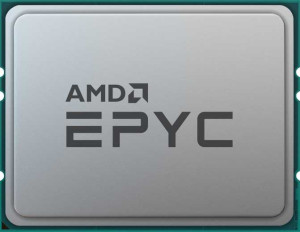
The AMD Epyc 9135 carries a Thermal Design Power (TDP) of 200W and is manufactured on a 4nm process node, reflecting a relatively compact fabrication geometry for this class of server processor. It supports the PCIe 5.0 standard for high-bandwidth peripheral connectivity and is fully 64-bit compatible. The processor does not include integrated graphics, meaning a discrete GPU or external graphics solution is required in any deployment.
The Epyc 9135 operates with 16 cores running at a base clock of 3.65 GHz each, yielding 32 threads through multithreading, and can reach a turbo clock speed of 4.3 GHz under sustained loads. The clock multiplier sits at 36.5 and is locked, so frequency adjustments outside of standard operating parameters are not supported. Cache is structured across three levels: 1280 KB of L1, 16 MB of L2 at 1 MB per core, and 64 MB of L3 at 4 MB per core — providing a substantial amount of fast on-die storage to help keep the processor fed with data across its many cores.
The Epyc 9135 features a 12-channel DDR5 memory configuration, supporting speeds of up to 6000 MHz and a maximum installed capacity of 9000 GB. Peak memory bandwidth reaches 576 GB/s, enabling substantial data throughput for workloads that place heavy demands on memory access. ECC memory is fully supported, providing error-correcting capability that helps maintain data integrity in server and enterprise environments.
The Epyc 9135 supports multithreading, allowing each physical core to handle two threads simultaneously for improved throughput across parallel workloads. It implements a broad range of instruction sets — including AVX, AVX2, FMA3, AES, F16C, MMX, SSE 4.1, and SSE 4.2 — covering vectorized math, hardware-accelerated encryption, and half-precision float conversion among other capabilities. The processor also includes the NX bit, a hardware-level security feature that helps prevent certain classes of malicious code execution by marking memory regions as non-executable.
In PassMark testing, the Epyc 9135 achieves a multi-core score of 57808, reflecting its capacity to distribute workloads efficiently across all 16 cores and 32 threads. Its single-core PassMark result of 3672 gives an indication of per-core performance for tasks that rely on sequential execution rather than parallelism.