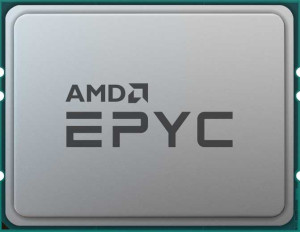
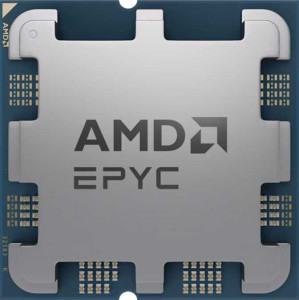
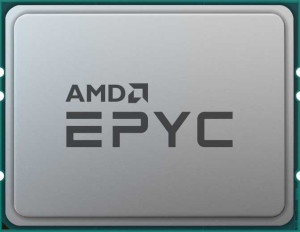
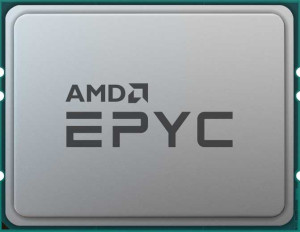
The AMD Epyc 9175F carries a Thermal Design Power (TDP) of 320W and is manufactured on a 4 nm semiconductor process, reflecting the precision fabrication used in its construction. It supports the PCIe 5.0 interface standard and is fully 64-bit compatible. The processor does not include integrated graphics, meaning a discrete graphics solution is required in any deployment.
The processor runs 16 cores at a base speed of 4.2 GHz each, totaling 32 threads through multithreading, with a turbo clock speed reaching 5 GHz under boosted conditions. Its clock multiplier sits at 42, though the multiplier is locked and cannot be adjusted. The cache layout is tiered across three levels: 1280 KB of L1, 16 MB of L2 at 1 MB per core, and a notably large 512 MB of L3 cache distributed at 32 MB per core — a generous allocation that supports data-intensive processing tasks.
The AMD Epyc 9175F supports DDR5 memory across 12 channels, with a maximum RAM speed of 6000 MHz and a peak memory bandwidth of 576 GB/s. It can address up to 9000 GB of total memory, making it suited for configurations where large memory pools are required. ECC memory support is included, providing error-correcting capability for environments where data integrity is a priority.
The processor supports multithreading, allowing each physical core to handle two threads simultaneously. It includes the NX bit for hardware-level memory protection against certain classes of malicious code execution. A broad range of instruction sets is supported, covering MMX, F16C, FMA3, AES, AVX, AVX2, SSE 4.1, and SSE 4.2, enabling compatibility with a wide variety of workloads that rely on vectorized, encrypted, or floating-point operations.
In PassMark testing, the AMD Epyc 9175F achieves a multi-threaded score of 65,792, reflecting its capacity to handle heavily parallelized workloads across all cores and threads. Its single-threaded PassMark score of 4,271 indicates the per-core performance level available for tasks that do not scale across multiple threads.