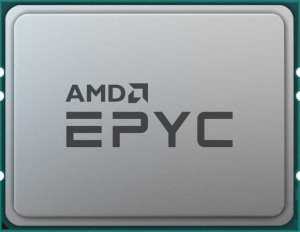
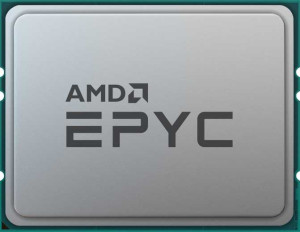
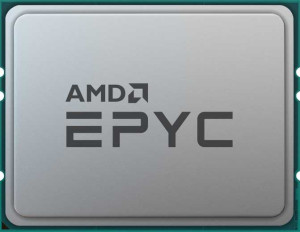
AMD Epyc 9335 specifications and in-depth review

AMD Epyc 9335

Manufacturer: AMD

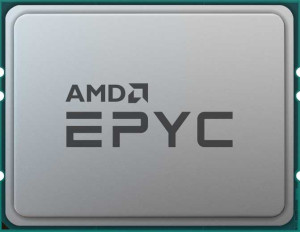
The AMD Epyc 9335 is a server-grade processor designed for demanding enterprise workloads, sitting within AMD's broader Epyc lineup of data center CPUs. With 32 physical cores operating at a base frequency of 3 GHz across all cores, it offers a substantial thread count of 64 through its multithreading support. A notable characteristic of this chip is its 4.4 GHz turbo clock speed, which allows individual cores to reach higher frequencies under lighter loads, giving it flexibility across varying workload profiles.

Built on a 4 nm semiconductor process, the Epyc 9335 operates within a thermal envelope of 210W and supports PCIe 5.0 for high-bandwidth peripheral connectivity. Its memory subsystem is particularly well-suited to large-scale deployments, with support for up to 9000 GB of DDR5 ECC RAM across 12 memory channels at speeds reaching 6000 MHz, delivering a maximum memory bandwidth of 576 GB/s. The processor also features a sizeable 128 MB L3 cache alongside 32 MB of L2 cache, and includes instruction set support for MMX, AVX, AVX2, FMA3, AES, F16C, SSE 4.1, and SSE 4.2. It does not include integrated graphics and ships with a locked clock multiplier.

Pros
  • Supports up to 9000 GB of DDR5 ECC RAM across 12 memory channels, making it well-suited for large-scale, memory-intensive server workloads
  • The 128 MB L3 cache provides a generous pool of on-chip memory that can reduce latency for data-heavy operations
  • PCIe 5.0 support enables high-bandwidth connectivity for compatible storage and networking expansion cards
  • A peak memory bandwidth of 576 GB/s allows rapid data throughput between RAM and processing cores
  • Multithreading delivers 64 threads from 32 cores, improving utilization across parallel workloads
  • Hardware AES instruction support allows encryption and decryption operations to be handled directly by the processor without additional overhead
Cons
  • A 210W TDP places significant thermal and power delivery demands on server infrastructure
  • The locked clock multiplier removes any flexibility for frequency tuning outside of the turbo boost mechanism
  • No integrated graphics means any display output requires a discrete graphics card, adding hardware requirements even for basic server management tasks
  • The turbo clock of 4.4 GHz applies selectively rather than across all cores simultaneously, which may limit single-threaded peak throughput in sustained scenarios
Who is this for?

This processor is well-matched to enterprise server environments that demand both high core density and substantial memory capacity. Deployments involving large in-memory databases benefit directly from the 12-channel DDR5 architecture and support for up to 9000 GB of ECC RAM, while the 576 GB/s memory bandwidth keeps data flowing efficiently at scale. Workloads that rely on parallel thread execution — such as virtualization hosts, distributed computing nodes, or multi-tenant cloud infrastructure — are also a natural fit given the 64-thread configuration. Additionally, environments with strict data integrity requirements will find the ECC memory support and NX bit security feature aligned with their operational standards.

Who is this NOT for?

This processor is not a practical choice for use cases where single-threaded responsiveness is the primary concern, as its base clock of 3 GHz and locked multiplier limit the ability to push peak per-core frequency beyond what the turbo mechanism allows. It is equally unsuitable for any deployment requiring integrated display output, since no onboard graphics are included and even basic visual access to the system requires an additional discrete card. The 210W thermal envelope also makes it a poor fit for infrastructure with limited cooling capacity or constrained power budgets, such as compact edge deployments or environments without server-grade thermal management in place.

General info:

Thermal Design Power (TDP) 210W
semiconductor size 4 nm
PCI Express (PCIe) version 5
Supports 64-bit
Has integrated graphics

The AMD Epyc 9335 carries a Thermal Design Power (TDP) of 210W and is manufactured on a 4 nm semiconductor process, reflecting a relatively compact fabrication node for a processor in this class. It supports the PCIe 5.0 interface standard, enabling high-bandwidth connectivity for compatible peripherals and expansion cards. The chip is fully 64-bit capable, while it does not include integrated graphics, meaning a discrete graphics solution is required for any display output.

Performance:

CPU speed 32 x 3 GHz
CPU threads 64 threads
turbo clock speed 4.4GHz
L3 cache 128 MB
L1 cache 2560 KB
L2 cache 32 MB
L2 core 1 MB/core
clock multiplier 30
Has an unlocked multiplier
L3 core 4 MB/core

The AMD Epyc 9335 runs 32 cores at a base clock speed of 3 GHz, with a turbo frequency reaching 4.4 GHz for increased throughput under appropriate conditions, and delivers 64 threads in total through multithreading. Its cache hierarchy consists of 2560 KB of L1 cache, 32 MB of L2 cache distributed at 1 MB per core, and a 128 MB L3 cache allocated at 4 MB per core — providing a substantial pool of fast on-chip memory to serve active workloads. The processor operates with a clock multiplier of 30, and the multiplier is locked, meaning frequency adjustments through multiplier changes are not supported.

Memory:

Supports ECC memory
maximum memory bandwidth 576 GB/s
DDR memory version 5
RAM speed (max) 6000 MHz
maximum memory amount 9000GB
memory channels 12

The AMD Epyc 9335 supports DDR5 memory and can address up to 9000 GB of total RAM across 12 memory channels, giving it considerable capacity headroom for memory-intensive server environments. Maximum RAM speed reaches 6000 MHz, and the processor achieves a peak memory bandwidth of 576 GB/s, enabling rapid data movement between memory and the processor cores. ECC memory support is included, allowing the system to detect and correct certain types of memory errors — a standard requirement in enterprise and data center deployments.

Features:

uses multithreading
instruction sets MMX, F16C, FMA3, AES, AVX, AVX2, SSE 4.1, SSE 4.2
Has NX bit

The AMD Epyc 9335 supports multithreading, allowing each physical core to handle multiple threads simultaneously for more efficient utilization under parallel workloads. It includes the NX bit, a hardware-level security feature that helps prevent certain classes of malicious code execution by marking memory regions as non-executable. On the instruction set side, the processor supports a broad range of extensions including MMX, AVX, AVX2, FMA3, F16C, AES, SSE 4.1, and SSE 4.2, covering vectorized math operations, floating-point conversions, hardware-accelerated encryption, and packed data processing.
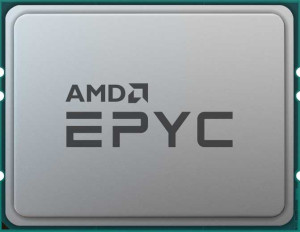
Benchmarks:

Final Verdict

The AMD Epyc 9335 is a processor built with a clear and deliberate focus on enterprise-scale server deployments, and its specifications reflect that purpose consistently. Its 12-channel DDR5 memory architecture supporting up to 9000 GB of ECC RAM stands out as a defining characteristic, positioning it for environments where data integrity and memory capacity are non-negotiable. Paired with a 64-thread configuration, PCIe 5.0 connectivity, and a broad instruction set that includes hardware-accelerated AES, it covers the functional requirements of virtualization, parallel computing, and data-intensive workloads with considerable depth. The trade-offs — namely a locked multiplier, the absence of integrated graphics, and a 210W thermal load — are consistent with a chip that prioritizes throughput and reliability over flexibility or ease of deployment. For organizations building or expanding server infrastructure where those priorities align, the Epyc 9335 presents a well-defined and technically coherent solution.

Popular Comparisons

AMD Epyc 9335
AMD Epyc 9335
VS
AMD Epyc 9275F
AMD Epyc 9275F
AMD Epyc 9335
AMD Epyc 9335
VS
AMD Epyc 9255
AMD Epyc 9255
AMD Epyc 9335
AMD Epyc 9335
VS
AMD Epyc 9135
AMD Epyc 9135
AMD Epyc 9335
AMD Epyc 9335
VS
AMD Epyc 9355
AMD Epyc 9355
AMD Epyc 9335
AMD Epyc 9335
VS
Intel Xeon 6737P
Intel Xeon 6737P
AMD Epyc 9335
AMD Epyc 9335
VS
Intel Xeon 6980P
Intel Xeon 6980P
AMD Epyc 9335
AMD Epyc 9335
VS
Intel Xeon Gold 6544Y