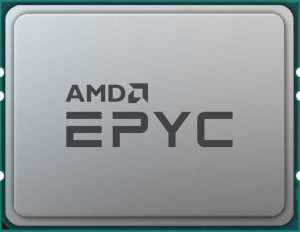
The AMD Epyc 9365 carries a Thermal Design Power (TDP) of 300W and is built on a 4 nm semiconductor process, reflecting a relatively compact fabrication node for a processor in this class. It operates with full 64-bit support and connects to the system via PCIe 5.0, enabling high-bandwidth communication with compatible peripherals and accelerators. The processor does not include integrated graphics, which is typical for server-oriented CPUs where discrete or remote graphics solutions are standard practice.
The AMD Epyc 9365 runs 36 cores at a base clock of 3.4 GHz, delivering a combined 72 threads for parallel workload handling, with a turbo clock speed of 4.3 GHz available when conditions allow. The clock multiplier is set at 34 and the multiplier is locked, meaning frequency adjustments are not user-configurable. Cache resources are distributed across three levels: 2880 KB of L1, 36 MB of L2 at 1 MB per core, and a 192 MB L3 cache — the latter working out to approximately 5.33 MB per core — providing substantial on-chip storage to keep frequently accessed data close to the execution units.
The AMD Epyc 9365 supports DDR5 memory at speeds up to 6000 MHz across 12 memory channels, enabling a peak bandwidth of 576 GB/s to sustain throughput-intensive server workloads. The processor accommodates a maximum installed memory of 9000 GB, providing substantial headroom for memory-demanding applications. ECC memory support is included, adding a layer of data integrity protection that is essential in enterprise and mission-critical environments.
The AMD Epyc 9365 supports multithreading, allowing each physical core to handle multiple threads simultaneously for more efficient utilization under concurrent workloads. It includes the NX bit, a hardware-level security feature that helps prevent certain classes of malicious code execution. The processor implements a broad set of instruction set extensions — MMX, F16C, FMA3, AES, AVX, AVX2, SSE 4.1, and SSE 4.2 — covering accelerated floating-point operations, hardware-assisted encryption, and wide vector processing capabilities.