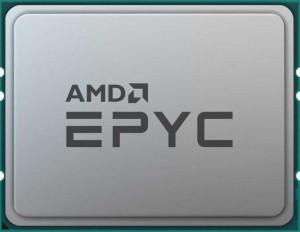
AMD Epyc 9455 specifications and in-depth review

AMD Epyc 9455

Manufacturer: AMD

The AMD Epyc 9455 is a server-grade processor designed for demanding enterprise workloads. Running 48 physical cores across 96 threads, it operates at a base clock of 3.15 GHz per core and can reach a turbo frequency of 4.4 GHz, making it suited for compute-intensive environments that require sustained multi-threaded throughput. Built on a 4 nm semiconductor process, the chip has a rated thermal design power of 300W and does not include integrated graphics.

On the memory side, the Epyc 9455 supports DDR5 memory at speeds up to 6000 MHz across 12 channels, with a maximum memory bandwidth of 576 GB/s and support for up to 9000 GB of ECC RAM. Cache resources are substantial, with 3840 KB of L1 cache, 48 MB of L2 cache at 1 MB per core, and a 256 MB L3 cache providing roughly 5.33 MB per core. The processor supports PCIe 5.0 and includes instruction set extensions such as AVX2, FMA3, AES, and SSE 4.2, along with NX bit support and hardware-level multithreading.

Pros
  • Supports up to 9000 GB of ECC RAM across 12 memory channels, offering substantial capacity for memory-intensive server workloads
  • The 256 MB L3 cache with 5.33 MB per core reduces memory latency for large data sets commonly encountered in enterprise environments
  • DDR5 support with a maximum speed of 6000 MHz and 576 GB/s of memory bandwidth enables fast data throughput across parallel tasks
  • 96 threads from 48 cores allow a high degree of concurrent task execution without requiring additional sockets
  • PCIe 5.0 support enables high-bandwidth connectivity for storage and networking components
  • Broad instruction set coverage including AVX2, FMA3, and AES supports vectorized computation and hardware-accelerated cryptographic operations
Cons
  • A 300W TDP places significant demands on server cooling infrastructure and power delivery systems
  • The locked clock multiplier removes any possibility of frequency tuning beyond factory specifications
  • No integrated graphics means a discrete display adapter is required even for basic system management or troubleshooting tasks
  • The base clock of 3.15 GHz is relatively moderate, meaning single-threaded tasks that do not benefit from turbo frequencies may see limited throughput
Who is this for?

This processor is well-suited to large-scale enterprise server deployments where high thread counts and memory capacity are essential, such as virtualization hosts running dozens of concurrent workloads or database servers handling complex query loads. The support for up to 9000 GB of ECC RAM across 12 channels makes it a strong fit for memory-intensive applications like in-memory analytics or large-scale data processing pipelines. Organizations building infrastructure around PCIe 5.0-connected NVMe storage or high-speed networking will also benefit from its connectivity capabilities, and workloads that leverage AVX2 or AES instruction sets — such as encryption-heavy services or scientific computing tasks — align well with its feature set.

Who is this NOT for?

This processor is not suited to environments where power and thermal constraints are a concern, as its 300W TDP demands robust cooling systems and substantial power delivery infrastructure that smaller or edge deployments typically cannot accommodate. Users requiring single-threaded responsiveness for latency-sensitive tasks may find the 3.15 GHz base clock limiting in scenarios where turbo frequencies cannot be sustained across all cores simultaneously. Additionally, since the chip lacks integrated graphics and carries a locked clock multiplier, it is unsuitable for any use case that requires display output without a discrete adapter or any form of frequency customization beyond factory settings.

General info:

Thermal Design Power (TDP) 300W
semiconductor size 4 nm
PCI Express (PCIe) version 5
Supports 64-bit
Has integrated graphics

The AMD Epyc 9455 carries a Thermal Design Power (TDP) of 300W and is manufactured on a 4 nm semiconductor process. It supports the PCIe 5.0 interface standard and is fully 64-bit compatible. The processor does not include integrated graphics, which is typical for server-focused chips of this class.

Performance:

CPU speed 48 x 3.15 GHz
CPU threads 96 threads
turbo clock speed 4.4GHz
L3 cache 256 MB
L1 cache 3840 KB
L2 cache 48 MB
L2 core 1 MB/core
clock multiplier 31.5
Has an unlocked multiplier
L3 core 5.33 MB/core

The AMD Epyc 9455 runs 48 cores at a base clock of 3.15 GHz each, totaling 96 threads, with a turbo clock speed of 4.4 GHz and a fixed clock multiplier of 31.5 — the multiplier is locked and cannot be adjusted. Cache resources are generous across all levels: L1 sits at 3840 KB, L2 at 48 MB total with 1 MB per core, and L3 reaches 256 MB across the chip, translating to approximately 5.33 MB of L3 cache per core.

Memory:

Supports ECC memory
maximum memory bandwidth 576 GB/s
DDR memory version 5
RAM speed (max) 6000 MHz
maximum memory amount 9000GB
memory channels 12

The AMD Epyc 9455 uses DDR5 memory and supports speeds of up to 6000 MHz across 12 memory channels, delivering a maximum memory bandwidth of 576 GB/s. It can address up to 9000 GB of total RAM and fully supports ECC memory, providing hardware-level error correction suited to server and enterprise environments.

Features:

uses multithreading
instruction sets MMX, F16C, FMA3, AES, AVX, AVX2, SSE 4.1, SSE 4.2
Has NX bit

The AMD Epyc 9455 supports multithreading and includes the NX bit for hardware-enforced memory protection against certain classes of malicious code. Its instruction set support spans MMX, F16C, FMA3, AES, AVX, AVX2, SSE 4.1, and SSE 4.2, covering a broad range of workloads from cryptographic operations and floating-point computation to vectorized data processing.

Benchmarks:

Final Verdict

The AMD Epyc 9455 is a well-specified enterprise processor that delivers on the core demands of modern server infrastructure — high thread counts, extensive memory support, and broad instruction set coverage. Its 96-thread configuration paired with 256 MB of L3 cache and 12-channel DDR5 memory support makes it a credible choice for data-heavy workloads, virtualization environments, and services that benefit from hardware-accelerated cryptographic or vectorized operations. The trade-offs — namely a 300W thermal envelope, a locked multiplier, and the absence of integrated graphics — narrow its appeal to well-resourced data center deployments rather than general-purpose or thermally constrained settings. For organizations operating at that scale, the Epyc 9455 represents a technically coherent platform built around the realities of enterprise workload demands.

Popular Comparisons

AMD Epyc 9455
AMD Epyc 9455
VS
AMD Epyc 9475F
AMD Epyc 9475F
AMD Epyc 9455
AMD Epyc 9455
VS
Intel Xeon Gold 6548N
AMD Epyc 9455
AMD Epyc 9455
VS
Intel Xeon Gold 5515 Plus