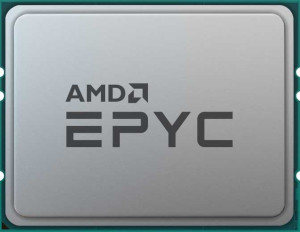
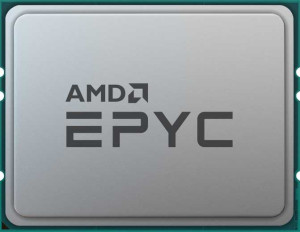
The AMD Epyc 9475F carries a Thermal Design Power (TDP) of 400W and is manufactured on a 4nm semiconductor process, reflecting its high-core-count server-oriented design. It supports the PCIe 5.0 interface standard and is fully 64-bit compatible. The processor does not include integrated graphics, meaning a discrete graphics solution is required for any display output.
The AMD Epyc 9475F operates with 48 cores running at a base clock of 3.65 GHz each, supporting 96 threads in total, and can reach a turbo clock speed of 4.8 GHz under boosted conditions. The clock multiplier is set at 36.5 and the multiplier is locked, meaning no manual frequency adjustment is available. Cache resources are substantial across all levels: L1 stands at 3840 KB, L2 totals 48 MB at 1 MB per core, and L3 reaches 256 MB at approximately 5.33 MB per core, providing a large pool of fast-access memory to support the processor's high thread count.
The AMD Epyc 9475F uses DDR5 memory and supports a maximum RAM speed of 6000 MHz across 12 memory channels, enabling a peak bandwidth of 576 GB/s. It can address up to 9000 GB of total memory and includes support for ECC, which allows the system to detect and correct memory errors — a standard requirement in server and enterprise environments.
The AMD Epyc 9475F supports multithreading, allowing each physical core to handle two threads simultaneously. Its instruction set support covers MMX, F16C, FMA3, AES, AVX, AVX2, SSE 4.1, and SSE 4.2, enabling a broad range of computational operations including vectorized math, hardware-accelerated encryption, and floating-point processing. The processor also includes the NX bit, a hardware security feature that helps prevent certain classes of malicious code execution by marking memory regions as non-executable.