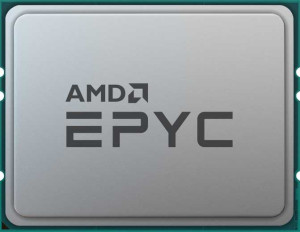
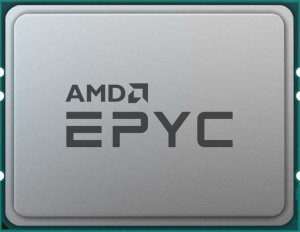
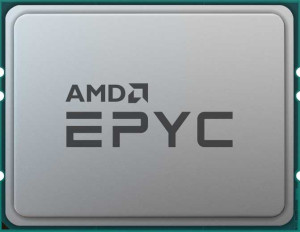
The AMD Epyc 9655 carries a Thermal Design Power (TDP) of 400W, reflecting the power envelope required to sustain its high core count under load. It is manufactured on a 4nm semiconductor process, a relatively compact fabrication node for a processor of this class. The chip supports the 64-bit instruction architecture and connects to the rest of the system through PCIe 5.0, the current generation of the PCI Express interface. There is no integrated graphics unit included, meaning a discrete or external graphics solution is required for display output.
The AMD Epyc 9655 operates across 96 cores at a base clock speed of 2.6 GHz, supporting 192 threads in total, with the ability to boost up to a turbo frequency of 4.5 GHz under appropriate conditions. The processor uses a clock multiplier of 26, though the multiplier is locked and cannot be adjusted. Its cache layout is structured across three levels: 7680 KB of L1, 96 MB of L2 at 1 MB per core, and a 384 MB L3 cache distributed at 4 MB per core — a notably large last-level cache that can help reduce memory latency for data-intensive workloads.
The AMD Epyc 9655 uses DDR5 memory and supports up to 12 memory channels, enabling a maximum bandwidth of 576 GB/s. RAM speeds can reach up to 6000 MHz, and the processor accommodates a substantial maximum memory capacity of 9000 GB. ECC memory is fully supported, which allows the system to detect and correct certain types of memory errors — a standard requirement in server and enterprise environments.
The AMD Epyc 9655 supports multithreading, allowing each physical core to handle multiple threads simultaneously. It includes the NX bit, a hardware-level feature that helps prevent certain classes of malicious code from executing in memory regions designated for data. On the instruction set side, the processor supports a broad range of extensions including AVX2, FMA3, and AES, alongside MMX, F16C, AVX, SSE 4.1, and SSE 4.2 — covering vectorized math operations, hardware-accelerated encryption, and floating-point conversion capabilities.
In PassMark testing, the AMD Epyc 9655 achieves a multi-threaded score of 156,085, reflecting the throughput available when all cores and threads are engaged across parallel workloads. Its single-threaded PassMark result stands at 3,845, representing the processor's per-core execution performance on sequential tasks.