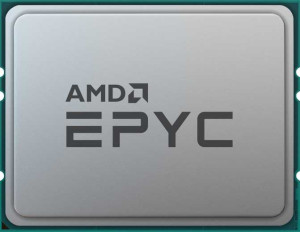
AMD Epyc 9745 specifications and in-depth review

AMD Epyc 9745

Manufacturer: AMD

The AMD Epyc 9745 is a high-core-count server processor designed for demanding enterprise workloads. Built on a 3 nm semiconductor process, it offers 128 cores running at a base clock of 2.4 GHz with a turbo frequency reaching 3.7 GHz, paired with 256 threads through multithreading support. The chip carries a thermal design power rating of 400W, reflecting its positioning within large-scale, compute-intensive deployment environments.

On the memory side, the Epyc 9745 supports DDR5 at up to 6000 MHz across 12 memory channels, delivering a maximum bandwidth of 576 GB/s and accommodating up to 9000 GB of ECC memory. Its cache hierarchy includes 10240 KB of L1, 128 MB of L2 at 1 MB per core, and a substantial 256 MB of L3 cache at 2 MB per core. The processor connects via PCIe 5.0 and supports instruction sets including AVX2, AES, FMA3, and SSE 4.2. In benchmark testing, it achieves a PassMark score of 130698, with an overclocked result of 142280.

Pros
  • Supports up to 9000 GB of ECC memory across 12 channels, making it suitable for memory-intensive server workloads that require both capacity and error correction
  • The 256 MB of L3 cache distributed at 2 MB per core helps reduce memory latency across the 128-core complex
  • DDR5 support at up to 6000 MHz with a maximum bandwidth of 576 GB/s enables fast data throughput for demanding enterprise applications
  • A broad instruction set including AES, AVX2, and FMA3 covers cryptographic, vector, and floating-point workloads without requiring additional hardware
  • PCIe 5.0 support allows for high-bandwidth connectivity with compatible storage and networking adapters
  • NX bit support adds a layer of hardware-level execution protection relevant to server security requirements
Cons
  • A 400W TDP places significant demands on cooling infrastructure and power delivery within server deployments
  • The clock multiplier is locked, removing any flexibility to adjust frequencies beyond factory settings
  • The single-threaded PassMark score of 2806 indicates modest per-core performance relative to the processor's overall scale
  • No integrated graphics are included, requiring a separate solution for any display or remote management tasks that depend on video output
Who is this for?

This processor is well-matched to large-scale enterprise environments where high core density and massive memory capacity are essential — such as database servers, virtualization hosts running many concurrent workloads, or HPC nodes that benefit from 128 cores and up to 9000 GB of ECC-registered memory. The 12-memory-channel DDR5 configuration and 576 GB/s of bandwidth make it particularly fitting for data-intensive workloads like in-memory analytics or large dataset processing. Its support for AES and AVX2 instruction sets also makes it a reasonable fit for workloads involving cryptographic operations or vectorized computation at scale.

Who is this NOT for?

This processor is not suited to environments where single-threaded responsiveness is a priority, as its per-core PassMark score of 2806 reflects modest individual core performance. Workloads that rely heavily on raw clock speed rather than parallelism will not fully benefit from its architecture. It is also unsuitable for any deployment with constrained power or thermal budgets, given its 400W TDP, which demands robust cooling and power infrastructure. Additionally, since it lacks integrated graphics and has a locked clock multiplier, it is not appropriate for use cases requiring display output or any form of frequency tuning beyond factory defaults.

General info:

Thermal Design Power (TDP) 400W
semiconductor size 3 nm
PCI Express (PCIe) version 5
Supports 64-bit
Has integrated graphics

The AMD Epyc 9745 carries a Thermal Design Power (TDP) of 400W and is manufactured on a 3 nm semiconductor process, reflecting the precision of its physical construction. It supports the PCIe 5.0 interface for high-speed peripheral connectivity and is fully 64-bit compatible. The processor does not include integrated graphics, meaning a discrete graphics solution is required for any display output.

Performance:

CPU speed 128 x 2.4 GHz
CPU threads 256 threads
turbo clock speed 3.7GHz
L3 cache 256 MB
L1 cache 10240 KB
L2 cache 128 MB
L2 core 1 MB/core
clock multiplier 24
Has an unlocked multiplier
L3 core 2 MB/core

The AMD Epyc 9745 operates across 128 cores at a base clock speed of 2.4 GHz, with a turbo frequency of 3.7 GHz, and delivers 256 threads in total. Its cache structure consists of 10240 KB of L1, 128 MB of L2 at 1 MB per core, and 256 MB of L3 cache at 2 MB per core, providing substantial on-chip data storage across the core complex. The processor uses a clock multiplier of 24, though the multiplier is locked and cannot be adjusted for overclocking purposes.

Memory:

Supports ECC memory
maximum memory bandwidth 576 GB/s
DDR memory version 5
RAM speed (max) 6000 MHz
maximum memory amount 9000GB
memory channels 12

The AMD Epyc 9745 supports DDR5 memory at speeds of up to 6000 MHz across 12 memory channels, enabling a maximum bandwidth of 576 GB/s. It can address up to 9000 GB of total memory, making it well-suited for configurations requiring large memory pools. ECC memory support is included, allowing the processor to detect and correct in-memory data errors for improved reliability in server environments.

Features:

uses multithreading
instruction sets MMX, F16C, FMA3, AES, AVX, AVX2, SSE 4.1, SSE 4.2
Has NX bit

The AMD Epyc 9745 supports multithreading, allowing each physical core to handle multiple threads simultaneously for improved throughput in parallel workloads. It includes a broad set of instruction sets — MMX, F16C, FMA3, AES, AVX, AVX2, SSE 4.1, and SSE 4.2 — covering capabilities ranging from floating-point operations and cryptographic acceleration to advanced vector processing. The processor also features NX bit support, which helps prevent certain classes of malicious code execution by marking memory regions as non-executable.

Benchmarks:

PassMark result 130698
PassMark result (single) 2806
PassMark result (overclocked) 142280

In PassMark testing, the AMD Epyc 9745 achieves a multi-threaded score of 130,698, reflecting its throughput across all available cores and threads. The single-threaded result stands at 2,806, indicating per-core processing capability. Under overclocked conditions, the overall PassMark score rises to 142,280.

Final Verdict

The AMD Epyc 9745 is a purpose-built enterprise processor that makes a clear case for itself in large-scale server and cloud infrastructure deployments. Its combination of 128 cores, 576 GB/s of DDR5 memory bandwidth across 12 channels, and support for up to 9000 GB of ECC memory positions it firmly within the upper tier of multi-threaded, memory-intensive workloads. Environments demanding parallel throughput — whether virtualization, in-memory analytics, or vectorized computation — will find its specification set well-aligned with those needs. Where it asks for compromise, chiefly in per-core performance and its substantial 400W power draw, those trade-offs are inherent to its design priorities rather than oversights. For organizations building out infrastructure where core count, memory scale, and data throughput are the governing requirements, the Epyc 9745 presents a coherent and well-specified option.

Popular Comparisons

AMD Epyc 9745
AMD Epyc 9745
VS
Intel Xeon 6980P
Intel Xeon 6980P