AMD Radeon Pro W7400 specifications and in-depth review

AMD Radeon Pro W7400

Manufacturer: AMD

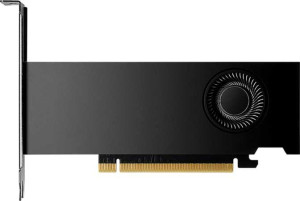
The AMD Radeon Pro W7400 is a workstation-class graphics card designed for professional environments where efficiency and reliability take precedence over raw consumer gaming features. Built on AMD's RDNA 3.0 architecture using a compact 6 nm manufacturing process, it integrates 13,300 million transistors into a relatively slim form factor measuring 168 mm × 69 mm, making it suitable for space-constrained workstation builds.

On the technical side, the W7400 operates with a base GPU clock of 1500 MHz and a boost clock reaching 1700 MHz, delivering 12.19 TFLOPS of floating-point performance alongside a texture rate of 190.4 GTexels/s. Its 8GB of GDDR6 memory runs across a 128-bit bus at an effective speed of 10800 MHz, yielding up to 172.8 GB/s of memory bandwidth. The card supports DirectX 12 Ultimate, OpenGL 4.6, OpenCL 2.1, ray tracing, and AMD SAM, and provides four DisplayPort outputs for multi-display configurations. With a TDP of just 55W and no requirement for auxiliary power connectors implied by its design, it prioritizes low power draw in professional deployments.

Pros
  • A 55W TDP keeps power consumption low, making it suitable for compact or thermally constrained workstation builds
  • Four DisplayPort outputs enable broad multi-monitor configurations without adapters
  • Support for ray tracing, DirectX 12 Ultimate, OpenGL 4.6, and OpenCL 2.1 covers a wide range of professional graphics and compute workloads
  • Double Precision Floating Point (DPFP) support adds utility for compute tasks requiring higher numerical precision
  • Built on a 6 nm process with RDNA 3.0 architecture, integrating 13,300 million transistors in a compact 168 x 69 mm form factor
  • AMD SAM support allows optimized memory access when paired with a compatible platform
Cons
  • The 128-bit memory bus width limits memory bandwidth headroom relative to cards with wider bus configurations
  • ECC memory is not supported, which may rule it out for workloads where memory error correction is critical
  • No HDMI, DVI, or USB-C outputs means users are restricted entirely to DisplayPort-compatible displays
  • 8GB of VRAM may prove insufficient for memory-intensive professional tasks such as large-scale 3D rendering or high-resolution texture work
  • No air-water cooling support limits thermal management options for users seeking alternative cooling configurations
Who is this for?

The AMD Radeon Pro W7400 is well-suited for professionals who need a low-power, compact workstation GPU without sacrificing broad API support. Its 55W TDP and small form factor make it a practical fit for space-constrained or thermally limited workstation environments. Users working with compute-oriented tasks that leverage OpenCL 2.1 or Double Precision Floating Point will benefit from the card's capabilities, as will those running multi-display setups across up to four DisplayPort monitors. The inclusion of DirectX 12 Ultimate, OpenGL 4.6, and ray tracing support also makes it appropriate for professional visualization and CAD workflows that require modern graphics API coverage.

Who is this NOT for?

Users engaged in memory-intensive workloads such as high-resolution 3D rendering or large dataset visualization may find the 8GB VRAM and 128-bit memory bus limiting, as these constrain the volume of data that can reside in and flow through GPU memory at any given time. The absence of ECC memory support makes it a poor fit for mission-critical compute environments where data integrity and error correction are non-negotiable requirements. Additionally, users who depend on HDMI, DVI, or USB-C display connectivity will find no flexibility here, as the card provides only DisplayPort outputs, which could be a practical limitation depending on the display hardware in use.

Performance:

GPU clock speed 1500 MHz
GPU turbo 1700 MHz
pixel rate 108.8 GPixel/s
floating-point performance 12.19 TFLOPS
texture rate 190.4 GTexels/s
GPU memory speed 1350 MHz
shading units 1792
texture mapping units (TMUs) 112
render output units (ROPs) 64
Has Double Precision Floating Point (DPFP)

The AMD Radeon Pro W7400 runs at a base GPU clock of 1500 MHz with a boost up to 1700 MHz, and its 1792 shading units contribute to a floating-point performance of 12.19 TFLOPS. Rasterization throughput is handled by 112 texture mapping units delivering a texture rate of 190.4 GTexels/s, paired with 64 render output units producing a pixel rate of 108.8 GPixel/s. GPU memory operates at 1350 MHz, and the card includes support for Double Precision Floating Point (DPFP), which benefits compute-oriented workloads that require higher numerical accuracy.

Memory:

effective memory speed 10800 MHz
maximum memory bandwidth 172.8 GB/s
VRAM 8GB
GDDR version GDDR6
memory bus width 128-bit
Supports ECC memory

The AMD Radeon Pro W7400 is equipped with 8GB of GDDR6 VRAM running across a 128-bit memory bus, achieving an effective memory speed of 10800 MHz and a maximum memory bandwidth of 172.8 GB/s. These figures reflect the card's memory throughput capacity within its given bus width configuration. It is worth noting that ECC memory support is not available on this card, which is a consideration for workloads where memory error correction is a requirement.

Features:

DirectX version DirectX 12 Ultimate
OpenGL version 4.6
OpenCL version 2.1
Supports multi-display technology
supports ray tracing
Supports 3D
supports DLSS
has XeSS (XMX)
AMD SAM / Intel Resizable BAR AMD SAM
has LHR
has RGB lighting

The AMD Radeon Pro W7400 supports DirectX 12 Ultimate, OpenGL 4.6, and OpenCL 2.1, covering a broad range of graphics and compute APIs relevant to professional workloads. Ray tracing and stereoscopic 3D are both supported, as is multi-display technology, giving users flexibility in display configurations. AMD SAM (Smart Access Memory) is included to help optimize data throughput between the CPU and GPU. DLSS and XeSS (XMX) are not supported, and the card does not feature LHR or RGB lighting, reflecting its focus on professional rather than consumer use cases.

Ports:

has an HDMI output
DisplayPort outputs 4
USB-C ports 0
DVI outputs 0

The AMD Radeon Pro W7400 offers four DisplayPort outputs, making it well-suited for multi-monitor setups that rely on that connection standard. It does not include HDMI, DVI, or USB-C outputs, meaning display connectivity is provided exclusively through DisplayPort.

General info:

GPU architecture RDNA 3.0
Thermal Design Power (TDP) 55W
PCI Express (PCIe) version 4
semiconductor size 6 nm
number of transistors 13300 million
Has air-water cooling
width 168 mm
height 69 mm

The AMD Radeon Pro W7400 is built on the RDNA 3.0 architecture, manufactured using a 6 nm process node and housing 13,300 million transistors within its die. It connects via PCIe 4.0 and carries a TDP of just 55W, reflecting a design oriented toward power efficiency. The card measures 168 mm in width and 69 mm in height, and it does not include air-water cooling, relying instead on its own integrated thermal solution within that compact footprint.

Final Verdict

The AMD Radeon Pro W7400 is a workstation graphics card that makes a clear case for itself in professional environments where power efficiency and broad API support matter more than raw throughput. Its RDNA 3.0 architecture, support for DirectX 12 Ultimate, OpenCL 2.1, ray tracing, and Double Precision Floating Point position it as a capable tool for visualization and compute workloads, while its 55W TDP within a compact 168 x 69 mm form factor sets it apart for use in thermally constrained systems. That said, the 8GB VRAM, 128-bit bus, and absence of ECC support do place meaningful limits on its suitability for the most demanding professional scenarios. On balance, the W7400 is a well-defined product with a clear audience — professionals who prioritize workstation-grade feature coverage and energy efficiency over maximum memory capacity or bandwidth.

Popular Comparisons

AMD Radeon Pro W7400
VS
Nvidia RTX 1000 Ada Generation Laptop
AMD Radeon Pro W7400
VS
Nvidia RTX 2000 ADA Generation