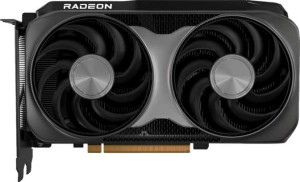
AMD Radeon RX 9060 XT LP 16GB specifications and in-depth review

AMD Radeon RX 9060 XT LP 16GB

Manufacturer: AMD

The AMD Radeon RX 9060 XT LP is a low-profile graphics card based on AMD's RDNA 4.0 architecture, manufactured on a 4nm process node with 29,700 million transistors. It operates with a base GPU clock of 1700 MHz and a boost frequency reaching 3130 MHz, paired with 2048 shading units and 128 texture mapping units to handle a broad range of rendering workloads.

On the memory side, the card carries 16GB of GDDR6 VRAM across a 128-bit bus, delivering an effective memory speed of 20,100 MHz and a maximum bandwidth of 320 GB/s. It supports DirectX 12 Ultimate, OpenGL 4.6, ray tracing, and AMD FSR4, while connectivity is handled through one HDMI 2.1b port and two DisplayPort outputs, accommodating up to three simultaneous displays. The card draws 140W and measures 267mm in length by 111mm in height.

Pros
  • 16GB of GDDR6 VRAM on a card of this size gives it substantial memory capacity for memory-intensive workloads
  • Ray tracing support is included, enabling hardware-accelerated lighting and shadow rendering
  • AMD FSR4 upscaling is present, allowing for higher output resolutions without proportional rendering overhead
  • ECC memory support adds a layer of data integrity useful in compute or professional tasks
  • The card can drive up to three displays simultaneously, making multi-monitor setups straightforward
  • HDMI 2.1b output supports modern high-bandwidth display connections
Cons
  • The 128-bit memory bus is relatively narrow, which limits sustained memory throughput despite the high effective memory speed
  • DLSS is not supported, leaving users without access to that particular upscaling option
  • There are no USB-C or mini DisplayPort outputs, reducing connectivity flexibility for certain display setups
  • The card does not include air-water cooling, so thermal management relies entirely on the system's standard airflow
  • At 267mm in length, physical fitment may be a consideration in smaller or compact form-factor cases
Who is this for?

This card is well-suited to users who need substantial VRAM capacity for memory-intensive rendering or compute workloads, given its 16GB GDDR6 configuration. Its support for ray tracing, AMD FSR4, and DirectX 12 Ultimate makes it a reasonable fit for users engaged in modern gaming or real-time 3D content creation at mid-to-high resolutions. The inclusion of ECC memory and Double Precision Floating Point support also makes it appealing for those running compute-oriented or professional GPU tasks alongside graphics work. Users who need to connect up to three displays simultaneously will also find the multi-output configuration practical for productivity-focused or creative multi-monitor setups.

Who is this NOT for?

Users who rely on DLSS or XeSS upscaling for their workflow will find those options unavailable on this card, which may be a drawback for those accustomed to those specific technologies. The 128-bit memory bus may also be a limiting factor for workloads that demand consistently high memory throughput, making the card less suitable for extremely bandwidth-heavy tasks despite its high effective memory speed. Additionally, those working in compact or small form-factor systems may face fitment challenges given the card's 267mm length, and the absence of air-water cooling means it depends entirely on adequate case airflow to manage its 140W thermal output.

Performance:

GPU clock speed 1700 MHz
GPU turbo 3130 MHz
pixel rate 200.3 GPixel/s
floating-point performance 25.64 TFLOPS
texture rate 400.6 GTexels/s
GPU memory speed 2518 MHz
shading units 2048
texture mapping units (TMUs) 128
render output units (ROPs) 64
Has Double Precision Floating Point (DPFP)

The card runs at a base GPU clock of 1700 MHz, with a boost frequency reaching 3130 MHz under load. It is equipped with 2048 shading units, 128 texture mapping units, and 64 render output units, producing a texture rate of 400.6 GTexels/s and a pixel rate of 200.3 GPixel/s. Floating-point performance is rated at 25.64 TFLOPS, while the GPU memory operates at 2518 MHz. The card also supports Double Precision Floating Point (DPFP), broadening its suitability for compute-oriented tasks alongside standard graphics workloads.

Memory:

effective memory speed 20100 MHz
maximum memory bandwidth 320 GB/s
VRAM 16GB
GDDR version GDDR6
memory bus width 128-bit
Supports ECC memory

The card is equipped with 16GB of GDDR6 VRAM running across a 128-bit memory bus, achieving an effective memory speed of 20,100 MHz and a maximum memory bandwidth of 320 GB/s. ECC memory support is also included, which helps maintain data integrity in error-sensitive workloads.

Features:

DirectX version DirectX 12 Ultimate
OpenGL version 4.6
OpenCL version 2.2
Supports multi-display technology
supports ray tracing
Supports 3D
supports DLSS
has FSR4
has XeSS (XMX)
AMD SAM / Intel Resizable BAR AMD SAM
has LHR
has RGB lighting
supported displays 3

The card supports DirectX 12 Ultimate, OpenGL 4.6, and OpenCL 2.2, covering a broad range of graphics and compute APIs. Ray tracing and stereoscopic 3D are both supported, alongside AMD FSR4 for upscaling, while DLSS and XeSS (XMX) are not available on this card. It includes AMD SAM for potentially improved CPU-to-GPU data throughput, and can drive up to three displays simultaneously via its multi-display support. LHR and RGB lighting are absent, keeping the feature set straightforward and utilitarian.

Ports:

has an HDMI output
HDMI ports 1
HDMI version HDMI 2.1b
DisplayPort outputs 2
USB-C ports 0
DVI outputs 0
mini DisplayPort outputs 0

The card's output configuration consists of one HDMI 2.1b port and two DisplayPort outputs, providing a total of three video connections for display use. There are no USB-C, DVI, or mini DisplayPort outputs present on this card.

General info:

GPU architecture RDNA 4.0
Thermal Design Power (TDP) 140W
PCI Express (PCIe) version 5
semiconductor size 4 nm
number of transistors 29700 million
Has air-water cooling
width 267 mm
height 111 mm

Built on the RDNA 4.0 architecture and fabricated using a 4nm process, the GPU integrates 29,700 million transistors and connects via a PCIe 5 interface. It carries a Thermal Design Power of 140W and does not include air-water cooling. The card measures 267mm in width and 111mm in height, giving a clear indication of its physical footprint.

Final Verdict

The AMD Radeon RX 9060 XT LP brings together a well-rounded specification set for a low-profile card, with its 16GB GDDR6 VRAM paired with RDNA 4.0 architecture standing out as the most compelling aspect of its overall package. Ray tracing support, AMD FSR4, DirectX 12 Ultimate, and ECC memory collectively give it a broader range of usable scenarios than its physical footprint might suggest, spanning both creative and compute workloads. Its limitations around memory bus width and the absence of certain upscaling technologies mean it is not without trade-offs, and users should ensure their system can accommodate its thermal and dimensional requirements. That said, for those seeking a capable, multi-display-ready graphics card with meaningful VRAM headroom in a compact form factor, the RX 9060 XT LP presents a coherent and well-defined proposition.