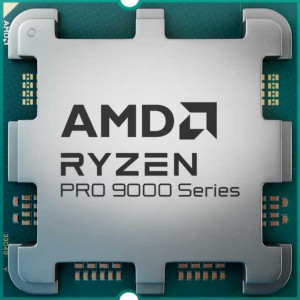
The AMD Ryzen 5 9600 is a desktop processor built on a 4 nm semiconductor process and designed for the AM5 socket, with compatibility spanning X670, B650, and X870 chipsets. It includes integrated graphics and supports 64-bit computing, while connecting to the rest of the system via PCIe 5.0. The chip is rated at a thermal design power of 65W, with a maximum operating temperature of 95 °C, and is constructed from approximately 8315 million transistors.
The Ryzen 5 9600 operates across six cores at a base speed of 3.8 GHz each, supporting 12 threads in total, with a turbo clock speed reaching 5.2 GHz. It does not use big.LITTLE technology, meaning all cores share a uniform architecture. The processor features an unlocked multiplier set at a base value of 38, offering straightforward frequency adjustments. Cache is organized across three levels: 480 KB of L1, 6 MB of L2 at 1 MB per core, and 32 MB of L3 at 5.33 MB per core.
In benchmark testing, the Ryzen 5 9600 achieves a PassMark multi-threaded score of 28904 and a single-threaded score of 4335, with the overclocked PassMark result climbing to 30949. On Geekbench 6, it records a multi-core score of 15019 and a single-core score of 3287.
The Ryzen 5 9600 includes integrated graphics with a GPU turbo frequency of 2200 MHz.
The Ryzen 5 9600 supports DDR5 memory at speeds up to 5600 MHz across two channels, with a maximum supported capacity of 192 GB. It also includes support for ECC memory, making it suitable for use cases where data integrity is a priority.
The Ryzen 5 9600 supports a range of instruction sets including AVX2, FMA3, AES, MMX, F16C, AVX, SSE 4.1, and SSE 4.2, covering workloads that rely on vectorized math, encryption acceleration, and floating-point operations. The processor also features NX bit support, which helps guard against certain classes of malicious code execution at the hardware level.