AMD Ryzen 5 Pro 8600GE specifications and in-depth review

AMD Ryzen 5 Pro 8600GE

Manufacturer: AMD

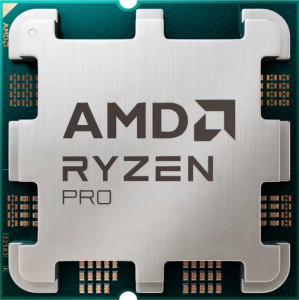
The AMD Ryzen 5 Pro 8600GE is a desktop processor designed for the AM5 socket, manufactured on a 4 nm semiconductor process. It features six cores running at a base clock of 3.9 GHz, with twelve threads enabled through multithreading support, and a turbo frequency reaching up to 5 GHz. The chip carries a thermal design power rating of 35W, making it a low-power option within the desktop segment.

On the memory side, the Ryzen 5 Pro 8600GE supports DDR5 across two channels with a maximum capacity of 256 GB, and it includes ECC memory support. Cache configuration consists of 384 KB of L1, 6 MB of L2, and 16 MB of L3. The processor integrates a Radeon 760M GPU clocked at 800 MHz with a turbo of 2600 MHz, backed by 512 shading units and DirectX 12 support across up to four displays. It also supports a broad instruction set including AVX2, AES, and FMA3, and connects via PCIe 4.0.

Pros
  • Supports DDR5 memory with dual-channel configuration and a maximum capacity of 256 GB, offering substantial headroom for memory-intensive workloads
  • ECC memory support adds a layer of data integrity protection useful in professional or reliability-sensitive desktop deployments
  • The integrated Radeon 760M GPU can drive up to four displays simultaneously and reaches a turbo clock of 2600 MHz without requiring a discrete card
  • An unlocked multiplier provides flexibility for manual clock speed adjustments beyond the default 3.9 GHz base
  • The 35W TDP keeps power draw low for a desktop processor, which can ease thermal management requirements
  • AVX2, AES, and FMA3 instruction set support broadens compatibility with vectorized and cryptographic workloads
Cons
  • With only 8 GPU execution units and 512 shading units, the integrated Radeon 760M is limited for demanding graphics tasks
  • The 35W TDP, while efficient, may constrain sustained peak performance compared to higher-wattage desktop processors
  • L3 cache totals 16 MB across six cores, which at roughly 2.67 MB per core leaves less per-core cache than some competing desktop configurations
  • The processor does not use big.LITTLE technology, meaning there is no distinction between efficiency and performance cores for workload scheduling
Who is this for?

This processor is well-matched for professional desktop builds where low power consumption and data reliability are priorities, such as compact workstations or always-on systems that benefit from its 35W TDP and ECC memory support. The integrated Radeon 760M with support for up to four simultaneous displays makes it a practical choice for multi-monitor productivity setups that do not require dedicated graphics. Its DDR5 dual-channel support with up to 256 GB capacity also suits memory-intensive professional applications where large data sets need to reside in RAM.

Who is this NOT for?

Users looking to run demanding graphics workloads such as modern gaming at high settings or GPU-accelerated rendering will find the integrated Radeon 760M's 8 execution units insufficient for those tasks. The processor is equally unsuitable for scenarios requiring sustained heavy multi-threaded throughput, as its 35W power envelope can limit peak performance under prolonged load compared to full-power desktop chips. Those building systems around high core-count or cache-intensive workloads may also find the six-core configuration and 16 MB of L3 cache restrictive.

General info:

Type Desktop
CPU socket AM5
Has integrated graphics
Thermal Design Power (TDP) 35W
semiconductor size 4 nm
CPU temperature 95 °C
PCI Express (PCIe) version 4
Supports 64-bit

The AMD Ryzen 5 Pro 8600GE is a desktop processor built for the AM5 socket, manufactured on a 4 nm semiconductor process. It carries a Thermal Design Power of 35W and supports a maximum operating temperature of 95 °C. The chip includes integrated graphics and fully supports 64-bit computing. Connectivity is handled through PCIe 4.0, keeping it compatible with a range of modern expansion hardware.

Performance:

CPU speed 6 x 3.9 GHz
CPU threads 12 threads
turbo clock speed 5GHz
Has an unlocked multiplier
L2 cache 6 MB
L3 cache 16 MB
L1 cache 384 KB
L2 core 1 MB/core
L3 core 2.67 MB/core
Uses big.LITTLE technology
clock multiplier 39

The processor runs six cores at a base speed of 3.9 GHz, totaling 12 threads for handling concurrent workloads, with a turbo clock reaching 5 GHz under boosted conditions. It does not use big.LITTLE technology, meaning all cores share a uniform architecture. The clock multiplier is set at 39 and the chip features an unlocked multiplier, allowing for manual frequency adjustment. Cache memory is arranged across three levels: 384 KB of L1, 6 MB of L2 at 1 MB per core, and 16 MB of L3 at approximately 2.67 MB per core.

Benchmarks:

PassMark result 23883
PassMark result (single) 3921

In PassMark testing, the processor achieves a multi-thread score of 23,883, reflecting its overall throughput across all cores and threads. The single-thread result of 3,921 indicates per-core processing capability as measured by the same benchmark.

Integrated graphics:

GPU clock speed 800 MHz
GPU name Radeon 760M
GPU turbo 2600 MHz
GPU execution units 8
DirectX version DirectX 12
supported displays 4
OpenGL version 4.6
OpenCL version 2.1
texture mapping units (TMUs) 32
render output units (ROPs) 16
shading units 512

The integrated Radeon 760M GPU operates at a base clock of 800 MHz and can boost up to 2600 MHz, backed by 8 execution units, 512 shading units, 32 texture mapping units, and 16 render output units. It supports up to four displays simultaneously and is compatible with DirectX 12, OpenGL 4.6, and OpenCL 2.1, covering a broad range of graphics and compute workloads.

Memory:

DDR memory version 5
memory channels 2
maximum memory amount 256GB
Supports ECC memory

The processor uses DDR5 memory across two channels, supporting a maximum installed capacity of 256 GB. It also includes ECC memory support, which enables error detection and correction for workloads where data integrity is a priority.

Features:

instruction sets MMX, F16C, FMA3, AES, AVX, AVX2, SSE 4.1, SSE 4.2
uses multithreading
Has NX bit

The processor supports multithreading and includes the NX bit for hardware-level memory protection. Its instruction set support covers MMX, F16C, FMA3, AES, SSE 4.1, SSE 4.2, AVX, and AVX2, providing a broad foundation for vectorized, encrypted, and floating-point compute operations.
Final Verdict

The AMD Ryzen 5 Pro 8600GE presents a well-defined profile as a desktop processor built around efficiency and professional reliability rather than raw computational muscle. Its 35W TDP combined with ECC memory support and DDR5 compatibility makes it a genuinely practical choice for compact professional desktops, multi-display productivity setups, and workloads where data integrity matters. The integrated Radeon 760M adds meaningful display flexibility without requiring additional hardware, though users with graphics-intensive or sustained heavy compute demands will find its boundaries relatively quickly. For the right deployment — one that values controlled power draw, memory reliability, and a capable integrated graphics solution — the Ryzen 5 Pro 8600GE delivers a coherent and purposeful specification set.

Popular Comparisons

AMD Ryzen 5 Pro 8600GE
VS
AMD Ryzen 5 Pro 8500GE
AMD Ryzen 5 Pro 8600GE
VS
AMD Ryzen 5 8500G
AMD Ryzen 5 8500G
AMD Ryzen 5 Pro 8600GE
VS
AMD Ryzen 7 Pro 8700GE
AMD Ryzen 5 Pro 8600GE
VS
AMD Ryzen 7 8700F
AMD Ryzen 7 8700F