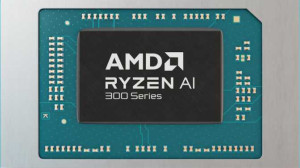
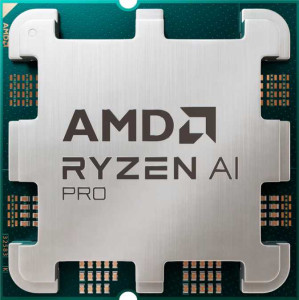
The AMD Ryzen 7 260 is designed for both laptop and desktop platforms and includes integrated graphics, making it suitable for systems without a discrete GPU. It is built on a 4 nm semiconductor process and operates within a Thermal Design Power of 45W, with a maximum CPU temperature of 100 °C. The processor supports PCIe version 4 for connectivity and is fully 64-bit compatible.
The Ryzen 7 260 features 8 cores running at a base clock of 3.8 GHz each, with 16 threads for handling parallel workloads, and a turbo clock speed reaching 5.1 GHz. The clock multiplier is set at 38 and the processor does not have an unlocked multiplier, meaning frequency adjustments beyond the default are not supported. Cache is organized across three levels: 512 KB of L1, 8 MB of L2 at 1 MB per core, and 16 MB of L3 at 2 MB per core. The chip does not use big.LITTLE heterogeneous core architecture, meaning all cores share the same design.
In benchmark testing, the Ryzen 7 260 achieves a multi-core PassMark score of 29,915, reflecting its overall throughput across all cores and threads. Its single-core PassMark result stands at 3,826, indicating per-core processing capability as measured by the PassMark benchmark suite.
The integrated graphics solution in this processor is the Radeon 780M, running at a base GPU clock of 800 MHz and capable of boosting up to 2700 MHz. It is equipped with 768 shading units, 48 texture mapping units (TMUs), and 32 render output units (ROPs), and can drive up to 4 displays simultaneously. API support covers DirectX 12, OpenGL 4.6, and OpenCL 2.1, providing broad compatibility across graphics and compute workloads.
The Ryzen 7 260 supports DDR5 memory across two channels, with a maximum RAM speed of 7500 MHz and a ceiling of 256 GB total system memory. This dual-channel configuration allows for balanced memory bandwidth across the available channels. ECC memory is not supported by this processor.
The Ryzen 7 260 supports a broad set of instruction sets including MMX, F16C, FMA3, AES, AVX, AVX2, SSE 4.1, and SSE 4.2, enabling compatibility with a wide range of software optimization paths. The processor uses multithreading, allowing each physical core to handle two threads simultaneously. It also includes the NX bit, a hardware-level feature that helps prevent certain classes of malicious code execution.