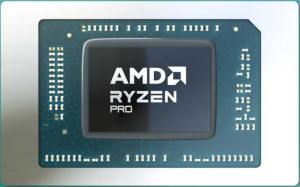
The AMD Ryzen 7 8745HS is designed for both laptop and desktop platforms and comes with integrated graphics, making it a versatile fit across different system configurations. It operates with a Thermal Design Power (TDP) of 45W and can sustain a maximum CPU temperature of 100°C. Manufactured on a 4nm process node, it supports PCIe 4.0 for connecting high-speed peripherals and storage devices, and fully supports 64-bit computing.
The Ryzen 7 8745HS features 8 cores running at a base clock of 3.8GHz, with 16 threads available for handling parallel workloads, and a turbo clock speed that reaches up to 4.9GHz when conditions allow. The clock multiplier sits at 38, though the multiplier is locked, meaning manual overclocking through that route is not supported. On the cache side, the processor provides 8MB of L2 cache at 1MB per core and 16MB of L3 cache at 2MB per core, helping to reduce latency for frequently accessed data. The chip does not use big.LITTLE heterogeneous core architecture, meaning all cores share the same design.
In PassMark testing, the Ryzen 7 8745HS achieves a multi-threaded score of 29,179, reflecting its throughput across all cores and threads. Its single-core PassMark result of 3,768 indicates the per-core processing capability of the chip.
The integrated graphics solution in the Ryzen 7 8745HS is the Radeon 780M, which runs at a base GPU clock of 800MHz and can boost up to 2600MHz. It is equipped with 768 shading units, 48 texture mapping units (TMUs), and 32 render output units (ROPs), and can drive up to four displays simultaneously. On the API side, it supports DirectX 12, OpenGL 4.6, and OpenCL 2.1, covering a broad range of graphics and compute workloads.
The Ryzen 7 8745HS supports DDR5 memory at speeds of up to 7500MHz across a dual-channel configuration, allowing for reasonable memory bandwidth in compatible systems. It can address a maximum of 256GB of RAM, providing ample headroom for memory-intensive use cases. ECC memory is not supported by this processor.
The Ryzen 7 8745HS supports multithreading, allowing each physical core to handle two threads simultaneously for more efficient parallel processing. Its instruction set support spans MMX, F16C, FMA3, AES, AVX, AVX2, SSE 4.1, and SSE 4.2, covering a wide range of operations from floating-point math and vector processing to hardware-accelerated encryption. The processor also includes the NX bit, a hardware security feature that helps prevent certain classes of malicious code from executing in memory regions designated as non-executable.