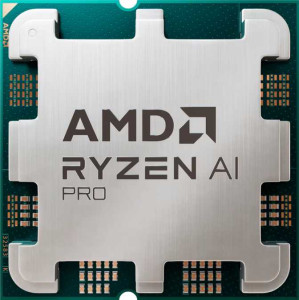
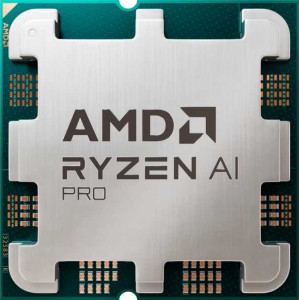
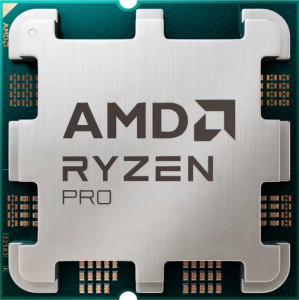
The AMD Ryzen 7 Pro 8700GE is a desktop processor built on a 4nm semiconductor process and designed for the AM5 socket. It includes integrated graphics and fully supports 64-bit computing. With a Thermal Design Power of 35W, the chip operates within a modest power envelope, while its maximum rated operating temperature sits at 95°C. Connectivity is handled through PCIe 4.0, offering a modern interface for compatible components.
The processor features eight cores running at a base speed of 3.6GHz each, supported by 16 threads for handling concurrent workloads. Turbo clock speed reaches up to 5.1GHz, with a clock multiplier of 36 and an unlocked multiplier that allows for frequency adjustments. On the cache side, the chip provides 8MB of L2 cache at 1MB per core and 16MB of L3 cache at 2MB per core, giving the processor a reasonably sized memory hierarchy for reducing latency. The design does not use big.LITTLE heterogeneous core architecture, meaning all eight cores share the same configuration.
In multi-threaded testing, the processor achieves a PassMark score of 28,321, climbing to 29,265 when overclocked. Its single-threaded PassMark result stands at 3,836, reflecting per-core responsiveness under lighter workloads. On the Geekbench 6 platform, the chip records a multi-core score of 12,732 and a single-core score of 2,692, rounding out a consistent set of benchmark results across both test suites.
The integrated Radeon 780M GPU operates at a base clock of 800MHz and can boost up to 2700MHz, backed by 12 execution units, 768 shading units, 48 texture mapping units, and 32 render output units. It supports up to four displays simultaneously and is compatible with DirectX 12, OpenGL 4.6, and OpenCL 2.1, covering a broad range of graphics and compute workloads handled entirely within the processor package.
The processor uses DDR5 memory across a dual-channel configuration, allowing for balanced bandwidth across two memory lanes. It supports a maximum installed capacity of 256GB, making it suitable for memory-intensive workloads. Additionally, the chip includes ECC memory support, which enables error detection and correction — a useful capability for applications where data integrity is a priority.
The processor supports multithreading and includes the NX bit for hardware-level memory protection. Its instruction set support spans MMX, F16C, FMA3, AES, AVX, AVX2, SSE 4.1, and SSE 4.2, covering a wide range of operations from legacy multimedia instructions to modern floating-point, encryption, and advanced vector extensions that can accelerate parallelized compute tasks.