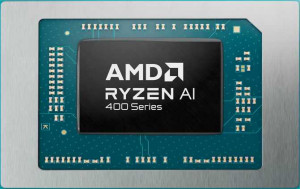
The AMD Ryzen AI 5 430 is designed for both laptop and desktop use, built on a 4nm semiconductor process and operating within a 28W thermal design power (TDP) envelope. It supports 64-bit computing and includes integrated graphics, while the maximum junction temperature is rated at 100°C. Connectivity is handled through PCIe 4.0, providing a modern interface for compatible peripherals and expansion devices.
The Ryzen AI 5 430 features a hybrid core layout using big.LITTLE technology, with base clock speeds configured as 1 x 2GHz and 3 x 2GHz across its cores, and a total of 8 threads available for concurrent workloads. The processor can reach a turbo clock speed of 4.5GHz, though the multiplier is locked and cannot be manually adjusted. Cache resources include 4MB of L2 and 8MB of L3 cache, supporting efficient data access across varying workload demands.
In PassMark testing, the Ryzen AI 5 430 achieves a multi-core score of 13,958, reflecting its overall throughput across all available threads. The single-core result of 3,877 indicates the processor's per-core execution capability as measured by the same benchmark suite.
The Ryzen AI 5 430 integrates a Radeon 840M GPU with a turbo frequency of 2,800MHz, capable of driving up to four displays simultaneously. It supports DirectX 12 for modern graphics workloads, alongside OpenGL 4.6 and OpenCL 2.1, covering a broad range of rendering and compute use cases handled directly through the integrated graphics solution.
The Ryzen AI 5 430 supports DDR5 memory across two channels, with a maximum rated speed of 8,000MHz. It can address up to 256GB of RAM in total, offering substantial headroom for memory-intensive workloads. ECC memory is not supported by this processor.
The Ryzen AI 5 430 supports multithreading and includes the NX bit for hardware-level execution protection. Its instruction set support spans MMX, AVX, AVX2, FMA3, F16C, AES, SSE 4.1, and SSE 4.2, covering a wide range of computational operations including vectorized math, encryption, and floating-point handling. Together, these features reflect a well-rounded capability set for both general-purpose and more specialized processing tasks.