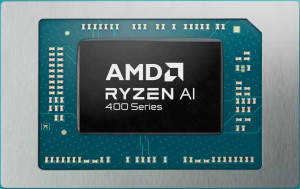
The AMD Ryzen AI 5 435 is designed for both laptop and desktop platforms, built on a 4nm semiconductor process that contributes to its compact power profile. It carries a thermal design power of 28W and a maximum operating temperature of 100°C. The chip includes integrated graphics, supports 64-bit operation, and is compatible with PCIe 4.0, covering the core connectivity and feature requirements expected of a modern processor in this class.
The Ryzen AI 5 435 operates across 12 threads using big.LITTLE technology, which pairs two cores at 2GHz with four cores also running at 2GHz in a mixed configuration, while turbo clock speeds reach up to 4.5GHz under load. The processor does not feature an unlocked multiplier, so clock speeds are fixed to their rated values. On the cache side, it includes 6MB of L2 cache and 8MB of L3 cache, providing a reasonable amount of fast-access memory to support its multi-threaded workload handling.
The Ryzen AI 5 435 includes an integrated Radeon 840M GPU with a turbo frequency of 2800MHz, capable of driving up to four displays simultaneously. It supports DirectX 12 for modern graphics workloads, alongside OpenGL 4.6 and OpenCL 2.1, covering a broad range of rendering and compute use cases without requiring a discrete graphics card.
The Ryzen AI 5 435 supports DDR5 memory across a dual-channel configuration, with a maximum RAM speed of 8000MHz and a ceiling of 256GB total memory capacity. These two channels allow memory bandwidth to be split across parallel paths, which benefits throughput-sensitive tasks. The processor does not support ECC memory, so error-correcting RAM configurations are not an option with this chip.
The Ryzen AI 5 435 supports multithreading and includes the NX bit for hardware-level execution protection. Its instruction set support spans MMX, SSE 4.1, SSE 4.2, AVX, AVX2, F16C, FMA3, and AES, covering a wide range of workloads from legacy multimedia operations to modern floating-point math and hardware-accelerated encryption. The combination of AVX2 and FMA3 in particular enables efficient handling of vectorized and fused multiply-add computations across compatible applications.