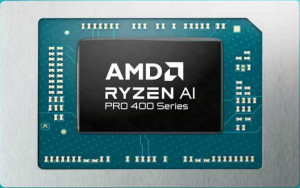
The AMD Ryzen AI 5 Pro 440 is designed for both laptop and desktop platforms, built on a 4 nm semiconductor process that contributes to its compact power profile. It carries a thermal design power of 28W and can operate at a maximum CPU temperature of 100 °C. The processor includes integrated graphics, supports 64-bit operation, and is compatible with PCIe version 4, providing a solid foundation for modern system connectivity.
The processor runs across six cores with a base clock configuration of 3 x 2 & 3 x 2 GHz and supports 12 threads in total, with big.LITTLE technology enabling the chip to distribute workloads across different core types for improved efficiency. Burst frequencies can reach a turbo clock speed of 4.8 GHz, while the multiplier remains locked, meaning clock speed adjustments through overclocking are not supported. On the cache side, the chip provides 6 MB of L2 cache and 16 MB of L3 cache, giving it a reasonable buffer for handling frequently accessed data.
The integrated graphics solution is the Radeon 840M, which can reach a turbo frequency of 2900 MHz and supports up to four displays simultaneously. It is compatible with DirectX 12, making it suitable for modern graphical workloads, and also supports OpenGL version 4.6 and OpenCL version 2.1, covering a broad range of rendering and compute tasks handled directly by the integrated GPU.
The processor supports DDR5 memory running at speeds of up to 8533 MHz through a dual-channel configuration, providing a reasonable bandwidth ceiling for memory-intensive tasks. It can address a maximum of 256 GB of RAM, making it capable of handling substantial memory loads in compatible systems. Additionally, the chip supports ECC memory, which enables error detection and correction — a feature particularly relevant in professional or reliability-sensitive environments.
The processor includes multithreading support, allowing each core to handle multiple threads concurrently to improve throughput across parallel workloads. It also features the NX bit, a hardware-level security mechanism that helps prevent certain types of malicious code execution. On the instruction set side, the chip supports a broad range of extensions including AVX2, AES, and FMA3, alongside MMX, F16C, AVX, SSE 4.1, and SSE 4.2, covering vectorized math, encryption acceleration, and a variety of multimedia and floating-point operations.