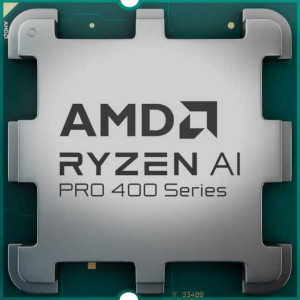
The AMD Ryzen AI 5 Pro 440GE is a desktop processor built around the AM5 socket, compatible with a broad set of chipsets including X670, B650, X870, B840, and B850. It includes integrated graphics and fully supports 64-bit operation. Fabricated on a 4 nm process node, the chip carries a thermal design power of 35W and is rated for a maximum operating temperature of 95°C. It implements PCIe 4.0 for peripheral connectivity, making it suitable for a range of modern desktop platform configurations.
The processor features 6 cores running at a base clock of 2 GHz each, supporting 12 threads in total, with a turbo frequency that climbs to 4.8 GHz under load. The clock multiplier is set at 20, and the chip does not include an unlocked multiplier, meaning clock adjustment beyond standard parameters is not supported. It does not use big.LITTLE heterogeneous core architecture, so all cores operate under a uniform design. The cache layout consists of 480 KB of L1, 6 MB of L2 at 1 MB per core, and 16 MB of L3 cache at approximately 2.67 MB per core, providing a tiered memory hierarchy to help reduce latency during typical workloads.
The integrated graphics solution in this processor is the Radeon 840M, which operates with a turbo frequency of 2900 MHz, allowing the system to handle display output and graphics tasks without requiring a discrete GPU.
This processor supports DDR5 memory running at speeds of up to 5600 MHz across a dual-channel configuration, providing two memory channels for parallel data throughput. The maximum supported memory capacity reaches 256 GB, making it well-suited for memory-intensive workloads at the platform level. Additionally, the chip includes support for ECC memory, which allows for error-correcting memory modules in configurations where data integrity is a priority.
The processor supports multithreading, allowing each physical core to handle multiple threads simultaneously for more efficient workload processing. It includes the NX bit for hardware-level memory protection against certain classes of malicious code execution. On the instruction set side, the chip covers a broad range of extensions including MMX, F16C, FMA3, AES, AVX, AVX2, SSE 4.1, and SSE 4.2, enabling optimized handling of floating-point operations, encryption tasks, and vectorized computations.