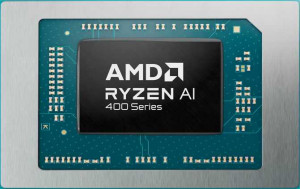
The AMD Ryzen AI 7 450 is designed for both laptop and desktop platforms, built on a 4nm semiconductor process that contributes to its compact thermal profile. It operates with a Thermal Design Power (TDP) of 28W and a maximum CPU temperature of 100°C, keeping its power envelope well-defined for system integrators. The processor includes integrated graphics, supports 64-bit computing, and is compatible with PCIe 4.0, making it capable of interfacing with a range of modern expansion components.
The Ryzen AI 7 450 features a dual-cluster core layout using big.LITTLE technology, with base speeds of 4 x 2 & 4 x 2 GHz across its cores and a turbo clock speed of 5.1GHz, allowing the processor to scale frequency based on workload demands. It supports 16 threads in total, enabling concurrent task handling across its core count. The cache hierarchy consists of 8MB of L2 cache and 16MB of L3 cache, providing tiered data access to help sustain throughput during varied operations. The multiplier is locked, meaning clock speed adjustments through manual overclocking are not supported.
The integrated graphics solution in this processor is the Radeon 860M, running at a base clock of 600MHz and scaling up to a GPU turbo speed of 3100MHz. It is equipped with 512 shading units, 32 texture mapping units (TMUs), and 8 render output units (ROPs), forming the core of its rendering pipeline. The GPU supports up to 4 displays simultaneously and is compatible with DirectX 12, OpenGL 4.6, and OpenCL 2.1, covering a broad range of graphics and compute interfaces.
The Ryzen AI 7 450 supports DDR5 memory with a maximum rated speed of 8533MHz, operating across a dual-channel configuration. It can accommodate up to 256GB of RAM in total, offering considerable headroom for memory-intensive workloads. ECC memory is not supported by this processor, and all memory operations run through the two available channels.
The Ryzen AI 7 450 supports multithreading, allowing its cores to handle multiple threads simultaneously for more efficient parallel processing. It includes the NX bit for hardware-level memory protection, helping to guard against certain classes of malicious code execution. The processor also carries a broad set of instruction set extensions, including MMX, F16C, FMA3, AES, AVX, AVX2, SSE 4.1, and SSE 4.2, enabling support for a wide range of computational operations across different software workloads.