AMD Ryzen AI 7 450GE specifications and in-depth review

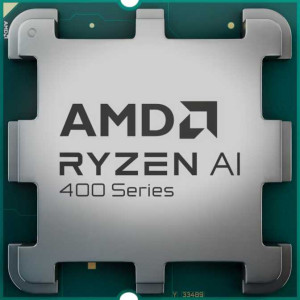
AMD Ryzen AI 7 450GE

Manufacturer: AMD

The AMD Ryzen AI 7 450GE is a desktop processor designed for the AM5 platform, combining a compact 35W thermal design power with a capable core configuration suited to a range of computing workloads. It integrates the Radeon 860M graphics unit, making it a self-contained option for systems where a discrete GPU is not required. The chip is fabricated on a 4 nm process node and supports a broad selection of chipsets including X670, B650, X870, B840, and B850.

On the performance side, the Ryzen AI 7 450GE operates with 8 cores and 16 threads, starting at a base clock of 2 GHz per core and reaching a turbo frequency of 5.1 GHz. Cache allocation totals 640 KB of L1, 8 MB of L2, and 16 MB of L3. The processor supports DDR5 memory at speeds up to 5600 MHz across two channels, with a maximum capacity of 256 GB and optional ECC support. Its integrated Radeon 860M features 512 shading units and a boost clock of 3100 MHz, with full DirectX 12 Ultimate compatibility. An unlocked multiplier is also included, along with a broad instruction set encompassing AVX2, AES, FMA3, and others.

Pros
  • The unlocked multiplier allows manual clock speed adjustments without restrictions
  • ECC memory support adds a layer of data integrity for workloads that require it
  • DDR5 support with speeds up to 5600 MHz across two channels provides substantial memory bandwidth
  • The integrated Radeon 860M with a 3100 MHz boost clock and 512 shading units handles graphics output without a discrete card
  • A broad set of instruction extensions including AVX2, AES, and FMA3 covers a wide range of compute and security workloads
  • The 35W TDP keeps power draw low, which eases thermal and cooling requirements in a desktop build
Cons
  • The 2 GHz base clock across all 8 cores is relatively modest for sustained multi-threaded workloads
  • No big.LITTLE heterogeneous core design means there is no energy-efficient core cluster for lighter background tasks
  • The GPU base clock of 600 MHz is quite low, which may result in slower ramp-up times before the turbo frequency kicks in
  • PCIe 4.0 rather than a newer generation may limit bandwidth for high-throughput expansion cards
Who is this for?

This processor is a practical fit for users building compact or low-power desktop systems where a discrete GPU is not necessary, thanks to the integrated Radeon 860M with a 3100 MHz boost clock handling everyday graphics needs. Its 35W TDP makes it well-suited for small form factor builds or thermally constrained environments where power efficiency matters. The ECC memory support and broad instruction set — including AES and AVX2 — also make it a reasonable choice for light workstation or data-integrity-sensitive tasks such as small-scale server use or developer machines.

Who is this NOT for?

Users looking to run demanding multi-threaded workloads continuously may find the 2 GHz base clock limiting, as sustained performance across all 8 cores depends heavily on turbo headroom. The integrated graphics, while capable for general use, lack the shader count and memory bandwidth needed for GPU-intensive tasks such as 3D rendering, video encoding at high resolutions, or modern gaming at elevated settings. Additionally, the absence of a big.LITTLE core configuration means the chip offers less flexibility for workloads that benefit from a mix of high-performance and efficiency-optimized cores.

General info:

Type Desktop
CPU socket AM5
chipset X670, B650, X870, B840, B850
Has integrated graphics
release date March 2026
Thermal Design Power (TDP) 35W
semiconductor size 4 nm
CPU temperature 95 °C
PCI Express (PCIe) version 4
Supports 64-bit

The AMD Ryzen AI 7 450GE is a desktop processor built on a compact 4 nm semiconductor process and designed for the AM5 socket, offering compatibility with a range of chipsets including X670, B650, X870, B840, and B850. It carries a thermal design power of 35W and supports a maximum operating temperature of 95 °C. The chip includes integrated graphics, supports 64-bit computing, and connects to the platform via PCIe 4.0.

Performance:

CPU speed 8 x 2 GHz
CPU threads 16 threads
turbo clock speed 5.1GHz
Has an unlocked multiplier
L2 cache 8 MB
L3 cache 16 MB
L1 cache 640 KB
L2 core 1 MB/core
L3 core 2 MB/core
Uses big.LITTLE technology
clock multiplier 20

The processor runs 8 cores at a base speed of 2 GHz each, supporting 16 threads in total, and can reach a turbo clock speed of 5.1 GHz under load. The clock multiplier is set at 20, and an unlocked multiplier is included for manual frequency adjustments. Cache is structured across three levels — 640 KB of L1, 8 MB of L2 at 1 MB per core, and 16 MB of L3 at 2 MB per core — providing a reasonable amount of fast-access memory for the core count. This chip does not use big.LITTLE heterogeneous core architecture, meaning all cores share the same design.

Benchmarks:

Integrated graphics:

GPU clock speed 600 MHz
GPU name Radeon 860M
GPU turbo 3100 MHz
DirectX version DirectX 12 Ultimate
OpenGL version 4.6
OpenCL version 2.1
texture mapping units (TMUs) 32
render output units (ROPs) 16
shading units 512

The integrated graphics solution is the Radeon 860M, which operates at a base clock of 600 MHz and can boost up to a GPU turbo of 3100 MHz. It is equipped with 512 shading units, 32 texture mapping units, and 16 render output units. API support covers DirectX 12 Ultimate, OpenGL 4.6, and OpenCL 2.1, providing a well-rounded set of compatibility options for graphics and compute workloads.

Memory:

RAM speed (max) 5600 MHz
DDR memory version 5
memory channels 2
maximum memory amount 256GB
Supports ECC memory

The processor supports DDR5 memory across two channels, with a maximum rated speed of 5600 MHz and a capacity ceiling of 256 GB. ECC memory is also supported, which allows for error-correcting configurations where data integrity is a priority.

Features:

instruction sets MMX, F16C, FMA3, AES, AVX, AVX2, SSE 4.1, SSE 4.2
uses multithreading
Has NX bit

The processor includes multithreading support and carries the NX bit for hardware-level execution protection. Its instruction set support spans a broad range of extensions, including MMX, F16C, FMA3, AES, SSE 4.1, SSE 4.2, AVX, and AVX2, covering vectorized math, encryption acceleration, and floating-point operations.
Final Verdict

The AMD Ryzen AI 7 450GE is a well-defined desktop processor built around efficiency and self-sufficiency, combining a 35W thermal design power with an integrated Radeon 860M graphics unit and DDR5 memory support to cover a meaningful range of everyday and light professional workloads without requiring additional components. Its ECC memory compatibility, unlocked multiplier, and broad instruction set give it a degree of flexibility that extends its appeal beyond purely consumer use. That said, its modest base clock and reliance on integrated graphics place a natural ceiling on sustained heavy compute and graphics-intensive tasks. For users building compact, power-conscious desktop systems that prioritize versatility and reliability over raw throughput, the Ryzen AI 7 450GE represents a focused and coherent platform choice.