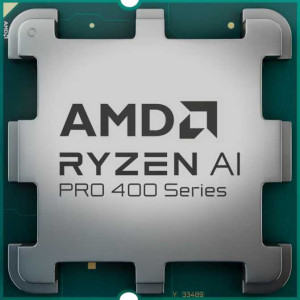
The AMD Ryzen AI 7 Pro 450G is a desktop processor that fits the AM5 socket and is compatible with a broad range of chipsets, including X670, B650, X870, B840, and B850. It is built on a 4nm semiconductor process and carries a Thermal Design Power of 65W, with a maximum operating temperature of 95°C. The chip includes integrated graphics, supports 64-bit computing, and offers PCIe 4.0 connectivity for expansion devices.
The processor runs eight cores at a base speed of 2GHz each, with a turbo clock speed reaching 5.1GHz, and supports 16 threads through multithreading. The clock multiplier is set at 20, and the chip does not feature an unlocked multiplier, nor does it use big.LITTLE heterogeneous core architecture. Cache memory is organized across three levels: 640KB of L1, 8MB of L2 at 1MB per core, and 16MB of L3 at 2MB per core, providing a tiered structure to help manage data access across workloads.
The integrated graphics solution is the Radeon 860M, running at a base clock of 600MHz and boosting up to 3100MHz under load. It is equipped with 512 shading units, 32 texture mapping units, and 16 render output units, forming a reasonably complete fixed-function pipeline for on-chip rendering. API support covers DirectX 12 Ultimate, OpenGL 4.6, and OpenCL 2.1, covering a wide range of graphics and compute workloads without requiring a discrete GPU.
The processor supports DDR5 memory at speeds up to 5600MHz across two channels, allowing for dual-channel configurations that improve memory bandwidth. It can address up to 256GB of RAM in total, providing ample headroom for memory-intensive workloads. Notably, the chip also supports ECC memory, which enables error-correcting functionality useful in reliability-focused or professional desktop deployments.
The processor supports multithreading, allowing each physical core to handle two threads simultaneously for more efficient parallel workload handling. Its instruction set support spans MMX, F16C, FMA3, AES, AVX, AVX2, SSE 4.1, and SSE 4.2, covering a broad range of general-purpose, floating-point, encryption, and SIMD operations. The chip also includes the NX bit, a hardware-level security feature that helps prevent certain classes of malicious code from executing in memory regions designated for data.