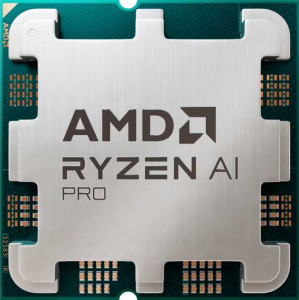
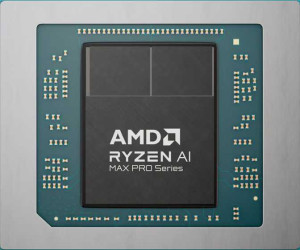
The AMD Ryzen AI 7 Pro 360 is designed for both desktop and laptop platforms, built on a 4nm semiconductor process that contributes to its compact power profile. It operates with a Thermal Design Power of 28W and can sustain a maximum CPU temperature of 100°C. The processor includes integrated graphics, supports 64-bit computing, and is compatible with PCIe 4.0, making it capable of interfacing with a range of modern expansion and storage devices.
The Ryzen AI 7 Pro 360 uses big.LITTLE technology, pairing three cores running at 2 GHz with five cores also clocked at 2 GHz, for a total of 16 threads across all cores. Cache is organized with 8MB of L2 and 16MB of L3, broken down to 1MB of L2 and 2MB of L3 per core, helping to keep frequently accessed data close to the processing units. The clock multiplier is set at 20, and the processor does not feature an unlocked multiplier, meaning clock speed adjustments beyond standard settings are not supported.
In PassMark testing, the Ryzen AI 7 Pro 360 achieves a multi-thread score of 22,194, reflecting its overall throughput across all cores and threads. Its single-thread PassMark result of 3,923 indicates the per-core processing capability, which is relevant for tasks that rely heavily on single-threaded execution.
The integrated graphics solution in this processor is the Radeon 880M, which runs at a base clock of 400 MHz and scales up to a turbo frequency of 2900 MHz. It is equipped with 512 shading units, 32 texture mapping units, and 12 render output units, and can drive up to four displays simultaneously. API support covers DirectX 12, OpenGL 4.6, and OpenCL 2.1, giving it a broad range of compatibility across graphics and compute workloads.
The Ryzen AI 7 Pro 360 supports DDR5 memory across two channels, with a maximum RAM speed of 8000 MHz and a total capacity ceiling of 256GB. It also includes support for ECC memory, which enables error detection and correction — a feature relevant for workloads where data integrity is a priority.
The Ryzen AI 7 Pro 360 supports multithreading and includes the NX bit for hardware-level memory protection against certain types of code execution exploits. Its instruction set support spans MMX, F16C, FMA3, AES, AVX, AVX2, SSE 4.1, and SSE 4.2, covering a broad range of operations from legacy multimedia extensions to modern floating-point, encryption, and vectorized computation workloads.