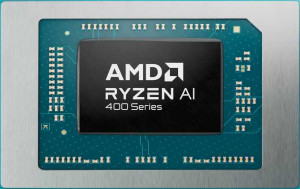
The AMD Ryzen AI 9 465 is designed for both laptop and desktop platforms, built on a 4nm semiconductor process with a Thermal Design Power of 28W, making it suitable for a range of form factors. It includes integrated graphics and fully supports 64-bit computing, while its PCI Express 4 interface enables compatibility with a broad set of expansion and storage devices. The processor has a maximum rated CPU temperature of 100°C, providing a clear thermal ceiling for system designers and cooling configurations.
The processor operates across two core groups running at 2 GHz each — four cores in one cluster and six in another — for a combined total of 20 threads, with burst workloads handled by a turbo clock speed of 5GHz. It uses big.LITTLE technology to distribute tasks across these core groups according to demand, and an unlocked multiplier allows for manual frequency adjustments within supported configurations. On the cache side, 10MB of L2 and 24MB of L3 cache are available to help reduce memory latency during sustained workloads.
The integrated Radeon 880M graphics core has a base clock of 400 MHz and can boost up to 2900 MHz, with support for up to four displays simultaneously. Its rendering pipeline consists of 768 shading units, 48 texture mapping units, and 16 render output units, providing a well-rounded set of resources for general graphics workloads. API compatibility covers DirectX 12, OpenGL 4.6, and OpenCL 2.1, allowing the GPU to serve a range of display, compute, and graphics tasks without requiring a discrete card.
The processor supports DDR5 memory across two channels, with a maximum rated speed of 8533 MHz and an upper capacity limit of 256GB. These two channels allow memory bandwidth to scale across the available slots, supporting configurations suited to both compact and more memory-intensive system builds. ECC memory is not supported, so error-correcting configurations are outside the scope of this processor's memory subsystem.
The processor includes a broad set of instruction sets — MMX, F16C, FMA3, AES, AVX, AVX2, SSE 4.1, and SSE 4.2 — covering vectorized math, hardware-accelerated encryption, and packed floating-point operations across a wide range of software workloads. Multithreading is supported, allowing the processor to handle multiple instruction streams concurrently across its available threads. The NX bit is also present, enabling hardware-level memory protection that helps prevent certain classes of malicious code execution.