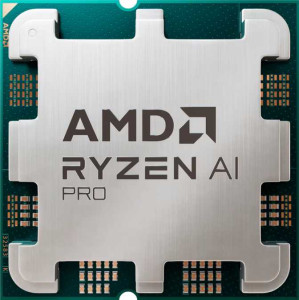
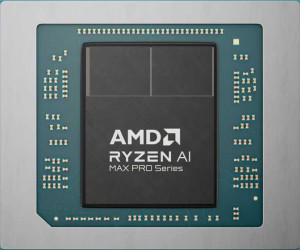
The AMD Ryzen AI 9 HX Pro 375 is compatible with both desktop and laptop platforms and includes integrated graphics, making it a versatile option across different system configurations. Built on a 4 nm semiconductor process, it operates within a 28W Thermal Design Power (TDP) envelope and can sustain a maximum CPU temperature of 100 °C. The processor supports 64-bit computing and interfaces with the system through PCIe version 4, ensuring compatibility with a wide range of modern expansion and storage components.
The processor uses big.LITTLE technology to arrange its cores into two groups — four cores and eight cores — each running at a 2 GHz base clock, with a combined thread count of 24 threads to support parallel workloads efficiently. Under sustained demand, the chip can reach a turbo clock speed of 5.1 GHz. Cache is distributed at 1 MB of L2 per core and 2 MB of L3 per core, totaling 12 MB of L2 and 24 MB of L3 cache across the die, helping to reduce latency when accessing frequently used data.
In PassMark testing, the processor achieves a multi-threaded score of 33,564 and a single-threaded score of 3,839, reflecting its per-core responsiveness alongside its parallel processing capacity. When overclocked, the PassMark result rises to 37,839, indicating the headroom available beyond its default operating configuration.
The integrated Radeon 890M graphics unit runs at a base clock of 400 MHz and boosts up to 2900 MHz under load, backed by 1024 shading units, 64 texture mapping units (TMUs), and 32 render output units (ROPs). It supports up to four displays simultaneously and is compatible with DirectX 12 Ultimate, as well as OpenGL 4.6 and OpenCL 2.1, covering a broad range of graphics and compute workloads without requiring a discrete GPU.
The processor supports DDR5 memory at speeds up to 8000 MHz across two channels, allowing for efficient data throughput in bandwidth-sensitive tasks. It can address a maximum of 256 GB of RAM, and the inclusion of ECC memory support makes it suitable for use cases where data integrity is a priority.
The processor supports multithreading and includes the NX bit for hardware-level memory protection against certain classes of malicious code execution. Its instruction set support spans MMX, AVX, AVX2, FMA3, F16C, AES, SSE 4.1, and SSE 4.2, covering a wide range of operations from floating-point and vector processing to hardware-accelerated encryption.