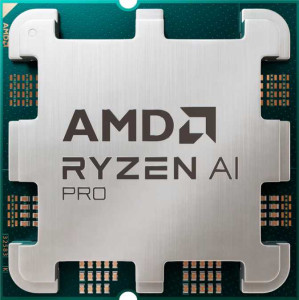
The AMD Ryzen AI 9 HX Pro 370 is built on a 4nm semiconductor process and is designed for use in both desktop and laptop platforms. It carries a thermal design power (TDP) of 28W and can operate up to a maximum temperature of 100°C. The processor includes integrated graphics, supports 64-bit computing, and is compatible with PCIe 4.0.
The processor uses big.LITTLE technology, combining four cores and eight cores all running at a 2 GHz base clock across its 12-core layout, with 24 threads available through multithreading. Under sustained workloads it can reach a turbo clock speed of 5.1 GHz. Cache memory consists of 12 MB of L2 cache at 1 MB per core and 24 MB of L3 cache at 2 MB per core, providing a tiered memory hierarchy to help reduce latency during data-intensive tasks.
In PassMark benchmarking, the processor achieves a multi-core score of 31,689, reflecting its overall throughput across all available threads. Its single-core PassMark result of 3,974 indicates the per-core processing capability measured under that same standardized test.
The integrated Radeon 890M runs at a base GPU clock of 400 MHz and can boost up to a turbo clock of 2900 MHz. It is equipped with 1024 shading units, 64 texture mapping units, and 32 render output units, and can drive up to four displays simultaneously. API support covers DirectX 12, OpenGL 4.6, and OpenCL 2.1, covering a broad range of graphics and compute workloads.
The processor supports DDR5 memory at speeds up to 8000 MHz across a dual-channel configuration, allowing for a maximum installed capacity of 256 GB. It also includes support for ECC memory, which enables error detection and correction functionality suited to reliability-sensitive workloads.
The processor supports multithreading and includes the NX bit for hardware-level memory protection. Its instruction set support spans MMX, SSE 4.1, SSE 4.2, AES, F16C, FMA3, AVX, and AVX2, covering a range of legacy, security, and vectorized compute extensions that broaden compatibility across various software workloads.