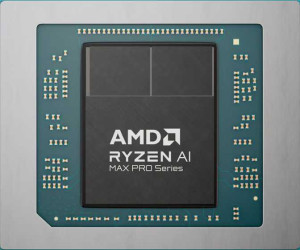
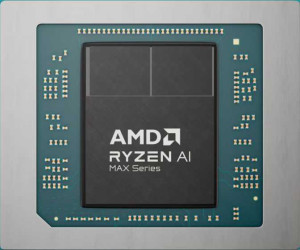
The AMD Ryzen AI Max Plus Pro 395 is designed for both laptop and desktop platforms, built on a 4nm semiconductor process that helps balance efficiency within its 55W thermal design power envelope. It includes integrated graphics and fully supports 64-bit computing, with a maximum rated CPU temperature of 100°C. Connectivity is handled through PCIe 4.0, providing a modern interface for compatible hardware components.
The processor features 16 cores running at a base clock of 3GHz, supported by 32 threads for handling concurrent workloads, and can reach a turbo clock speed of 5.1GHz with a clock multiplier of 30. It does not use big.LITTLE technology and does not have an unlocked multiplier. Cache is structured across three levels: 1280KB of L1, 16MB of L2 at 1MB per core, and 64MB of L3 at 4MB per core, providing a substantial amount of fast-access memory to keep the cores fed efficiently.
In PassMark testing, the processor achieves a multi-core score of 52016 and a single-core result of 4138, reflecting its per-core output under standard conditions. When overclocked, the PassMark score rises to 57737, indicating the additional headroom available beyond the default configuration.
The integrated graphics solution is the Radeon 8060S, which operates at a turbo frequency of 2900MHz and supports up to four displays simultaneously. It is compatible with DirectX 12, OpenGL 4.6, and OpenCL 3, covering a broad range of graphics and compute workloads without requiring a separate graphics card.
The processor supports DDR5 memory at speeds up to 8000MHz across four channels, allowing for substantial memory bandwidth in compatible configurations. It can address a maximum of 128GB of RAM and includes support for ECC memory, making it suitable for use cases where data integrity is a priority.
The processor supports multithreading and includes the NX bit for hardware-level memory protection. Its instruction set support spans MMX, F16C, FMA3, AES, AVX, AVX2, SSE 4.1, and SSE 4.2, covering a wide range of compute, cryptographic, and vector processing operations that software can take advantage of when optimized accordingly.