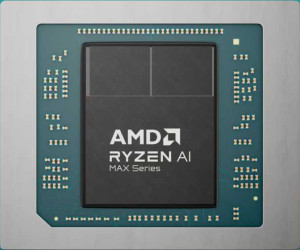
The AMD Ryzen AI Max Plus 388 is compatible with both laptop and desktop platforms and includes integrated graphics, making it a versatile option across different form factors. It operates within a 55W Thermal Design Power (TDP) envelope and is manufactured on a 4 nm semiconductor process, with a maximum CPU temperature of 100 °C. The processor supports 64-bit computing, connects via PCIe version 4, and has a maximum operating temperature of 100 °C before thermal throttling measures engage.
The processor runs 8 cores at a base speed of 3.6 GHz each, supported by 16 threads for handling concurrent workloads, and can reach a turbo clock speed of 5 GHz under sustained demand. It carries a clock multiplier of 36 and does not feature an unlocked multiplier, meaning frequency adjustments beyond stock settings are not supported. Cache configuration consists of 8 MB of L2 cache at 1 MB per core and a 32 MB L3 cache at 4 MB per core, providing solid data retrieval capacity across all cores. The chip does not employ big.LITTLE heterogeneous core technology, meaning all cores share a uniform architecture.
The integrated graphics solution is the Radeon 8060S, operating at a base clock of 1295 MHz and capable of boosting up to 2900 MHz under load. It features 2560 shading units alongside 160 texture mapping units and 64 render output units, forming a reasonably detailed rendering pipeline for an integrated GPU. The card supports up to 4 simultaneous displays and is compatible with DirectX 12, OpenGL 4.6, and OpenCL 2.1, covering a broad range of graphics and compute workloads.
The processor supports DDR5 memory, with a maximum RAM speed of 8000 MHz and a ceiling of 128 GB for total addressable memory, providing ample headroom for memory-intensive workloads and large data sets.
The processor supports multithreading and includes the NX bit for hardware-level memory protection against certain classes of malicious code execution. Its instruction set support spans MMX, F16C, FMA3, AES, AVX, AVX2, SSE 4.1, and SSE 4.2, covering a wide range of extended operations including floating-point handling, hardware-accelerated encryption, and advanced vector processing.