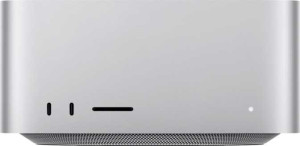
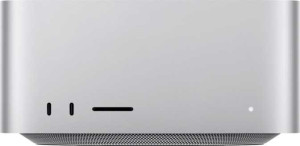
The Mac Studio 2025 M3 Ultra ships with a 16TB NVMe SSD, offering fast solid-state storage suited to large workloads. Its physical dimensions come in at 196 × 196 mm with a height of 94 mm, giving it a total volume of 3,611.104 cm³ — a compact footprint for a desktop unit. Despite its small chassis, the machine carries a weight of 3,640 g, reflecting the density of its internal components.
The CPU runs across 32 threads with a heterogeneous clock speed arrangement of 24 cores at 3.7 GHz and 8 cores at 3.4 GHz, all within an 80W TDP. It supports 64-bit computing and includes integrated graphics, while multithreading is not used. The processor also carries a 32 MB L2 cache to help sustain throughput across its core configuration.
The integrated graphics solution delivers a maximum memory bandwidth of 819 GB/s and is built on a 3 nm semiconductor process, operating over a PCIe 4 interface. It supports simultaneous output to up to 8 displays, making it well-suited to multi-monitor desktop configurations.
The Mac Studio 2025 M3 Ultra is equipped with 512GB of DDR5 RAM, providing a substantial memory pool for data-intensive tasks. The use of DDR5 reflects the latest generation of memory standard available in this configuration.
Wireless connectivity covers Wi-Fi 6E, Wi-Fi 6, Wi-Fi 5, and Wi-Fi 4 standards alongside Bluetooth 5.3. On the wired side, the unit provides two USB 3.2 Gen 2 ports in USB-A format and four USB 3.2 Gen 2 ports in USB-C format, with no USB 2.0, USB 3.2 Gen 1, USB 4, Thunderbolt 3, or Thunderbolt 4 ports present. Video output is handled by a single HDMI port, while DisplayPort and VGA outputs are absent. One RJ45 port handles wired networking, and a 3.5 mm headset jack is included for audio. There is no S/PDIF output.
In Geekbench 6 testing, the M3 Ultra scores 3,221 in the single-core test and 27,749 in the multi-core test, reflecting the throughput available across its 32-thread CPU configuration.
This is a desktop-class processor configuration with a maximum supported memory of 512GB. It employs both big.LITTLE technology and Heterogeneous Multi-Processing (HMP), allowing the CPU to distribute workloads across performance and efficiency cores dynamically. Security features include an NX bit and TrustZone support, while ECC memory is not supported.