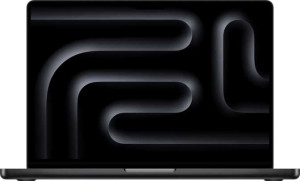
The MacBook Pro (2024) 14″ M4 Max is classified as a productivity laptop and carries a weight of 1,620 g, with physical dimensions of 312 mm wide, 221 mm deep, and 15 mm thick, yielding a total volume of 1,034.28 cm³. It operates within a temperature range of 10 °C to 45 °C and features a fanless design alongside a backlit keyboard. The chassis is neither weather-sealed nor built to a rugged standard.
The laptop features a 14.2″ OLED/AMOLED panel with a resolution of 3024 x 1964 px at 254 ppi, paired with a 120 Hz refresh rate and a typical brightness of 1,000 nits. The contrast ratio of 1,000,000:1 is a notable characteristic of the display technology used. The screen does not support touch input and lacks an anti-reflection coating, but the system can drive up to four external displays simultaneously.
At the core of this configuration sits a 16-thread CPU running twelve cores at 4.51 GHz and four cores at 2.59 GHz, built on a 3 nm semiconductor process and supporting both 64-bit operation and multithreading. Memory amounts to 128GB of DDR5 RAM running at 8,533 MHz, which also represents the maximum supported capacity. Storage is handled by an 8,192GB NVMe SSD using flash technology, rounding out a performance profile oriented toward demanding workloads.
Wired connectivity is built around three USB 4 40Gbps ports (USB-C form factor) and a single HDMI output, while there are no USB-A, Thunderbolt 3 or 4, DisplayPort, mini DisplayPort, RJ45, or VGA ports present. Wireless connectivity covers Wi-Fi 6E (802.11ax) alongside backward-compatible Wi-Fi 6, 5, and 4 standards, complemented by Bluetooth 5.3 and AirPlay support. An external memory slot is also included for removable storage expansion.
The laptop houses a 72.4 Wh battery with a rated life of 18 hours, providing a full day of use on a single charge. Charging is handled via a MagSafe power adapter, and the USB ports support sleep-and-charge functionality, allowing connected devices to be charged even when the laptop is not in active use.
Audio is covered by stereo speakers with Dolby Atmos support, a three-microphone array, and a 3.5 mm headphone jack, while there is no S/PDIF output or optical disc drive. The 12MP front camera is accompanied by both a fingerprint scanner and 3D facial recognition for biometric authentication, though voice commands are not supported. Motion and location sensors — including a gyroscope, accelerometer, compass, and GPS — are absent, and neither ray tracing, DLSS, nor a stylus is included.
The chip is classified for both laptop and desktop use and is built with 28,000 million transistors, employing big.LITTLE technology and Heterogeneous Multi-Processing (HMP) for workload distribution across core types. Memory runs across 4 channels with a maximum bandwidth of 546 GB/s and a top RAM speed of 4,266 MHz, though ECC memory is not supported. Security provisions include TrustZone and NX bit support, integrated graphics are present, and there are no USB 3.0 ports on the device.