Design:
| weight |
1620 g |
| Uses a fanless design |
✕ |
| Has a backlit keyboard |
✓ |
| volume |
1034.28 cm³ |
| width |
312 mm |
| height |
221 mm |
| thickness |
15 mm |
| maximum operating temperature |
35 °C |
| lowest potential operating temperature |
10 °C |
| is weather-sealed (splashproof) |
✕ |
| has a rugged build |
✕ |
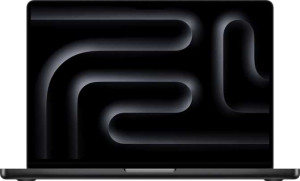
The Apple MacBook Pro (2024) 14″ M4 Max has a compact physical footprint of 312 × 221 mm with a thickness of just 15 mm and a total volume of 1,034.28 cm³, weighing 1,620 g. It includes a backlit keyboard and relies on an active cooling system rather than a fanless design. The laptop is not weather-sealed or ruggedized, and it operates within a temperature range of 10 °C to 35 °C.
Display:
| screen size |
14.2" |
| resolution |
3024 x 1964 px |
| pixel density |
254 ppi |
| has a touch screen |
✕ |
| brightness (typical) |
1000 nits |
| refresh rate |
120Hz |
| contrast ratio |
1000000:1 |
| has anti-reflection coating |
✕ |
| supported displays |
4 |
The 14.2″ display outputs a resolution of 3,024 × 1,964 px at a pixel density of 254 ppi, paired with a 120Hz refresh rate and a typical brightness of 1,000 nits. The panel achieves a contrast ratio of 1,000,000:1, though it does not include an anti-reflection coating and does not support touch input. The system can drive up to four external displays simultaneously.
Performance:
| RAM |
36GB |
| Uses flash storage |
✓ |
| internal storage |
8192GB |
| CPU speed |
10 x 4.05 & 4 x 2.75 GHz |
| CPU threads |
14 threads |
| Is an NVMe SSD |
✓ |
| uses multithreading |
✓ |
| maximum memory amount |
128GB |
| DDR memory version |
5 |
| semiconductor size |
3 nm |
| Supports 64-bit |
✓ |
The system is built on a 3nm semiconductor process and features a 14-core CPU running at 10 cores × 4.05 GHz and 4 cores × 2.75 GHz, with 14 threads and support for multithreading and 64-bit processing. It comes with 36GB of DDR5 memory, expandable up to 128GB, alongside 8,192GB of NVMe flash storage. Both the CPU architecture and memory configuration are oriented toward sustained workloads that benefit from high thread counts and fast storage access.
Benchmarks:
| Geekbench 6 result (multi) |
23455 |
| Geekbench 6 result (single) |
4007 |
| PassMark result |
38870 |
| PassMark result (single) |
4531 |
In Geekbench 6, the system scores 4,007 in the single-core test and 23,455 in the multi-core test, reflecting the throughput available across all CPU cores. PassMark results follow a similar pattern, with a single-core score of 4,531 and an overall PassMark result of 38,870, capturing broader CPU performance across multi-threaded workloads.
Connectivity:
| USB 3.2 Gen 2 ports (USB-C) |
0 |
| USB 3.2 Gen 2 ports (USB-A) |
0 |
| USB 4 20Gbps ports |
0 |
| USB 4 40Gbps ports |
3 |
| Thunderbolt 4 ports |
0 |
| USB 3.2 Gen 1 ports (USB-C) |
0 |
| USB 3.2 Gen 1 ports (USB-A) |
0 |
| Thunderbolt 3 ports |
0 |
| has an HDMI output |
✓ |
| Has USB Type-C |
✓ |
| supports Wi-Fi |
✓ |
| Wi-Fi version |
Wi-Fi 6E (802.11ax), Wi-Fi 6 (802.11ax), Wi-Fi 5 (802.11ac), Wi-Fi 4 (802.11n) |
| has an external memory slot |
✓ |
| Bluetooth version |
5.3 |
| RJ45 ports |
0 |
| HDMI ports |
1 |
| DisplayPort outputs |
0 |
| has AirPlay |
✓ |
| mini DisplayPort outputs |
0 |
| has a VGA connector |
✕ |
Wired connectivity centers on three USB 4 40Gbps ports (USB-C form factor) and one HDMI output, while there are no USB-A, DisplayPort, mini DisplayPort, RJ45, or VGA connections present. An external memory slot is included alongside AirPlay support for wireless display output. On the wireless side, the machine supports Wi-Fi 6E (802.11ax) along with Wi-Fi 6, Wi-Fi 5, and Wi-Fi 4, and pairs with devices over Bluetooth 5.3.
Battery:
| Battery life |
18 hours |
| battery size |
72.4 Wh |
| Has sleep-and-charge USB ports |
✓ |
| Has a MagSafe power adapter |
✓ |
The 72.4 Wh battery is rated for 18 hours of battery life, and the laptop charges via a MagSafe power adapter. USB ports remain active while the system is asleep, allowing connected devices to charge without the machine being fully powered on.
Features:
| has stereo speakers |
✓ |
| has a socket for a 3.5 mm audio jack |
✓ |
| megapixels (front camera) |
12MP |
| supports ray tracing |
✕ |
| supports DLSS |
✕ |
| has Dolby Atmos |
✓ |
| Stylus included |
✕ |
| Has a fingerprint scanner |
✓ |
| number of microphones |
3 |
| Uses 3D facial recognition |
✓ |
| has voice commands |
✓ |
| has a front camera |
✓ |
| Has S/PDIF Out port |
✕ |
| has a gyroscope |
✕ |
| has GPS |
✕ |
| has an accelerometer |
✕ |
| has a compass |
✕ |
| Has an optical disc drive |
✕ |
Audio is handled by stereo speakers with Dolby Atmos support, a 3.5 mm headset jack, and a three-microphone array, while there is no S/PDIF output or optical disc drive. The 12MP front camera is accompanied by both a fingerprint scanner and 3D facial recognition, and the system supports voice commands. Ray tracing, DLSS, and a stylus are not supported, and the laptop does not include a gyroscope, accelerometer, GPS, or compass.
Miscellaneous:
| Thermal Design Power (TDP) |
80W |
| Type |
Laptop, Desktop |
| Supports ECC memory |
✕ |
| maximum memory bandwidth |
410 GB/s |
| Uses HMP |
✓ |
| Has TrustZone |
✓ |
| Has NX bit |
✓ |
| Has integrated graphics |
✓ |
| number of transistors |
28000 million |
| Uses big.LITTLE technology |
✓ |
| RAM speed (max) |
6400 MHz |
The chip carries a TDP of 80W and is built with 28,000 million transistors, incorporating integrated graphics and using both big.LITTLE and HMP technologies for workload distribution across core types. RAM runs at up to 6,400 MHz with a maximum memory bandwidth of 410 GB/s, though ECC memory is not supported. Security features include TrustZone and NX bit, and the CPU is classified for use in both laptop and desktop form factors.