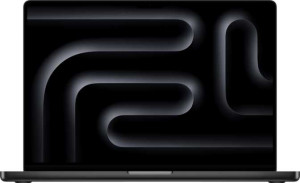
Apple MacBook Pro (2024) 16" Apple M4 Max (16-core CPU / 40-core GPU) / 64GB RAM / 8TB SSD specifications and in-depth review

Apple MacBook Pro (2024) 16" Apple M4 Max (16-core CPU / 40-core GPU) / 64GB RAM / 8TB SSD

Manufacturer: Apple

Apple's MacBook Pro (2024) in the 16″ configuration represents the top of the M4 generation lineup, built around the M4 Max system-on-chip. Aimed at users who place heavy demands on both processing and graphics throughput, it ships with 64GB of unified memory running at up to 4266 MHz across four memory channels, paired with 8TB of internal NVMe flash storage. The chassis measures 355 × 248 × 16 mm and weighs 2150 g, with an active cooling system rather than a fanless design.

The 16.2″ Liquid Retina XDR panel delivers a resolution of 3456 × 2234 px at 254 ppi, a typical brightness of 1000 nits, and a contrast ratio of 1,000,000:1, with a 120Hz adaptive refresh rate. Connectivity is handled by three USB 4 40Gbps ports alongside one HDMI output, Wi-Fi 6E, and Bluetooth 5.3, while an SD card slot provides external memory expansion. Battery capacity is rated at 100 Wh with up to 21 hours of declared battery life, and MagSafe charging is supported. Additional features include a three-microphone array, Dolby Atmos audio, a fingerprint scanner, Face ID-style facial recognition, and a front-facing camera.

Pros
  • The 16-core CPU with 12 high-performance cores clocked at 4.51 GHz and 4 efficiency cores, combined with 16 threads and multithreading support, enables sustained parallel workloads across demanding tasks
  • 8TB of NVMe flash storage provides substantial on-device capacity, removing the need for most users to rely on external drives for large project libraries
  • A 120Hz refresh rate paired with a 1,000,000:1 contrast ratio and 1000 nits of typical brightness makes the display well-suited to prolonged visual work
  • Three USB 4 40Gbps ports offer high-bandwidth wired connectivity, and the system can drive up to four external displays simultaneously
  • A rated battery life of 21 hours from a 100 Wh cell means the machine can sustain full workdays without access to a power source
  • Both a fingerprint scanner and 3D facial recognition are included, giving users two hardware-level authentication options
Cons
  • At 2150 g the laptop sits on the heavier end for a portable machine, which may be noticeable during frequent travel
  • There are no USB-A ports of any generation, requiring adapters for accessories that use the older connector type
  • The display lacks an anti-reflection coating, which can reduce visibility in environments with strong ambient or direct light
  • The operating temperature ceiling of 35 °C means the machine is not rated for use in hotter uncontrolled environments
  • No RJ45 port is present, so wired Ethernet connections require an external adapter
Who is this for?

This machine is well-matched to users who regularly push through compute-intensive workloads — such as video editing, 3D rendering, or large-scale software compilation — thanks to its 16-core CPU with multithreading and a maximum memory bandwidth of 546 GB/s. The combination of 64GB of DDR5 unified memory and 8TB of NVMe storage means professionals handling large project files or extensive media libraries can work entirely on-device without constant reliance on external drives. The 21-hour rated battery life also makes it a reasonable fit for users who work for extended periods away from a fixed desk, while support for up to four external displays suits those who prefer an expansive multi-monitor setup at a workstation.

Who is this NOT for?

Users who prioritize portability above all else may find the 2150 g weight and 16 mm profile inconvenient for frequent travel or commuting, particularly when carried alongside other equipment. The absence of USB-A ports and an RJ45 jack means anyone relying on legacy peripherals or wired Ethernet will need to carry additional adapters, which undermines the convenience of a mobile setup. The machine is also unsuitable for use in warmer uncontrolled environments, as its maximum operating temperature of 35 °C leaves little headroom in hot climates or outdoor conditions; similarly, the lack of weather sealing rules it out for scenarios where exposure to moisture is a possibility.

Design:

weight 2150 g
Uses a fanless design
Has a backlit keyboard
volume 1408.64 cm³
width 355 mm
height 248 mm
thickness 16 mm
maximum operating temperature 35 °C
lowest potential operating temperature 10 °C
is weather-sealed (splashproof)

The MacBook Pro (2024) 16″ has a footprint of 355 × 248 mm with a thickness of just 16 mm and a total volume of 1408.64 cm³, while tipping the scales at 2150 g. It uses an active cooling system rather than a fanless design and is not weather-sealed. The keyboard includes backlighting, and the machine is rated for operation in ambient temperatures ranging from 10 °C up to a maximum of 35 °C.

Display:

screen size 16.2"
resolution 3456 x 2234 px
pixel density 254 ppi
has a touch screen
brightness (typical) 1000 nits
refresh rate 120Hz
contrast ratio 1000000:1
has anti-reflection coating
supported displays 4

The 16.2″ screen renders at a resolution of 3456 × 2234 px, yielding a pixel density of 254 ppi, and supports a 120Hz refresh rate alongside a contrast ratio of 1,000,000:1 and a typical brightness of 1000 nits. The display does not include a touch layer or an anti-reflection coating, and the system can drive up to four external displays simultaneously.

Performance:

RAM 64GB
Uses flash storage
internal storage 8192GB
CPU speed 12 x 4.51 & 4 x 2.59 GHz
CPU threads 16 threads
Is an NVMe SSD
uses multithreading
maximum memory amount 128GB
DDR memory version 5
semiconductor size 3 nm
Supports 64-bit

The processor runs 16 threads across a 16-core configuration clocked at 12 cores × 4.51 GHz and 4 cores × 2.59 GHz, with multithreading and 64-bit support both active. The chip is fabricated on a 3 nm process and paired with 64GB of DDR5 unified memory, expandable up to 128GB. Storage comes in at 8192GB via an NVMe flash SSD, rounding out a performance profile built entirely around solid-state, high-bandwidth components.

Benchmarks:

Connectivity:

USB 3.2 Gen 2 ports (USB-C) 0
USB 3.2 Gen 2 ports (USB-A) 0
USB 4 20Gbps ports 0
USB 4 40Gbps ports 3
Thunderbolt 4 ports 0
USB 3.2 Gen 1 ports (USB-C) 0
USB 3.2 Gen 1 ports (USB-A) 0
Thunderbolt 3 ports 0
has an HDMI output
Has USB Type-C
supports Wi-Fi
Wi-Fi version Wi-Fi 6E (802.11ax), Wi-Fi 6 (802.11ax), Wi-Fi 5 (802.11ac), Wi-Fi 4 (802.11n)
has an external memory slot
Bluetooth version 5.3
RJ45 ports 0
HDMI ports 1
DisplayPort outputs 0
has AirPlay
mini DisplayPort outputs 0
has a VGA connector

Wired connectivity centers on three USB 4 40Gbps ports (USB-C form factor) and a single HDMI output; there are no USB-A, Thunderbolt 3 or 4, DisplayPort, mini DisplayPort, or RJ45 ports, nor a VGA connector. Wireless options include Wi-Fi 6E with backward compatibility down to Wi-Fi 4, paired with Bluetooth 5.3 and AirPlay support. An external memory slot is also present for removable storage media.

Battery:

Battery life 21 hours
battery size 100 Wh
Has sleep-and-charge USB ports
Has a MagSafe power adapter

The battery carries a capacity of 100 Wh and is rated for up to 21 hours of use on a single charge. Charging is handled via a MagSafe power adapter, and the USB ports support sleep-and-charge functionality, allowing connected devices to be powered even when the machine is not in active use.

Features:

has stereo speakers
has a socket for a 3.5 mm audio jack
has Dolby Atmos
Stylus included
Has a fingerprint scanner
number of microphones 3
Uses 3D facial recognition
has voice commands
has a front camera
Has S/PDIF Out port
has a gyroscope
has GPS
has an accelerometer
has a compass
Has an optical disc drive

Audio output is handled by stereo speakers with Dolby Atmos support, complemented by a 3.5 mm headset jack; there is no S/PDIF output or optical disc drive. A three-microphone array is built in alongside a front camera, and the system supports voice commands. Security features include a fingerprint scanner and 3D facial recognition, while no stylus is included. Motion and location sensors — gyroscope, accelerometer, compass, and GPS — are absent from this configuration.

Miscellaneous:

memory channels 4
Type Laptop, Desktop
Supports ECC memory
maximum memory bandwidth 546 GB/s
Uses HMP
Has TrustZone
Has NX bit
Has integrated graphics
number of transistors 28000 million
Uses big.LITTLE technology
RAM speed (max) 4266 MHz

The chip is built with 28,000 million transistors and employs both big.LITTLE technology and Heterogeneous Multi-Processing (HMP) to distribute workloads across its core types. Memory runs across four channels at up to 4266 MHz, delivering a maximum memory bandwidth of 546 GB/s, though ECC memory is not supported. The processor includes integrated graphics and incorporates hardware security provisions in the form of TrustZone and an NX bit. It is classified for use in both laptop and desktop form factors.

Final Verdict

The Apple MacBook Pro (2024) 16″ with M4 Max is a purpose-built machine for professional workloads that demand sustained, high-throughput computing. Its 16-core CPU, 64GB of DDR5 unified memory, and 546 GB/s memory bandwidth combine to form a platform that handles memory-intensive and parallel tasks without compromise, while 8TB of NVMe storage and up to 21 hours of battery life add meaningful on-the-go practicality for those who can accommodate its weight. The connectivity and port selection will require adapters in many real-world setups, and its operating environment limits are worth noting, but these trade-offs are characteristic of a device optimized for raw capability rather than broad versatility. For users whose work consistently demands this level of processing and storage headroom, the MacBook Pro 16″ M4 Max represents a well-defined, unambiguous choice.