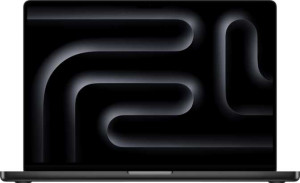
Design:
| Type |
Productivity |
| weight |
2150 g |
| Uses a fanless design |
✓ |
| Has a backlit keyboard |
✓ |
| volume |
1408.64 cm³ |
| width |
355 mm |
| height |
248 mm |
| thickness |
16 mm |
| maximum operating temperature |
35 °C |
| lowest potential operating temperature |
10 °C |
| is weather-sealed (splashproof) |
✕ |
| has a rugged build |
✕ |
The MacBook Pro (2024) 16″ is classified as a productivity laptop and adopts a fanless design, measuring 355mm wide, 248mm deep, and just 16mm thick, with a total volume of 1408.64cm³ and a weight of 2150g. It includes a backlit keyboard for use in low-light conditions. Operating temperatures range from 10°C to a maximum of 35°C, and the build is neither weather-sealed nor ruggedized.
Display:
| screen size |
16.2" |
| resolution |
3456 x 2234 px |
| pixel density |
254 ppi |
| has a touch screen |
✕ |
| brightness (typical) |
1000 nits |
| refresh rate |
120Hz |
| contrast ratio |
1000000:1 |
| has anti-reflection coating |
✕ |
| supported displays |
4 |
The 16.2-inch display renders at a resolution of 3456 x 2234 pixels, resulting in a pixel density of 254 ppi, and supports a 120Hz refresh rate for smooth on-screen motion. Typical brightness is rated at 1000 nits, and the contrast ratio of 1,000,000:1 allows for a wide range between the darkest and brightest areas of the image. The panel does not include a touch screen or an anti-reflection coating, and the system can drive up to four external displays simultaneously.
Performance:
| RAM |
36GB |
| RAM speed |
8533 MHz |
| Uses flash storage |
✓ |
| internal storage |
8192GB |
| CPU speed |
10 x 4.05 & 4 x 2.75 GHz |
| CPU threads |
14 threads |
| Is an NVMe SSD |
✓ |
| uses multithreading |
✓ |
| maximum memory amount |
128GB |
| DDR memory version |
5 |
| semiconductor size |
3 nm |
| has XeSS (XMX) |
✕ |
| Supports 64-bit |
✓ |
The system is equipped with 36GB of DDR5 unified memory running at 8533MHz, with the configuration supporting a maximum of 128GB. The 14-core CPU spans ten cores clocked at 4.05GHz and four cores at 2.75GHz, operating across 14 threads with multithreading enabled, and the chip is built on a 3nm semiconductor process. Storage comes in the form of an 8192GB NVMe SSD using flash technology, and the processor supports 64-bit computing. XeSS (XMX) acceleration is not available on this configuration.
Benchmarks:
| Geekbench 6 result (multi) |
23455 |
| Geekbench 6 result (single) |
4007 |
| PassMark result |
38870 |
| PassMark result (single) |
4531 |
In Geekbench 6, the system scores 4007 in the single-core test and 23455 in the multi-core test, reflecting the combined output of its 14-core CPU configuration. PassMark results follow a similar pattern, with a single-core score of 4531 and an overall PassMark result of 38870.
Connectivity:
| USB 3.2 Gen 2 ports (USB-C) |
0 |
| USB 3.2 Gen 2 ports (USB-A) |
0 |
| USB 4 20Gbps ports |
0 |
| USB 4 40Gbps ports |
3 |
| Thunderbolt 4 ports |
0 |
| USB 3.2 Gen 1 ports (USB-C) |
0 |
| USB 3.2 Gen 1 ports (USB-A) |
0 |
| Thunderbolt 3 ports |
0 |
| has an HDMI output |
✓ |
| Has USB Type-C |
✓ |
| supports Wi-Fi |
✓ |
| Wi-Fi version |
Wi-Fi 6E (802.11ax), Wi-Fi 6 (802.11ax), Wi-Fi 5 (802.11ac), Wi-Fi 4 (802.11n) |
| has an external memory slot |
✓ |
| Bluetooth version |
5.3 |
| RJ45 ports |
0 |
| HDMI ports |
1 |
| DisplayPort outputs |
0 |
| has AirPlay |
✓ |
| mini DisplayPort outputs |
0 |
| has a VGA connector |
✕ |
Wired connectivity centers on three USB 4 40Gbps ports (USB-C form factor) and a single HDMI output, while there are no USB-A ports, no Thunderbolt 3 or 4 ports, no DisplayPort or mini DisplayPort outputs, and no RJ45 ethernet port. Wireless connectivity covers Wi-Fi 6E (802.11ax) along with backward-compatible Wi-Fi 6, Wi-Fi 5, and Wi-Fi 4 standards, paired with Bluetooth 5.3. The machine also includes an external memory slot and supports AirPlay, but does not feature a VGA connector.
Battery:
| Battery life |
21 hours |
| battery size |
100 Wh |
| Has sleep-and-charge USB ports |
✓ |
| Has a MagSafe power adapter |
✓ |
The laptop carries a 100Wh battery with a rated life of up to 21 hours. Charging is handled via a MagSafe power adapter, and the USB ports support sleep-and-charge functionality, allowing connected devices to be charged even when the laptop is not in active use.
Features:
| has stereo speakers |
✓ |
| has a socket for a 3.5 mm audio jack |
✓ |
| megapixels (front camera) |
12MP |
| supports ray tracing |
✕ |
| supports DLSS |
✕ |
| has Dolby Atmos |
✓ |
| Stylus included |
✕ |
| Has a fingerprint scanner |
✓ |
| number of microphones |
3 |
| Uses 3D facial recognition |
✓ |
| has voice commands |
✓ |
| has a front camera |
✓ |
| Has S/PDIF Out port |
✕ |
| has a gyroscope |
✕ |
| has GPS |
✕ |
| has an accelerometer |
✕ |
| has a compass |
✕ |
| Has an optical disc drive |
✕ |
Audio output is handled by stereo speakers with Dolby Atmos support, and a 3.5mm headphone jack is included, though there is no S/PDIF output or optical disc drive. The 12MP front camera is accompanied by three microphones and supports voice commands. Security features include both a fingerprint scanner and 3D facial recognition. The laptop does not support ray tracing, DLSS, or come with a stylus, and it lacks motion and location sensors such as a gyroscope, accelerometer, compass, and GPS.
Miscellaneous:
| Thermal Design Power (TDP) |
80W |
| Type |
Laptop, Desktop |
| Supports ECC memory |
✕ |
| maximum memory bandwidth |
410 GB/s |
| Uses HMP |
✓ |
| Has TrustZone |
✓ |
| Has NX bit |
✓ |
| Has integrated graphics |
✓ |
| number of transistors |
28000 million |
| Uses big.LITTLE technology |
✓ |
| RAM speed (max) |
6400 MHz |
The chip carries a Thermal Design Power of 80W and is classified for use in both laptop and desktop configurations. It contains 28,000 million transistors and employs big.LITTLE technology alongside Heterogeneous Multi-Processing (HMP) to manage its mix of performance and efficiency cores. Maximum memory bandwidth reaches 410GB/s, while the maximum supported RAM speed is 6400MHz; ECC memory is not supported. The processor includes integrated graphics, and security is reinforced through TrustZone and NX bit support.