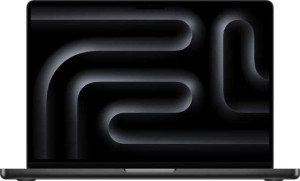
The Apple MacBook Pro (2026) 14″ is a productivity laptop with a slim 15 mm profile and dimensions of 312 × 221 mm, keeping its total volume to 1,034.28 cm³ and its weight at 1,620 g. It includes a backlit keyboard and uses an active cooling system rather than a fanless design. Operating temperatures range from 10 °C to 35 °C, and the build does not carry weather sealing or a ruggedized construction.
The 14.2″ display outputs a 3024 x 1964 px resolution at 254 ppi, paired with a 120Hz refresh rate and a typical brightness of 1,000 nits. Its 1,000,000:1 contrast ratio and anti-reflection coating contribute to consistent clarity across varied lighting conditions, while the panel does not support touch input. The GPU can drive up to four external displays simultaneously.
The processor runs 18 threads across two clusters — 6 cores at 4.6 GHz and 12 cores at 3.2 GHz — built on a 3 nm semiconductor process with multithreading and 64-bit support. Memory tops out at 128GB of DDR5 RAM, while internal storage reaches 8,192GB via an NVMe SSD using flash technology. XeSS (XMX) is not supported.
Wired connectivity centers on three USB 4 40Gbps ports (USB-C form factor) and a single HDMI output, with no USB-A, Thunderbolt 3 or 4, DisplayPort, mini DisplayPort, RJ45, or VGA connections present. Wireless support covers Wi-Fi 7 (802.11be) alongside Wi-Fi 6E, 6, 5, and 4, complemented by Bluetooth 6 and AirPlay. An external memory slot is also included.
The 72.4 Wh battery is rated for 20 hours of use on a single charge, and the laptop charges via a MagSafe power adapter. USB ports support sleep-and-charge, allowing connected devices to be powered even when the laptop is not in active use.
Audio is handled by stereo speakers with Dolby Atmos support, a 3.5 mm headset jack, and a three-microphone array, though there is no S/PDIF output or optical disc drive. The 12MP front camera enables video calls but does not include 3D facial recognition, while a fingerprint scanner and voice commands cover biometric and hands-free access. Ray tracing, DLSS, and a stylus are not supported, and the laptop does not include GPS, a gyroscope, accelerometer, or compass.
Graphics are handled by the integrated Apple M5 Max GPU, with no discrete or external GPU in play, and the chip employs big.LITTLE technology alongside Heterogeneous Multi-Processing (HMP) to distribute workloads across its core types. Maximum memory bandwidth reaches 614 GB/s, though ECC memory is not supported and the CPU multiplier is locked. Security features include TrustZone and NX bit support, rounding out a laptop-class platform designed with hardware-level protection in mind.