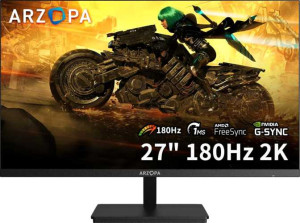
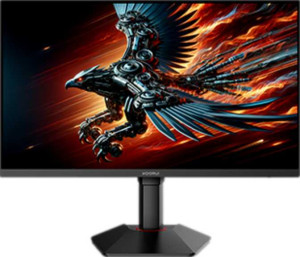
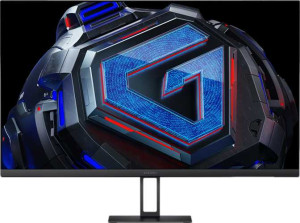
The Arzopa M1RC 27-inch monitor uses an IPS LCD panel with LED backlighting, delivering a 2560 x 1440 resolution at 108 ppi for a noticeably sharp image across its 27-inch screen. It runs at a 180Hz refresh rate with a 5ms response time, and supports VESA Adaptive Sync to help keep motion consistent during fast-moving content. Viewing angles reach 178 degrees both horizontally and vertically, allowing the image to remain relatively accurate when viewed off-center. The panel does not feature an anti-glare coating, a matte surface, or a glossy finish designation, and it does not support touch input.
The Arzopa M1RC is classified as a gaming monitor and supports tilt adjustment, allowing the screen angle to be changed to suit different viewing positions. It is also compatible with VESA mounting, making it possible to attach to third-party arms or wall mounts. The stand does not offer swivel movement, and the monitor does not support portrait mode rotation.
The Arzopa M1RC produces 16.7 million colors through an 8-bit panel, with a 110% sRGB coverage rating that extends slightly beyond the standard sRGB gamut. Typical brightness is rated at 350 nits, and the contrast ratio sits at 1000:1. The monitor does not support hardware color calibration.
The Arzopa M1RC offers a straightforward set of wired connections, including one HDMI 2.0 port, one DisplayPort output, one USB Type-C port, one USB port, and a 3.5mm audio jack. There are no mini DisplayPort, DVI, or VGA connectors, and the monitor does not support Thunderbolt. Wireless connectivity is not available, as the monitor lacks Wi-Fi, Ethernet, and AirPlay support.
The Arzopa M1RC draws 45W during normal operation and drops to a low 0.5W in standby mode, keeping idle power consumption minimal when the display is not in active use.
The Arzopa M1RC is focused on core display functionality and does not include several features found on more multipurpose monitors. It has no built-in speakers, no support for Dolby Digital, Dolby Digital Plus, or DTS Surround, keeping audio output entirely dependent on external devices. There is also no Picture-in-Picture mode, no ambient light sensor, no front camera, no remote control, and no built-in smart TV platform.