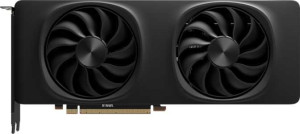
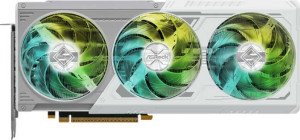
ASRock Arc B580 Challenger OC specifications and in-depth review

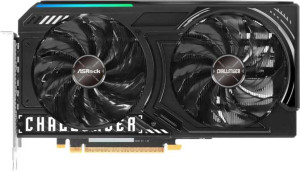
ASRock Arc B580 Challenger OC

Manufacturer: ASRock

The ASRock Arc B580 Challenger OC is a discrete graphics card based on Intel's Xe2-HPG architecture, manufactured on a 6 nm process and housing 21,700 million transistors. It ships with 12GB of GDDR6 memory across a 192-bit bus, delivering a maximum bandwidth of 460 GB/s at an effective memory speed of 19,000 MHz — a notably wide memory configuration for its segment. The card measures 249 mm in length and 132 mm in height, runs a base GPU clock of 1700 MHz with a boost ceiling of 2740 MHz, and carries a TDP of 190W.

On the feature side, the Arc B580 Challenger OC supports DirectX 12 Ultimate, OpenGL 4.6, and OpenCL 3, alongside hardware-accelerated ray tracing and Intel's XeSS upscaling via XMX engines. Its 2560 shading units are complemented by 160 texture mapping units and 80 render output units, yielding a texture rate of 438.4 GTexels/s and a pixel rate of 219.2 GPixel/s. Display output is handled through one HDMI 2.1 port and three DisplayPort connectors, allowing up to four simultaneous displays. The card connects via PCIe 4.0 and includes RGB lighting, while ECC memory support is also present.

Pros
  • Supports up to four simultaneous displays through a combination of three DisplayPort outputs and one HDMI 2.1 port
  • 12GB of GDDR6 VRAM across a 192-bit bus provides a large memory pool for memory-intensive workloads
  • ECC memory support helps maintain data integrity during extended operation
  • Hardware-accelerated ray tracing and XeSS upscaling via XMX engines are both included
  • DirectX 12 Ultimate, OpenGL 4.6, and OpenCL 3 support covers a wide range of graphics and compute use cases
  • RGB lighting is present for users who want visual customization
Cons
  • DLSS is not supported, limiting upscaling options to XeSS only
  • No USB-C, DVI, or mini DisplayPort outputs, which may not suit all monitor setups
  • A 190W TDP requires adequate system power delivery and case airflow, with no liquid cooling option available
  • The card does not include air-water cooling, relying solely on its air cooler for thermal management
Who is this for?

This card is well-suited to users who need a capable desktop graphics solution for ray-traced rendering and compute workloads, given its hardware ray tracing support, 14.03 TFLOPS of floating-point performance, and OpenCL 3 compatibility. The generous 12GB GDDR6 VRAM with 460 GB/s of bandwidth makes it a reasonable fit for content creators and developers working with large textures or memory-intensive pipelines. Its four-display output capacity also makes it a practical choice for multi-monitor desktop setups requiring both DisplayPort and HDMI 2.1 connectivity.

Who is this NOT for?

Users who rely on DLSS-based upscaling will find this card unsuitable, as that technology is not supported — only XeSS is available. The 190W TDP and air-only cooling solution make it a poor match for small form factor or thermally constrained builds where heat dissipation is limited. Additionally, users with existing monitors or peripherals that depend on USB-C, DVI, or mini DisplayPort connections will need to account for the complete absence of those outputs on this card.

Performance:

GPU clock speed 1700 MHz
GPU turbo 2740 MHz
pixel rate 219.2 GPixel/s
floating-point performance 14.03 TFLOPS
texture rate 438.4 GTexels/s
GPU memory speed 2400 MHz
shading units 2560
texture mapping units (TMUs) 160
render output units (ROPs) 80

The ASRock Arc B580 Challenger OC operates at a base GPU clock of 1700 MHz, with a boost frequency reaching up to 2740 MHz. Its 2560 shading units are supported by 160 texture mapping units and 80 render output units, producing a texture rate of 438.4 GTexels/s and a pixel rate of 219.2 GPixel/s. Floating-point performance is rated at 14.03 TFLOPS, while the GPU memory runs at 2400 MHz to help sustain throughput across workloads.

Memory:

effective memory speed 19000 MHz
maximum memory bandwidth 460 GB/s
VRAM 12GB
GDDR version GDDR6
memory bus width 192-bit
Supports ECC memory

The card is equipped with 12GB of GDDR6 VRAM running across a 192-bit memory bus, reaching an effective memory speed of 19,000 MHz and a maximum bandwidth of 460 GB/s. ECC memory support is also included, which helps maintain data integrity during operation.

Features:

DirectX version DirectX 12 Ultimate
OpenGL version 4.6
OpenCL version 3
Supports multi-display technology
supports ray tracing
Supports 3D
supports DLSS
has XeSS (XMX)
has LHR
has RGB lighting
supported displays 4

The card supports DirectX 12 Ultimate, OpenGL 4.6, and OpenCL 3, covering a broad range of graphics and compute workloads. Hardware-accelerated ray tracing is included, as is stereoscopic 3D and multi-display support for up to four simultaneous outputs. Upscaling is handled through XeSS via XMX engines, while DLSS is not supported. The card does not feature LHR, and RGB lighting is present on the board.

Ports:

has an HDMI output
HDMI ports 1
HDMI version HDMI 2.1
DisplayPort outputs 3
USB-C ports 0
DVI outputs 0
mini DisplayPort outputs 0

Display connectivity is provided through one HDMI 2.1 port and three DisplayPort outputs, giving a total of four available display connections. There are no USB-C, DVI, or mini DisplayPort outputs on this card.

General info:

GPU architecture Xe2-HPG
Thermal Design Power (TDP) 190W
PCI Express (PCIe) version 4
semiconductor size 6 nm
number of transistors 21700 million
Has air-water cooling
width 249 mm
height 132 mm

Built on the Xe2-HPG architecture and fabricated using a 6 nm process, the card packs 21,700 million transistors and connects via PCIe 4.0. It carries a TDP of 190W and does not include liquid cooling, relying instead on air cooling. Physically, the card measures 249 mm in width and 132 mm in height.
Final Verdict

The ASRock Arc B580 Challenger OC is a desktop graphics card that brings together a well-rounded specification set under the Xe2-HPG architecture, with its 12GB of GDDR6 VRAM and 460 GB/s memory bandwidth standing out as particularly strong attributes for memory-intensive tasks. Hardware ray tracing, XeSS upscaling, DirectX 12 Ultimate support, and four-display output capability round out a feature set that suits multi-monitor workstations and compute-oriented users alike. That said, the absence of DLSS and the card's reliance on air cooling within a 190W thermal envelope mean it asks something of the system it sits in. For users whose workflows align with what this card offers, the Arc B580 Challenger OC presents a technically coherent and feature-complete option within its category.

Popular Comparisons

ASRock Arc B580 Challenger OC
VS
MSI GeForce RTX 5050 Ventus 2X OC
ASRock Arc B580 Challenger OC
VS
Asus TUF Gaming GeForce RTX 5060
ASRock Arc B580 Challenger OC
VS
Intel Arc B580
Intel Arc B580
ASRock Arc B580 Challenger OC
VS
ASRock Arc B580 Steel Legend OC
ASRock Arc B580 Challenger OC
VS
Nvidia GeForce RTX 5080
ASRock Arc B580 Challenger OC
VS
Sparkle Arc B580 Titan OC
ASRock Arc B580 Challenger OC
VS
XFX Radeon RX 7900 GRE
ASRock Arc B580 Challenger OC
VS
Sparkle Arc A580 ORC OC Edition