ASRock B860 Challenger Wi-Fi White specifications and in-depth review

ASRock B860 Challenger Wi-Fi White

Manufacturer: ASRock

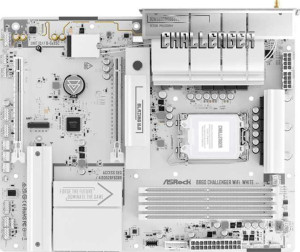
The ASRock B860 Challenger Wi-Fi White is an ATX form factor motherboard built around Intel's LGA 1851 socket and B860 chipset. It ships in a white finish with RGB lighting onboard, and integrates Wi-Fi 7 (802.11be) alongside Bluetooth 5.4, making wired-only setups entirely optional. A three-year warranty accompanies the board, and the BIOS supports easy overclocking out of the box.

Memory support runs up to 256GB of DDR5 across four slots in a dual-channel configuration, with overclocked speeds reaching 8666 MHz. Storage connectivity includes three M.2 sockets, four SATA 3 connectors, and full RAID 0, 1, 5, and 10 support. The rear I/O provides six USB 3.2 Gen 1 Type-A ports, one USB 3.2 Gen 1 Type-C, two USB 2.0 ports, an HDMI 2.1 output, and a single RJ45 port. Expansion is handled by one PCIe 5.0 x16 slot and one PCIe 4.0 x16 slot, while seven fan headers give reasonable control over system thermals.

Pros
  • Supports Wi-Fi 7 alongside all previous Wi-Fi generations down to Wi-Fi 4, covering a wide range of wireless needs
  • Bluetooth 5.4 is built in, removing the need for a separate adapter
  • Four DDR5 slots with support for up to 256GB and overclocked speeds reaching 8666 MHz offer substantial memory headroom
  • Three M.2 sockets combined with four SATA 3 connectors provide flexible storage configuration options
  • RAID 0, 1, 5, and 10 support gives meaningful options for both performance and data redundancy setups
  • Seven fan headers allow for thorough control over system cooling
Cons
  • No USB 3.2 Gen 2 ports on the rear I/O limits high-speed peripheral throughput
  • Absence of Thunderbolt 3 or Thunderbolt 4 ports restricts connectivity for devices that rely on those standards
  • No S/PDIF output means users dependent on digital audio passthrough will need an alternative solution
  • Clear CMOS functionality is not available via a dedicated button, which can complicate BIOS recovery
  • Dual BIOS is not supported, removing a hardware-level fallback in the event of a corrupted firmware flash
Who is this for?

This board suits builders targeting a modern Intel LGA 1851 platform who want a capable ATX foundation without unnecessary complexity. The combination of DDR5 support with up to 256GB capacity and overclocked speeds reaching 8666 MHz makes it a solid fit for memory-intensive workloads such as video editing, 3D rendering, or heavy multitasking. Users who rely on wireless connectivity will benefit from the integrated Wi-Fi 7 module, while those working with multiple storage devices will appreciate the three M.2 sockets, four SATA 3 ports, and broad RAID support. The seven fan headers also make it a reasonable choice for builders who want detailed thermal control in a mid-to-full tower setup.

Who is this NOT for?

This board is not well suited for users who need high-speed USB connectivity at the rear, as the I/O panel lacks USB 3.2 Gen 2 and any USB 4 ports, which could bottleneck workflows involving fast external drives or modern docking stations. It is also a poor match for professionals who depend on Thunderbolt-based peripherals such as high-bandwidth capture cards, external GPUs, or pro audio interfaces, since neither Thunderbolt 3 nor Thunderbolt 4 is available. Additionally, users requiring ECC memory for error-sensitive applications such as scientific computing or financial data processing will need to look elsewhere, as ECC support is absent on this board.

General info:

CPU socket LGA 1851
chipset B860
form factor ATX
release date January 2026
supports Wi-Fi
Wi-Fi version Wi-Fi 4 (802.11n), Wi-Fi 5 (802.11ac), Wi-Fi 6 (802.11ax), Wi-Fi 6E (802.11ax), Wi-Fi 7 (802.11be)
Has Bluetooth
Bluetooth version 5.4
HDMI version HDMI 2.1
Easy to overclock
has RGB lighting
Easy to reset BIOS
Has dual BIOS
has aptX
CPU sockets 1
Has integrated graphics
warranty period 3 years
height 244 mm
width 305 mm
Has integrated CPU

The ASRock B860 Challenger Wi-Fi White is built around the LGA 1851 socket and is compatible with the B860 chipset, arriving in a standard ATX form factor measuring 305 mm wide and 244 mm tall. It supports a single CPU and carries no integrated processor or onboard graphics. Wireless connectivity is handled by a built-in module covering Wi-Fi 4 through Wi-Fi 7 (802.11be), paired with Bluetooth 5.4, though aptX audio codec support is not included. The board features RGB lighting and is noted as easy to overclock, while HDMI 2.1 is available for display output. Dual BIOS is not present, and the clear CMOS function is not supported via a dedicated button. A 3-year warranty is included with the board.

Memory:

maximum memory amount 256GB
overclocked RAM speed 8666 MHz
memory slots 4
DDR memory version 5
memory channels 2
Supports ECC memory

This motherboard supports DDR5 memory across four slots in a dual-channel configuration, with a maximum capacity of 256GB. Overclocked RAM speeds can reach up to 8666 MHz, offering headroom for performance-oriented memory kits. ECC memory is not supported.

Ports:

USB 3.2 Gen 2 ports (USB-A) 0
USB 3.2 Gen 1 ports (USB-A) 6
USB 3.2 Gen 2 ports (USB-C) 0
USB 3.2 Gen 1 ports (USB-C) 1
USB 2.0 ports 2
USB 3.2 Gen 2x2 ports 0
USB 4 40Gbps ports 0
USB 4 20Gbps ports 0
Thunderbolt 4 ports 0
Thunderbolt 3 ports 0
has an HDMI output
DisplayPort outputs 0
RJ45 ports 1
Has USB Type-C
eSATA ports 0
DVI outputs 0
has a VGA connector
PS/2 ports 0

The rear I/O panel includes six USB 3.2 Gen 1 Type-A ports and one USB 3.2 Gen 1 Type-C port, alongside two USB 2.0 ports for legacy device compatibility. There are no USB 3.2 Gen 2, Gen 2x2, USB 4, Thunderbolt 3, or Thunderbolt 4 ports present. Display output is limited to a single HDMI output, with no DisplayPort, DVI, or VGA connectivity available. Networking is handled by one RJ45 port, and there are no eSATA or PS/2 ports on this board.

Connectors:

USB 3.2 Gen 1 ports (through expansion) 2
USB 3.2 Gen 2 ports (through expansion) 0
USB 3.2 Gen 2x2 ports (through expansion) 0
USB-C 3.2 Gen 2 ports (through expansion) 0
USB 2.0 ports (through expansion) 4
SATA 3 connectors 4
fan headers 7
M.2 sockets 3
Has TPM connector
U.2 sockets 0
Has mSATA connector
SATA 2 connectors 0

Internal expansion connectors include two USB 3.2 Gen 1 headers and four USB 2.0 headers, while higher-speed USB 3.2 Gen 2, Gen 2x2, and USB-C Gen 2 internal headers are absent. Storage connectivity is provided by three M.2 sockets and four SATA 3 connectors, with no SATA 2, U.2, or mSATA support. The board also includes seven fan headers for thermal management and a TPM connector for security module installation.

Expansion slots:

PCIe 4.0 x16 slots 1
PCIe 5.0 x16 slots 1
PCIe 3.0 x16 slots 0
PCIe x1 slots 0
PCI slots 0
PCIe 2.0 x16 slots 0
PCIe x4 slots 0
PCIe x8 slots 0

The board provides two full-length expansion slots: one PCIe 5.0 x16 slot and one PCIe 4.0 x16 slot. There are no PCIe 3.0, PCIe 2.0, PCIe x8, PCIe x4, PCIe x1, or legacy PCI slots present, keeping the expansion layout straightforward and focused on modern high-bandwidth use cases.

Audio:

audio channels 7.1
Has S/PDIF Out port
audio connectors 3

The onboard audio supports a 7.1-channel configuration and is served by three analog audio connectors on the rear panel. An S/PDIF output port is not included on this board.

Storage:

Supports RAID 1
Supports RAID 10 (1+0)
Supports RAID 5
Supports RAID 0
Supports RAID 0+1

The board supports RAID 0, 1, 5, and 10 configurations, covering a range of performance and redundancy needs. RAID 0+1 is not supported.
Final Verdict

The ASRock B860 Challenger Wi-Fi White delivers a well-rounded ATX platform for builders committing to Intel's LGA 1851 ecosystem, with its most compelling attributes being DDR5 support scaling up to 256GB at 8666 MHz and integrated Wi-Fi 7, which together give it a clear foothold in modern, connectivity-focused builds. The storage layout is practical and flexible, and the broad RAID support adds a layer of utility that goes beyond typical consumer use. That said, the rear I/O reflects some constraints — the absence of USB 3.2 Gen 2 and Thunderbolt will matter to users with demanding peripheral setups. For builders focused on a clean, capable system with strong wireless connectivity and solid memory performance, this board presents a coherent and technically complete option within the B860 segment.