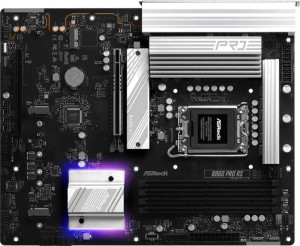
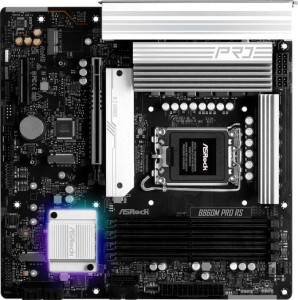
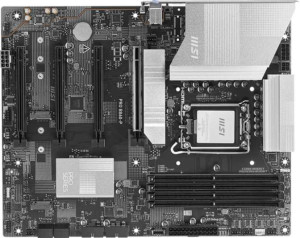
The ASRock B860 Pro RS is built around the LGA 1851 socket and the B860 chipset, housed in a standard ATX form factor measuring 305 mm wide and 254 mm tall. It features a single CPU socket without an integrated processor or integrated graphics, and it does not include Wi-Fi or Bluetooth connectivity. The board supports easy overclocking, includes RGB lighting, and comes equipped with dual BIOS, though manual CMOS reset is not supported. A 3-year warranty is included, rounding out a fairly straightforward set of general characteristics.
The board supports DDR5 memory across four slots in a dual-channel configuration, with a maximum capacity of 256 GB. Standard RAM speeds top out at 5600 MHz, while overclocked profiles can reach up to 8666 MHz. ECC memory is not supported.
The rear I/O offers a total of six USB 3.2 Gen 1 Type-A ports alongside two USB 2.0 ports, and one USB 3.2 Gen 2x2 Type-C port. There are no USB 3.2 Gen 2 Type-A or Type-C ports, and no USB 4 or Thunderbolt connectivity of any kind. Video output is handled through an HDMI port and one DisplayPort output, while VGA, DVI, and eSATA are absent. A single RJ45 port provides wired network connectivity, and there are no PS/2 ports present.
For internal connectivity, the board provides three M.2 sockets and four SATA 3 connectors for storage, with no SATA 2, U.2, or mSATA options available. Expansion headers include two USB 3.2 Gen 1 ports, two USB 3.0 ports, and four USB 2.0 ports, all accessible through panel connectors. Cooling is well catered for with seven fan headers on board, and a TPM connector is also present for security module support.
The board offers two full-length PCIe slots: one PCIe 5.0 x16 and one PCIe 4.0 x16, covering the primary expansion needs for modern add-in cards. There are no PCIe 3.0, 2.0, x8, x4, or x1 slots, and no legacy PCI slots are present.
The board supports 7.1-channel audio with three analog audio connectors on the rear panel. There is no S/PDIF output available.
The board supports four RAID configurations: RAID 0, 1, 5, and 10, covering a range of performance and redundancy setups. RAID 0+1 is not supported.