ASRock Radeon RX 7600 XT Challenger OC specifications and in-depth review

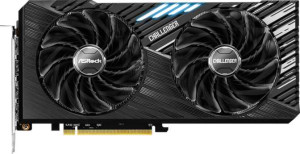
ASRock Radeon RX 7600 XT Challenger OC

Manufacturer: ASRock

The ASRock Radeon RX 7600 XT Challenger OC is a graphics card built on AMD's RDNA 3.0 architecture, manufactured on a 6nm process with 13,300 million transistors. It runs a base clock of 1720 MHz that boosts up to 2799 MHz, and its 2,048 shading units are paired with 128 texture mapping units and 64 render output units, delivering a texture rate of 358.3 GTexels/s and a floating-point throughput of 22.93 TFLOPS.

The card carries 16GB of GDDR6 VRAM on a 128-bit bus at an effective speed of 18,000 MHz, translating to a maximum memory bandwidth of 288 GB/s. ECC memory is supported, and the feature set includes ray tracing, DirectX 12, OpenGL 4.6, OpenCL 2.2, stereoscopic 3D, and AMD SAM. Up to four displays can be connected simultaneously via one HDMI 2.1 port and three DisplayPort outputs, and RGB lighting is present. The card measures 267 mm in width and 130 mm in height, uses PCIe 4, and has a thermal design power of 190W with air-only cooling.

Pros
  • 16GB of GDDR6 VRAM provides a generous memory buffer for texture-heavy workloads and high-resolution gaming scenarios
  • A compact 267 mm length and 130 mm height makes physical installation more feasible in a wider range of case sizes
  • AMD SAM support allows the CPU to access the full GPU memory pool, which can improve frame throughput on compatible systems
  • ECC memory support adds data reliability for compute tasks where memory accuracy matters
  • Ray tracing is supported at the hardware level, enabling real-time lighting effects in compatible titles
  • No LHR restriction means the full compute capacity of the GPU is available without limitations
Cons
  • The 128-bit memory bus width constrains memory bandwidth to 288 GB/s, which may limit sustained throughput in bandwidth-sensitive workloads
  • DLSS is not supported, and neither is XeSS (XMX), leaving the card without AI-based upscaling options
  • Air-water hybrid cooling is absent, so thermal management depends entirely on the air cooling solution
  • OpenCL support is limited to version 2.2, which may be a consideration for users running compute workloads that benefit from newer API features
  • There are no USB-C, DVI, or mini DisplayPort outputs, restricting compatibility with certain display hardware
Who is this for?

This card is a practical fit for users building systems in smaller or mid-tower cases, where its 267 mm length and 130 mm height allow installation without the clearance concerns that larger cards often create. The 16GB of GDDR6 VRAM makes it well-suited to users who work with texture-heavy applications or need a comfortable memory buffer for modern game titles at higher resolutions. Its ECC memory support and DPFP capability also make it a reasonable option for those with light GPU compute or data-integrity-sensitive workloads who do not require a dedicated professional card.

Who is this NOT for?

Users who depend on AI-based upscaling — whether through DLSS or XeSS — will find neither available on this card, which limits access to those frame-generation and image quality techniques in supported titles. The 128-bit memory bus restricts total bandwidth to 288 GB/s, making the card less suitable for workloads that are heavily bandwidth-dependent, such as high-resolution texture streaming or certain GPU compute tasks. Additionally, those running software that benefits from OpenCL 3 or newer compute API features may find the card's OpenCL 2.2 support a limiting factor in those specific workflows.

Performance:

GPU clock speed 1720 MHz
GPU turbo 2799 MHz
pixel rate 179.1 GPixel/s
floating-point performance 22.93 TFLOPS
texture rate 358.3 GTexels/s
GPU memory speed 2250 MHz
shading units 2048
texture mapping units (TMUs) 128
render output units (ROPs) 64
Has Double Precision Floating Point (DPFP)

The GPU operates at a base clock of 1720 MHz, climbing to a turbo frequency of 2799 MHz, backed by 2,048 shading units, 128 texture mapping units, and 64 render output units. These translate into a texture rate of 358.3 GTexels/s, a pixel rate of 179.1 GPixel/s, and a floating-point throughput of 22.93 TFLOPS. GPU memory runs at 2250 MHz, and Double Precision Floating Point (DPFP) is supported, extending the card's utility to compute workloads that require 64-bit precision.

Memory:

effective memory speed 18000 MHz
maximum memory bandwidth 288 GB/s
VRAM 16GB
GDDR version GDDR6
memory bus width 128-bit
Supports ECC memory

The card is equipped with 16GB of GDDR6 VRAM running at an effective speed of 18,000 MHz across a 128-bit memory bus, resulting in a maximum memory bandwidth of 288 GB/s. ECC memory support is included, offering an added layer of data integrity for workloads where memory accuracy is a practical consideration.

Features:

DirectX version DirectX 12
OpenGL version 4.6
OpenCL version 2.2
Supports multi-display technology
supports ray tracing
Supports 3D
supports DLSS
has XeSS (XMX)
AMD SAM / Intel Resizable BAR AMD SAM
has LHR
has RGB lighting
supported displays 4

The card supports DirectX 12, OpenGL 4.6, and OpenCL 2.2, covering a solid range of graphics and compute APIs. Ray tracing and stereoscopic 3D are both included, while DLSS and XeSS (XMX) are not supported on this model. Multi-display technology is present, with the card capable of driving up to four screens simultaneously. AMD SAM (Smart Access Memory) is supported to help optimize CPU-to-GPU memory access, and there is no LHR restriction in place. RGB lighting is built into the card's design.

Ports:

has an HDMI output
HDMI ports 1
HDMI version HDMI 2.1
DisplayPort outputs 3
USB-C ports 0
DVI outputs 0
mini DisplayPort outputs 0

Display connectivity is handled by one HDMI 2.1 port and three DisplayPort outputs, accommodating up to four monitors in total. There are no USB-C, DVI, or mini DisplayPort connections available on this card.

General info:

GPU architecture RDNA 3.0
Thermal Design Power (TDP) 190W
PCI Express (PCIe) version 4
semiconductor size 6 nm
number of transistors 13300 million
Has air-water cooling
width 267 mm
height 130 mm

Built on the RDNA 3.0 architecture, this card uses a 6nm manufacturing process and houses 13,300 million transistors, connecting to the system via PCIe 4. It carries a thermal design power of 190W and relies solely on air cooling, as air-water hybrid cooling is not available. Physically, the card measures 267 mm in width and 130 mm in height, making it a moderately sized unit within the graphics card category.
Final Verdict

The ASRock Radeon RX 7600 XT Challenger OC is an RDNA 3.0-based graphics card that makes a reasonable case for itself through its 16GB of GDDR6 VRAM, compact physical footprint, and a feature set that covers ray tracing, AMD SAM, ECC memory, and four-display output support. Its 128-bit memory bus and the absence of AI-based upscaling options do place some constraints on what it can deliver in bandwidth-intensive or upscaling-dependent scenarios, and users with those specific needs should weigh those factors carefully. That said, for builders working within tighter case dimensions or those who need a capable card with a solid VRAM allocation and reliable compute features without the bulk of larger designs, the RX 7600 XT Challenger OC represents a well-rounded and physically practical option within its category.