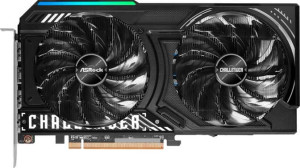
ASRock Radeon RX 7650 GRE Challenger OC Plus specifications and in-depth review

ASRock Radeon RX 7650 GRE Challenger OC Plus

Manufacturer: ASRock

The ASRock Radeon RX 7650 GRE Challenger OC Plus is a mid-range graphics card that combines AMD's RDNA 3.0 architecture with a factory overclocked configuration. Built on a 6 nm semiconductor process and packing 13,300 million transistors, this card delivers 11.51 TFLOPS of floating-point performance alongside RGB lighting and support for up to four simultaneous displays.

On the memory side, the card carries 8GB of GDDR6 across a 128-bit bus, reaching an effective speed of 18,000 MHz and a maximum bandwidth of 288 GB/s. The GPU base clock sits at 1720 MHz with a turbo frequency of 2810 MHz, backed by 2048 shading units, 128 TMUs, and 64 ROPs. Connectivity includes one HDMI 2.1 port and three DisplayPort outputs, while feature support extends to DirectX 12 Ultimate, ray tracing, OpenGL 4.6, and AMD SAM. The card draws 170W and fits within 249 x 132 mm.

Pros
  • Supports ray tracing, DirectX 12 Ultimate, and stereoscopic 3D, covering a wide range of modern rendering features
  • Four simultaneous display outputs via one HDMI 2.1 port and three DisplayPort connections
  • ECC memory support adds data integrity protection during compute-intensive tasks
  • AMD SAM is included, allowing the processor to access the full VRAM pool for improved data throughput
  • RGB lighting is built into the card for users who care about visual customization inside their system
  • Double Precision Floating Point (DPFP) support extends the card's usefulness beyond typical gaming workloads
Cons
  • 128-bit memory bus width limits memory bandwidth scaling compared to wider bus configurations in the same card tier
  • No USB-C, DVI, or mini DisplayPort outputs, reducing flexibility for users with older or specialized monitors
  • DLSS and XeSS (XMX) upscaling technologies are not supported, leaving only AMD-native upscaling options
  • No water-cooling support; the card relies entirely on air cooling, which may be a constraint in thermally limited builds
Who is this for?

This card is a reasonable fit for users building a mid-range desktop system who want ray tracing support and DirectX 12 Ultimate compatibility for modern game rendering. The four-display output capability makes it practical for users who need a multi-monitor setup for productivity or extended desktop workflows. Additionally, DPFP support and ECC memory make it a usable option for users running light compute or data-integrity-sensitive workloads alongside everyday graphics tasks.

Who is this NOT for?

Users who rely on DLSS or XeSS-based upscaling for improved frame rates at higher resolutions will find this card lacking, as neither technology is supported. The 128-bit memory bus may also prove limiting for those working with high-resolution textures or memory-bandwidth-intensive applications where wider bus configurations would be more appropriate. Furthermore, users building in thermally constrained environments or those who prefer liquid cooling solutions should note that water cooling is not supported, making this card a poor fit for compact high-thermal-density builds.

Performance:

GPU clock speed 1720 MHz
GPU turbo 2810 MHz
pixel rate 179.8 GPixel/s
floating-point performance 11.51 TFLOPS
texture rate 359.7 GTexels/s
GPU memory speed 2250 MHz
shading units 2048
texture mapping units (TMUs) 128
render output units (ROPs) 64
Has Double Precision Floating Point (DPFP)

The Performance section of this card centers on a base GPU clock of 1720 MHz that boosts up to 2810 MHz, supporting a floating-point throughput of 11.51 TFLOPS. The 2048 shading units work alongside 128 texture mapping units and 64 render output units to produce a texture rate of 359.7 GTexels/s and a pixel rate of 179.8 GPixel/s. GPU memory runs at 2250 MHz, and the card includes support for Double Precision Floating Point (DPFP), rounding out a performance profile suited to a range of compute and rendering workloads.

Memory:

effective memory speed 18000 MHz
maximum memory bandwidth 288 GB/s
VRAM 8GB
GDDR version GDDR6
memory bus width 128-bit
Supports ECC memory

This card is equipped with 8GB of GDDR6 VRAM running across a 128-bit memory bus, achieving an effective memory speed of 18,000 MHz and a maximum bandwidth of 288 GB/s. ECC memory support is also included, which helps maintain data integrity during intensive workloads by detecting and correcting memory errors.

Features:

DirectX version DirectX 12 Ultimate
OpenGL version 4.6
OpenCL version 2.2
Supports multi-display technology
supports ray tracing
Supports 3D
supports DLSS
has XeSS (XMX)
AMD SAM / Intel Resizable BAR AMD SAM
has LHR
has RGB lighting
supported displays 4

The card supports DirectX 12 Ultimate, OpenGL 4.6, and OpenCL 2.2, covering a broad range of modern graphics and compute workloads. Ray tracing, stereoscopic 3D, and multi-display output across up to four screens are all supported, while AMD SAM is included to help improve data throughput between the CPU and GPU. RGB lighting is present on the card itself. DLSS and XeSS (XMX) are not supported, and the card does not feature LHR (Lite Hash Rate) limiting.

Ports:

has an HDMI output
HDMI ports 1
HDMI version HDMI 2.1
DisplayPort outputs 3
USB-C ports 0
DVI outputs 0
mini DisplayPort outputs 0

The card's output configuration consists of one HDMI 2.1 port and three DisplayPort outputs, offering a total of four display connections. There are no USB-C, DVI, or mini DisplayPort outputs on this card.

General info:

GPU architecture RDNA 3.0
Thermal Design Power (TDP) 170W
PCI Express (PCIe) version 4
semiconductor size 6 nm
number of transistors 13300 million
Has air-water cooling
width 249 mm
height 132 mm

Built on AMD's RDNA 3.0 architecture and fabricated using a 6 nm process, this card integrates 13,300 million transistors and connects via PCIe 4. It carries a Thermal Design Power of 170W and relies on air cooling, with no water-cooling option included. The card measures 249 mm in width and 132 mm in height.

Final Verdict

The ASRock Radeon RX 7650 GRE Challenger OC Plus is a mid-range graphics card that brings together a solid set of modern features — including ray tracing, DirectX 12 Ultimate, four-display output, and AMD SAM — within a 170W power envelope. Built on the RDNA 3.0 architecture with a 6 nm process and 13,300 million transistors, it handles a respectable range of rendering and light compute tasks, aided by ECC memory support and DPFP capability. Its limitations, particularly the 128-bit memory bus and absence of DLSS or XeSS upscaling, mean it is best suited to users whose workloads align with its actual hardware scope rather than those pushing bandwidth-heavy or upscaling-dependent applications. For a straightforward multi-display or ray-tracing-capable desktop build, it covers the essentials without overreaching.

Popular Comparisons

ASRock Radeon RX 7650 GRE Challenger OC Plus
VS
AMD Radeon RX 6750 GRE 10GB