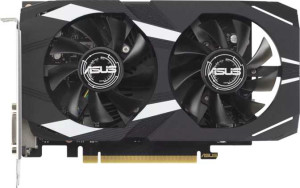
Asus Dual GeForce RTX 3050 OC Edition 6GB specifications and in-depth review

Asus Dual GeForce RTX 3050 OC Edition 6GB

Manufacturer: Asus

The Asus Dual GeForce RTX 3050 OC Edition 6GB is a factory-overclocked graphics card built on NVIDIA's Ampere architecture, aimed at users who want access to modern GPU features within a compact, low-power design. Measuring 201 × 120 mm and operating at a TDP of just 70W, it fits comfortably into smaller chassis without demanding a high-wattage power supply. The OC Edition designation reflects a boosted turbo clock of 1507 MHz over the standard configuration, with ray tracing, DLSS, and DirectX 12 Ultimate all supported out of the box.

The card is built on an 8 nm die containing 8,700 million transistors and features 2304 shading units, 72 texture mapping units, and 32 ROPs, delivering 6.944 TFLOPS of floating-point performance alongside a texture rate of 108.5 GTexels/s. Its 6 GB of GDDR6 VRAM runs at an effective speed of 14,000 MHz across a 96-bit bus, providing up to 168 GB/s of memory bandwidth, with ECC memory support also available. Output options include one HDMI 2.1 port, one DisplayPort, and one DVI connection, collectively supporting up to four displays, and the card connects to the system via PCIe 4.0. Intel Resizable BAR is supported, while XeSS, RGB lighting, and USB-C outputs are absent.

Pros
  • The factory overclock pushes the turbo clock to 1507 MHz, delivering 6.944 TFLOPS of floating-point performance without requiring any manual tuning from the user
  • A 70W TDP allows the card to operate in compact builds with modest power supplies, broadening its compatibility with smaller system configurations
  • Hardware support for ray tracing and DLSS gives users access to modern rendering techniques without relying on software-only solutions
  • Up to four displays can be connected simultaneously through the HDMI 2.1, DisplayPort, and DVI outputs, making it a practical option for multi-monitor setups
  • ECC memory support adds reliability for workloads where data integrity is a priority alongside general graphics use
  • Intel Resizable BAR support enables the CPU to access the full GPU frame buffer at once, which can benefit data transfer efficiency in compatible systems
Cons
  • The 96-bit memory bus is narrow, which constrains memory bandwidth headroom and can become a limiting factor in memory-intensive rendering or compute tasks
  • 6 GB of VRAM may prove insufficient for users working with high-resolution textures, large 3D assets, or memory-heavy applications
  • No USB-C display output is available, limiting compatibility with monitors or devices that require USB-C or Thunderbolt video connections
  • The card relies solely on air cooling with no water-cooling option, which may be a constraint in thermally limited or high-ambient-temperature environments
  • RGB lighting is absent, which may be a drawback for users who want a visually coordinated system build
Who is this for?

This card is well-suited to users building compact or power-conscious systems who still want access to current-generation GPU features, as its 70W TDP and 201 × 120 mm form factor make it compatible with smaller chassis and modest power supplies. The factory overclock to 1507 MHz means users get a modest performance uplift without any manual configuration, which suits those who prefer a straightforward setup. Support for ray tracing, DLSS, and DirectX 12 Ultimate also makes it a reasonable fit for mid-range gaming where these features are desired but raw throughput is less critical. Users who need to drive multiple screens will find the four-display support across HDMI 2.1, DisplayPort, and DVI outputs a practical advantage for productivity-oriented multi-monitor configurations.

Who is this NOT for?

Users who work with memory-intensive workloads such as high-resolution texture rendering, large 3D scene files, or professional compute tasks will find the 6 GB VRAM on a 96-bit bus a meaningful constraint, as both capacity and bandwidth impose real limits under heavy loads. The card is equally unsuitable for those who need USB-C or Thunderbolt display connectivity, as no such output is present on the bracket. Enthusiast gamers who target high-resolution or high-fidelity settings that push the GPU's floating-point throughput will also encounter the ceiling of 6.944 TFLOPS relatively quickly, and users in thermally demanding environments may find the air-only cooling solution insufficient for sustained workloads.

Performance:

GPU clock speed 1042 MHz
GPU turbo 1507 MHz
pixel rate 48.22 GPixel/s
floating-point performance 6.944 TFLOPS
texture rate 108.5 GTexels/s
GPU memory speed 1750 MHz
shading units 2304
texture mapping units (TMUs) 72
render output units (ROPs) 32
Has Double Precision Floating Point (DPFP)

The GPU runs at a base clock of 1042 MHz and reaches a turbo speed of 1507 MHz, producing 6.944 TFLOPS of floating-point performance with Double Precision Floating Point (DPFP) support included. The rendering pipeline consists of 2304 shading units, 72 texture mapping units, and 32 render output units, yielding a texture rate of 108.5 GTexels/s and a pixel rate of 48.22 GPixel/s. GPU memory operates at 1750 MHz at the chip level, separate from the effective system-level memory speed.

Memory:

effective memory speed 14000 MHz
maximum memory bandwidth 168 GB/s
VRAM 6GB
GDDR version GDDR6
memory bus width 96-bit
Supports ECC memory

The card features 6 GB of GDDR6 VRAM with an effective memory speed of 14,000 MHz, delivering a maximum bandwidth of 168 GB/s across a 96-bit bus. ECC memory support is included, providing error detection and correction capability for workloads where data accuracy is important.

Features:

DirectX version DirectX 12 Ultimate
OpenGL version 4.6
OpenCL version 3
Supports multi-display technology
supports ray tracing
Supports 3D
supports DLSS
has XeSS (XMX)
AMD SAM / Intel Resizable BAR Intel Resizable BAR
has LHR
has RGB lighting
supported displays 4

The card supports DirectX 12 Ultimate, OpenGL 4.6, and OpenCL 3, providing broad compatibility across gaming and compute applications. Ray tracing and DLSS are both enabled at the hardware level, and stereoscopic 3D output is also supported. Multi-display technology allows up to four screens to be connected simultaneously, and Intel Resizable BAR is available for improved CPU-to-GPU memory access. XeSS (XMX), Lite Hash Rate (LHR), and RGB lighting are not part of this card's feature set.

Ports:

has an HDMI output
HDMI ports 1
HDMI version HDMI 2.1
DisplayPort outputs 1
USB-C ports 0
DVI outputs 1
mini DisplayPort outputs 0

The display output configuration includes one HDMI 2.1 port, one DisplayPort, and one DVI output, enabling connections across a range of monitor types. There are no USB-C or mini DisplayPort outputs available on the bracket.

General info:

GPU architecture Ampere
Thermal Design Power (TDP) 70W
PCI Express (PCIe) version 4
semiconductor size 8 nm
number of transistors 8700 million
Has air-water cooling
width 201 mm
height 120 mm

The Asus Dual GeForce RTX 3050 OC Edition 6GB is based on the Ampere architecture, built on an 8 nm process with 8,700 million transistors. It has a TDP of 70W and connects via PCIe 4.0, fitting into a compact 201 × 120 mm footprint. Cooling is handled entirely by air, with no water-cooling option included.

Final Verdict

The Asus Dual GeForce RTX 3050 OC Edition 6GB is a focused graphics card that delivers a clear and consistent proposition: Ampere-generation features in a compact, low-power design with a factory overclock applied from the start. Its combination of ray tracing, DLSS, and a 70W TDP makes it a coherent option for users building space- or power-constrained systems who still want access to modern rendering capabilities without manual tuning. The constraints around VRAM capacity, bus width, and the absence of USB-C output are real, and users with more demanding workloads will encounter them — but for those whose usage patterns align with what this card actually offers, it performs its intended role without unnecessary compromise. As a factory-overclocked variant of an entry-level Ampere card, it represents a well-packaged option for mid-range builds where ease of use and feature access within a tight power budget take priority.

Popular Comparisons

Asus Dual GeForce RTX 3050 OC Edition 6GB
VS
Asus Dual GeForce RTX 5050 OC Edition
Asus Dual GeForce RTX 3050 OC Edition 6GB
VS
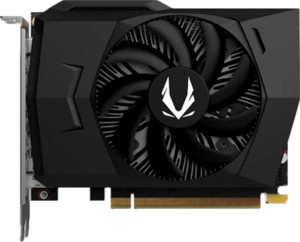
Zotac Gaming GeForce RTX 3050 Solo 6GB
Asus Dual GeForce RTX 3050 OC Edition 6GB
VS
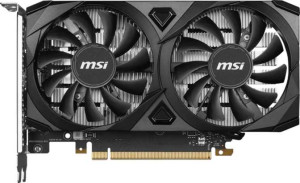
MSI GeForce RTX 3050 Ventus 2X OC 6GB
Asus Dual GeForce RTX 3050 OC Edition 6GB
VS
Nvidia GeForce RTX 3050 6GB