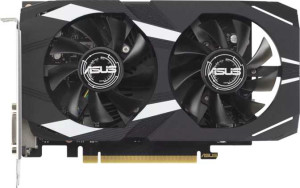
The Asus Dual GeForce RTX 3050 6GB has a base GPU clock of 1042 MHz that boosts up to 1470 MHz in turbo mode, delivering 6.774 TFLOPS of floating-point performance with Double Precision Floating Point (DPFP) support. The rendering pipeline is built around 2304 shading units, 72 texture mapping units, and 32 render output units, producing a texture rate of 105.8 GTexels/s and a pixel rate of 47.04 GPixel/s. The GPU memory itself runs at 1750 MHz, separate from the effective memory speed at the system level.
The card is equipped with 6 GB of GDDR6 VRAM running at an effective speed of 14,000 MHz across a 96-bit memory bus, yielding a maximum memory bandwidth of 168 GB/s. ECC memory support is also included, which helps detect and correct memory errors — a useful feature for workloads where data integrity matters.
The Asus Dual GeForce RTX 3050 6GB supports DirectX 12 Ultimate, OpenGL 4.6, and OpenCL 3, covering a broad range of gaming and compute workloads. Hardware-accelerated ray tracing and DLSS are both available, and stereoscopic 3D output is also supported. The card can drive up to three displays simultaneously through its multi-display technology, and Intel Resizable BAR is supported for improved CPU-to-GPU data throughput. XeSS (XMX) and Lite Hash Rate (LHR) are not present, and the card does not feature RGB lighting.
The card's output configuration consists of one HDMI 2.1 port, one DisplayPort, and one DVI output, supporting a total of three simultaneous displays. There are no USB-C or mini DisplayPort outputs on the bracket.
The Asus Dual GeForce RTX 3050 6GB is built on NVIDIA's Ampere architecture, fabricated using an 8 nm process with 8,700 million transistors packed onto the die. It has a TDP of 70W, keeping power draw modest, and connects to the motherboard via PCIe 4.0. The card measures 201 × 120 mm and relies entirely on air cooling, with no water-cooling option available.