Asus Dual GeForce RTX 4070 Super EVO White OC Edition specifications and in-depth review

Asus Dual GeForce RTX 4070 Super EVO White OC Edition

Manufacturer: Asus

The Asus Dual GeForce RTX 4070 Super EVO White OC Edition is a graphics card based on NVIDIA's Ada Lovelace architecture, produced on a 5 nm process with 35,800 million transistors. It runs at a base clock of 1980 MHz and boosts up to 2520 MHz, with 7,168 shading units driving a floating-point throughput of 36.13 TFLOPS. The card includes RGB lighting and supports up to four simultaneous displays, while its 227.2 mm length and 123.2 mm height make it a relatively compact option within the graphics card category.

On the memory side, the card carries 12GB of GDDR6X VRAM on a 192-bit bus with an effective speed of 21,000 MHz, yielding a maximum bandwidth of 504.2 GB/s. ECC memory support is included, and the feature set covers ray tracing, DLSS, DirectX 12 Ultimate, OpenGL 4.6, OpenCL 3, stereoscopic 3D, and Intel Resizable BAR. LHR is not present on this model, and XeSS is not supported. Connectivity consists of one HDMI 2.1a port and three DisplayPort outputs, with no USB-C, DVI, or mini DisplayPort connections available. The card's TDP is rated at 220W and cooling is handled through air only.

Pros
  • At 227.2 mm in length and 123.2 mm in height, the card has a compact footprint that makes it easier to install in a wider variety of cases, including smaller mid-tower builds
  • A 220W TDP places relatively modest power demands on the system, reducing strain on the power supply and potentially simplifying cooling requirements for the overall build
  • LHR is not active on this model, meaning there are no built-in restrictions affecting certain compute workloads
  • ECC memory support provides an added layer of data integrity for workloads where memory accuracy matters
  • Ray tracing and DLSS are both supported, enabling hardware-accelerated visual effects and AI-assisted upscaling
  • RGB lighting is integrated into the card, offering visual customization without requiring additional components
Cons
  • The 192-bit memory bus is narrower than what some cards in this category offer, which limits the maximum achievable memory bandwidth to 504.2 GB/s
  • 12GB of GDDR6X VRAM may be a constraint for workloads that rely on large texture sets or memory-intensive compute tasks
  • XeSS (XMX) is not supported, so users who prefer or require an alternative to DLSS for upscaling have no option available
  • Air-water cooling is not included, leaving thermal performance dependent solely on the card's air cooling arrangement
  • No USB-C, DVI, or mini DisplayPort outputs are present, which may limit compatibility with certain display configurations
Who is this for?

This card is a natural fit for users who need a capable graphics card in a compact build, as its 227.2 mm length and 123.2 mm height allow it to slot into a wide range of mid-tower and smaller cases without clearance concerns. The combination of ray tracing, DLSS, DirectX 12 Ultimate, and a 220W TDP makes it well-suited to users who want a feature-complete gaming or creative workstation without placing heavy demands on their power supply. ECC memory support and Double Precision Floating Point also extend its appeal to users with compute workloads that require data accuracy and numerical precision.

Who is this NOT for?

Users running applications that rely heavily on large VRAM allocations may find the 12GB capacity limiting, particularly for high-resolution texture work or memory-intensive compute tasks. The 192-bit bus width, which caps memory bandwidth at 504.2 GB/s, could also be a bottleneck for workloads that are highly bandwidth-sensitive. Additionally, users who depend on USB-C, DVI, or mini DisplayPort connections for their display setup will find this card incompatible with that hardware without additional adapters, and those who prefer upscaling options beyond DLSS will find no XeSS support available here.

Performance:

GPU clock speed 1980 MHz
GPU turbo 2520 MHz
pixel rate 201.6 GPixel/s
floating-point performance 36.13 TFLOPS
texture rate 564.5 GTexels/s
GPU memory speed 1313 MHz
shading units 7168
texture mapping units (TMUs) 224
render output units (ROPs) 80
Has Double Precision Floating Point (DPFP)

This card runs at a base GPU clock of 1980 MHz with a boost frequency of 2520 MHz, backed by 7,168 shading units and 224 texture mapping units that produce a texture rate of 564.5 GTexels/s and a pixel rate of 201.6 GPixel/s. Floating-point performance is rated at 36.13 TFLOPS, while GPU memory operates at 1313 MHz. With 80 render output units and support for Double Precision Floating Point, the card handles both graphical and compute-oriented workloads that require higher numerical accuracy.

Memory:

effective memory speed 21000 MHz
maximum memory bandwidth 504.2 GB/s
VRAM 12GB
GDDR version GDDR6X
memory bus width 192-bit
Supports ECC memory

The card features 12GB of GDDR6X VRAM on a 192-bit memory bus, running at an effective speed of 21,000 MHz to deliver a maximum memory bandwidth of 504.2 GB/s. ECC memory support is included, which adds a useful degree of data integrity for compute workloads where memory accuracy is a priority.

Features:

DirectX version DirectX 12 Ultimate
OpenGL version 4.6
OpenCL version 3
Supports multi-display technology
supports ray tracing
Supports 3D
supports DLSS
has XeSS (XMX)
AMD SAM / Intel Resizable BAR Intel Resizable BAR
has LHR
has RGB lighting
supported displays 4

The card supports DirectX 12 Ultimate, OpenGL 4.6, and OpenCL 3, along with ray tracing, DLSS, and stereoscopic 3D, providing a well-rounded set of graphics and compute capabilities. Multi-display technology is supported for up to four outputs, and Intel Resizable BAR is present to allow the CPU more direct access to GPU memory. LHR is not active on this model, and XeSS (XMX) is not supported, making DLSS the sole available upscaling option. RGB lighting is built into the card.

Ports:

has an HDMI output
HDMI ports 1
HDMI version HDMI 2.1a
DisplayPort outputs 3
USB-C ports 0
DVI outputs 0
mini DisplayPort outputs 0

Display output is handled through one HDMI 2.1a port and three DisplayPort outputs, together supporting up to four connected displays. There are no USB-C, DVI, or mini DisplayPort connections on this card.

General info:

GPU architecture Ada Lovelace
Thermal Design Power (TDP) 220W
PCI Express (PCIe) version 4
semiconductor size 5 nm
number of transistors 35800 million
Has air-water cooling
width 227.2 mm
height 123.2 mm

Underpinned by the Ada Lovelace architecture and manufactured on a 5 nm node with 35,800 million transistors, this card connects via PCIe 4 and carries a TDP of 220W. It measures 227.2 mm in width and 123.2 mm in height, giving it a notably compact physical profile that should suit a wide range of case sizes. Air-water cooling is not included, so the card relies entirely on its air cooling solution for thermal management.
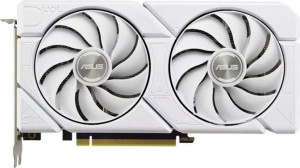
Final Verdict

The Asus Dual GeForce RTX 4070 Super EVO White OC Edition makes a strong case for users who want a compact, feature-complete graphics card that fits comfortably into a wide range of builds without demanding a high-wattage power supply. Its support for ray tracing, DLSS, DirectX 12 Ultimate, and ECC memory gives it genuine versatility across both graphics and compute use cases, while the absence of LHR removes an unnecessary restriction. That said, users with demanding memory bandwidth requirements or those working with large VRAM allocations may find the 12GB capacity and 192-bit bus width limiting in certain scenarios. For users whose workloads align with what this card offers, it represents a coherent and practically sized option with few significant compromises.