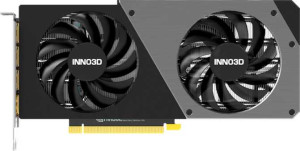
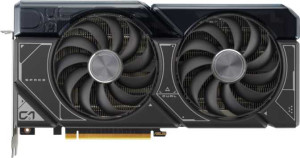
Asus Dual GeForce RTX 4070 Super OC Edition specifications and in-depth review

Asus Dual GeForce RTX 4070 Super OC Edition

Manufacturer: Asus

The Asus Dual GeForce RTX 4070 Super OC Edition is a desktop graphics card built on NVIDIA's Ada Lovelace architecture and manufactured using a 5 nm process with 35,800 million transistors. It features 12GB of GDDR6X VRAM operating at an effective speed of 21,000 MHz across a 192-bit bus, producing a maximum memory bandwidth of 504.2 GB/s. The card supports ray tracing, DLSS, DirectX 12 Ultimate, and Intel Resizable BAR, and includes RGB lighting along with multi-display support for up to four screens simultaneously.

The Asus Dual RTX 4070 Super OC Edition runs at a base GPU clock of 1,980 MHz with a boost clock of 2,520 MHz, delivering 36.13 TFLOPS of floating-point performance. Its 7,168 shading units are paired with 224 texture mapping units and 80 render output units, yielding a texture rate of 564.5 GTexels/s and a pixel rate of 201.6 GPixel/s. With a TDP of 220W, the card connects via PCIe 4.0 and measures 267 mm in length and 133.9 mm in height, relying on air cooling. Output options include one HDMI 2.1a port and three DisplayPort outputs, with no DVI, mini DisplayPort, or USB-C connections present.

Pros
  • At 267 mm in length, the card fits into a wider range of mid-tower and compact cases than many full-length graphics cards
  • A 220W TDP places relatively modest demands on system power delivery, giving more flexibility in power supply selection
  • Supports up to four simultaneous displays via three DisplayPort outputs and one HDMI 2.1a port, covering a wide range of multi-monitor configurations
  • Ray tracing and DLSS are both supported natively, enabling compatibility with modern rendering and upscaling techniques
  • ECC memory support adds error detection and correction capability, which is useful for compute workloads requiring data integrity
  • Double Precision Floating Point (DPFP) support extends the card's usability beyond gaming into numerical and scientific compute tasks
Cons
  • The boost clock of 2,520 MHz is lower than some other cards built on the same GPU architecture, which can affect peak throughput in GPU-limited scenarios
  • No USB-C output is available, limiting direct connectivity to displays or devices that require that interface
  • Water cooling is not supported, so thermal performance depends entirely on the air cooling solution
  • The 192-bit memory bus restricts potential memory bandwidth scaling compared to wider bus configurations
  • XeSS (XMX) is not supported, narrowing upscaling options to DLSS only
Who is this for?

This card is a practical fit for users working with mid-tower or compact builds, as its 267 mm length and 220W TDP make it easier to accommodate within tighter cases and less demanding power configurations. Gamers who want to take advantage of ray tracing and DLSS in modern titles will find the necessary hardware support in place, while the inclusion of ECC memory and DPFP support also makes it a reasonable choice for users who occasionally run compute or numerical workloads alongside their primary graphics tasks. The four-display output capability further suits those managing multi-monitor setups without needing additional hardware.

Who is this NOT for?

Users who push hardware to its limits in heavily GPU-bound scenarios may find the 2,520 MHz boost clock and 36.13 TFLOPS of floating-point throughput insufficient for the most demanding workloads at very high resolutions or with all quality settings maximized. Those with displays or peripheral devices that rely on USB-C connectivity will need to factor in the complete absence of that port type, as no adapter solution is built in. Additionally, users interested in liquid cooling integration will need to look at alternative cards, since water cooling is not supported and the card depends entirely on its air cooler for thermal management.

Performance:

GPU clock speed 1980 MHz
GPU turbo 2520 MHz
pixel rate 201.6 GPixel/s
floating-point performance 36.13 TFLOPS
texture rate 564.5 GTexels/s
GPU memory speed 1313 MHz
shading units 7168
texture mapping units (TMUs) 224
render output units (ROPs) 80
Has Double Precision Floating Point (DPFP)

The card operates at a base GPU clock of 1,980 MHz, rising to a boost clock of 2,520 MHz under load, with overall floating-point throughput reaching 36.13 TFLOPS. Its 7,168 shading units are supported by 224 texture mapping units and 80 render output units, producing a texture rate of 564.5 GTexels/s and a pixel rate of 201.6 GPixel/s. GPU memory runs at 1,313 MHz, and Double Precision Floating Point (DPFP) is supported, extending the card's utility to compute workloads that require higher numerical precision.

Memory:

effective memory speed 21000 MHz
maximum memory bandwidth 504.2 GB/s
VRAM 12GB
GDDR version GDDR6X
memory bus width 192-bit
Supports ECC memory

The card carries 12GB of GDDR6X VRAM running at an effective memory speed of 21,000 MHz over a 192-bit bus, resulting in a maximum memory bandwidth of 504.2 GB/s. This configuration supports sustained data throughput for memory-intensive tasks, and ECC memory is also supported, providing error detection and correction capabilities that add a degree of reliability for compute-focused use cases.

Features:

DirectX version DirectX 12 Ultimate
OpenGL version 4.6
OpenCL version 3
Supports multi-display technology
supports ray tracing
Supports 3D
supports DLSS
has XeSS (XMX)
AMD SAM / Intel Resizable BAR Intel Resizable BAR
has LHR
has RGB lighting
supported displays 4

The card supports DirectX 12 Ultimate, OpenGL 4.6, and OpenCL 3, providing broad compatibility across modern graphics and compute APIs. Ray tracing and DLSS are both enabled, while XeSS (XMX) is not supported. Multi-display technology allows connection of up to four screens simultaneously, and stereoscopic 3D is also supported. Intel Resizable BAR is present to facilitate wider CPU access to GPU memory, whereas Lite Hash Rate (LHR) limiting is not applied. RGB lighting is included on the card itself, rounding out a feature set that covers the main capabilities expected in this product category.

Ports:

has an HDMI output
HDMI ports 1
HDMI version HDMI 2.1a
DisplayPort outputs 3
USB-C ports 0
DVI outputs 0
mini DisplayPort outputs 0

The card offers a total of four video outputs arranged as three DisplayPort connections and one HDMI 2.1a port. There are no DVI, mini DisplayPort, or USB-C outputs available, keeping the interface selection focused on the two dominant modern display standards without any legacy or alternative connector options.

General info:

GPU architecture Ada Lovelace
Thermal Design Power (TDP) 220W
PCI Express (PCIe) version 4
semiconductor size 5 nm
number of transistors 35800 million
Has air-water cooling
width 267 mm
height 133.9 mm

Built on the Ada Lovelace architecture using a 5 nm fabrication process, the GPU integrates 35,800 million transistors and connects to the system via PCIe 4.0. It carries a TDP of 220W and relies entirely on air cooling, as water cooling is not supported. The card measures 267 mm in width and 133.9 mm in height, placing it in a more compact footprint relative to many full-length graphics cards in this segment.
Final Verdict

The Asus Dual GeForce RTX 4070 Super OC Edition carves out a clear identity as a compact, system-friendly graphics card that doesn't sacrifice the core feature set expected from a modern GPU. Its 267 mm length and 220W TDP make it genuinely accessible to a broader range of build configurations, while support for ray tracing, DLSS, ECC memory, and four simultaneous display outputs ensures it covers the practical needs of both gaming and lighter compute use cases. Users who require peak overclocked performance or liquid cooling integration may need to look at alternative configurations, but for those prioritizing build compatibility and a well-rounded feature set in a more manageable physical package, this card presents a coherent and capable option.

Popular Comparisons

Asus Dual GeForce RTX 4070 Super OC Edition
VS
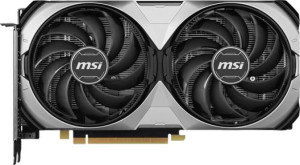
MSI GeForce RTX 4070 Super Ventus 2X OC
Asus Dual GeForce RTX 4070 Super OC Edition
VS
Inno3D GeForce RTX 4070 Ti Super Twin X2