Asus Dual GeForce RTX 4070 Super EVO OC Edition specifications and in-depth review

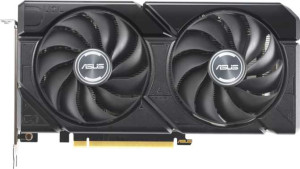
Asus Dual GeForce RTX 4070 Super EVO OC Edition

Manufacturer: Asus

The Asus Dual GeForce RTX 4070 Super EVO OC Edition is a graphics card built on NVIDIA's Ada Lovelace architecture, manufactured on a 5 nm process with 35,800 million transistors. One of its more notable physical characteristics is its compact footprint of 227.2 mm in length and 123.2 mm in height, which sets it apart from the larger multi-fan designs typical in this segment. The card includes ray tracing, DLSS, DirectX 12 Ultimate, stereoscopic 3D support, Intel Resizable BAR, and RGB lighting, covering the standard feature set for Ada Lovelace-based products.

Performance figures show a base GPU clock of 1980 MHz with a turbo of 2520 MHz, delivering 36.13 TFLOPS of floating-point throughput alongside a texture rate of 564.5 GTexels/s and a pixel rate of 201.6 GPixel/s. The card's 7,168 shading units are complemented by 224 texture mapping units and 80 render output units. On the memory side, 12GB of GDDR6X runs across a 192-bit bus at an effective speed of 21,000 MHz, providing up to 504.2 GB/s of bandwidth, with ECC support and Double Precision Floating Point capability also present. Display output consists of one HDMI 2.1a port and three DisplayPort connections, with no USB-C, DVI, or mini DisplayPort outputs. The card carries a 220W TDP, uses PCIe 4.0, and relies on air cooling without a water-cooling option.

Pros
  • At 227.2 mm in length and 123.2 mm in height, the card's compact dimensions make it compatible with a wider range of cases, including smaller mid-tower and some compact builds
  • A 220W TDP places relatively modest demands on system power delivery for a card in this segment
  • ECC memory support adds data integrity protection useful for compute-oriented or reliability-sensitive workloads
  • Double Precision Floating Point capability extends usability to 64-bit compute tasks beyond standard graphics workloads
  • Ray tracing and DLSS are both supported, providing a full feature set for compatible rendering workloads
  • Intel Resizable BAR support allows the CPU to access the full GPU frame buffer, improving data transfer efficiency
Cons
  • The 192-bit memory bus width constrains total bandwidth to 504.2 GB/s, which may be a limiting factor for memory-intensive workloads
  • Only one HDMI port is available, reducing flexibility for users who need to connect multiple HDMI-dependent displays simultaneously
  • No USB-C output is present, which limits connectivity for monitors or devices that rely on that interface
  • XeSS (XMX) is not supported, narrowing upscaling options to DLSS only
Who is this for?

The card's most distinctive characteristic is its compact 227.2 mm length, which makes it a natural fit for users building in smaller cases where full-length cards simply won't clear. Despite its reduced footprint, it retains ray tracing, DLSS, DirectX 12 Ultimate, and support for up to four simultaneous displays, making it well-suited to users who want a feature-complete Ada Lovelace card in a space-constrained build. The 220W TDP also makes it a reasonable match for systems with modest power supplies, and ECC memory support adds appeal for users running compute or data-integrity-sensitive workloads alongside everyday graphics tasks.

Who is this NOT for?

Users who depend on connecting multiple displays via HDMI will find the single HDMI 2.1a port limiting, as only one such connection is available alongside the three DisplayPort outputs. Those running heavily memory-bandwidth-dependent workloads may also encounter constraints from the 192-bit bus, which caps total bandwidth at 504.2 GB/s — a ceiling that can become noticeable in tasks involving large texture sets or high-resolution framebuffers. Additionally, users who require USB-C display output for compatible monitors or docking solutions will find no such port on this model.

Performance:

GPU clock speed 1980 MHz
GPU turbo 2520 MHz
pixel rate 201.6 GPixel/s
floating-point performance 36.13 TFLOPS
texture rate 564.5 GTexels/s
GPU memory speed 1313 MHz
shading units 7168
texture mapping units (TMUs) 224
render output units (ROPs) 80
Has Double Precision Floating Point (DPFP)

The GPU operates at a base clock of 1980 MHz, reaching a turbo frequency of 2520 MHz under load. Its 7,168 shading units work alongside 224 texture mapping units and 80 render output units, yielding a texture rate of 564.5 GTexels/s and a pixel rate of 201.6 GPixel/s. Floating-point throughput is rated at 36.13 TFLOPS, with GPU memory running at 1313 MHz. Double Precision Floating Point (DPFP) is supported, making the card capable of handling workloads that require 64-bit arithmetic in addition to standard graphics tasks.

Memory:

effective memory speed 21000 MHz
maximum memory bandwidth 504.2 GB/s
VRAM 12GB
GDDR version GDDR6X
memory bus width 192-bit
Supports ECC memory

The card carries 12GB of GDDR6X memory on a 192-bit bus, running at an effective speed of 21,000 MHz and delivering a maximum bandwidth of 504.2 GB/s. ECC memory support is included, offering an additional layer of data integrity for workloads where reliability matters.

Features:

DirectX version DirectX 12 Ultimate
OpenGL version 4.6
OpenCL version 3
Supports multi-display technology
supports ray tracing
Supports 3D
supports DLSS
has XeSS (XMX)
AMD SAM / Intel Resizable BAR Intel Resizable BAR
has LHR
has RGB lighting
supported displays 4

Feature support covers DirectX 12 Ultimate, OpenGL 4.6, and OpenCL 3, alongside ray tracing, DLSS, and stereoscopic 3D. Multi-display technology is present with support for up to four simultaneous outputs, and Intel Resizable BAR is also included. XeSS (XMX) is not supported, LHR is absent, and RGB lighting is available for visual customization within a build.

Ports:

has an HDMI output
HDMI ports 1
HDMI version HDMI 2.1a
DisplayPort outputs 3
USB-C ports 0
DVI outputs 0
mini DisplayPort outputs 0

The card provides four physical display outputs in total: one HDMI 2.1a port and three DisplayPort connections. USB-C, DVI, and mini DisplayPort outputs are not present on this model.

General info:

GPU architecture Ada Lovelace
Thermal Design Power (TDP) 220W
PCI Express (PCIe) version 4
semiconductor size 5 nm
number of transistors 35800 million
Has air-water cooling
width 227.2 mm
height 123.2 mm

The card is based on the Ada Lovelace architecture, built on a 5 nm process with 35,800 million transistors, and connects to the system over PCIe 4.0. It carries a TDP of 220W and relies entirely on air cooling, with no air-water cooling option available. Physically, the card measures 227.2 mm in length and 123.2 mm in height, giving it a notably compact form factor for its class.
Final Verdict

The Asus Dual GeForce RTX 4070 Super EVO OC Edition makes a clear case for itself through its unusually compact 227.2 mm form factor, which allows it to bring Ada Lovelace features — including ray tracing, DLSS, ECC memory, and four-display support — into builds where larger cards simply aren't an option. The 220W TDP keeps power requirements manageable, and the inclusion of Double Precision Floating Point support adds utility beyond standard graphics workloads. Users who need more than one HDMI connection or require higher memory bandwidth will need to account for those constraints, but for anyone prioritizing a small footprint without sacrificing the core Ada Lovelace feature set, this card delivers a well-rounded and practical solution.

Popular Comparisons

Asus Dual GeForce RTX 4070 Super EVO OC Edition
VS
Asus Dual GeForce RTX 4070 Super EVO