Asus Dual GeForce RTX 5060 Ti Evo OC Edition 16GB specifications and in-depth review

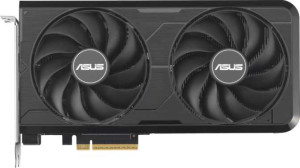
Asus Dual GeForce RTX 5060 Ti Evo OC Edition 16GB

Manufacturer: Asus

The Asus Dual GeForce RTX 5060 Ti Evo OC Edition is a mid-range graphics card from Asus based on NVIDIA's Blackwell architecture. It comes equipped with 16GB of GDDR7 VRAM across a 128-bit memory bus, delivering an effective memory speed of 28000 MHz and a maximum memory bandwidth of 448 GB/s. The card carries a boost clock of 2602 MHz and a base clock of 2407 MHz, with floating-point performance rated at 23.98 TFLOPS.

On the technical side, the card houses 4608 shading units, 144 texture mapping units, and 48 render output units, with a texture rate of 374.7 GTexels/s and a pixel rate of 124.9 GPixel/s. It supports DirectX 12 Ultimate, OpenGL 4.6, OpenCL 3, ray tracing, and DLSS, alongside Intel Resizable BAR. The card has a TDP of 180W, is built on a 5 nm process with 21.9 billion transistors, and connects via PCIe 5. Display output options include one HDMI 2.1b port and three DisplayPort outputs, supporting up to four displays simultaneously. The card measures 225 mm in width and 120 mm in height.

Pros
  • Comes with 16GB of GDDR7 VRAM, which is a notably large amount for this card's segment
  • The 128-bit memory bus delivers up to 448 GB/s of bandwidth thanks to the high effective memory speed of 28000 MHz
  • Supports ray tracing and DLSS, enabling more advanced rendering capabilities
  • Four display outputs — one HDMI 2.1b and three DisplayPort — allow flexible multi-monitor configurations supporting up to four screens
  • Built on a 5 nm process with the Blackwell architecture, packing 21,900 million transistors into a relatively compact 225 x 120 mm footprint
  • ECC memory support adds a layer of data integrity protection during operation
Cons
  • The memory bus width is limited to 128-bit, which constrains raw bandwidth potential regardless of memory speed
  • No USB-C display output is available, which may be limiting for users with newer monitors or displays that rely on that connection
  • Does not include air-water cooling, so thermal management depends entirely on the card's air cooler
  • XeSS (XMX) is not supported, reducing compatibility with certain upscaling workflows
  • No RGB lighting for users who factor aesthetics into their build
Who is this for?

This card is well-suited for users who want to run games or applications that take advantage of ray tracing and DLSS, as both are fully supported. The generous 16GB of GDDR7 VRAM makes it a reasonable fit for content creators or developers working with memory-intensive workloads, as well as gamers who want headroom for high-resolution textures. The ability to drive up to four displays simultaneously via its HDMI 2.1b and three DisplayPort outputs also makes it a practical option for multi-monitor setups, whether for productivity or immersive gaming environments.

Who is this NOT for?

Users requiring high-bandwidth memory throughput beyond what a 128-bit bus can deliver may find this card limiting in scenarios that are heavily memory-bandwidth-dependent. Those looking for a card with water-cooling compatibility will need to look elsewhere, as air-water cooling is not supported and the card relies solely on its air cooler. Additionally, users invested in Intel's XeSS upscaling technology will find no support for it here, making this card a poor match for workflows or games that depend specifically on XeSS (XMX)-based upscaling.

Performance:

GPU clock speed 2407 MHz
GPU turbo 2602 MHz
pixel rate 124.9 GPixel/s
floating-point performance 23.98 TFLOPS
texture rate 374.7 GTexels/s
GPU memory speed 1750 MHz
shading units 4608
texture mapping units (TMUs) 144
render output units (ROPs) 48
Has Double Precision Floating Point (DPFP)

The card runs at a base clock of 2407 MHz with a boost clock reaching 2602 MHz, supported by a GPU memory speed of 1750 MHz. Floating-point performance is rated at 23.98 TFLOPS, while the texture rate and pixel rate come in at 374.7 GTexels/s and 124.9 GPixel/s respectively. Under the hood, the card features 4608 shading units, 144 texture mapping units, and 48 render output units, and it includes support for Double Precision Floating Point (DPFP).

Memory:

effective memory speed 28000 MHz
maximum memory bandwidth 448 GB/s
VRAM 16GB
GDDR version GDDR7
memory bus width 128-bit
Supports ECC memory

This card is equipped with 16GB of GDDR7 VRAM running at an effective memory speed of 28000 MHz across a 128-bit memory bus, yielding a maximum memory bandwidth of 448 GB/s. ECC memory is supported, which helps maintain data integrity during operation.

Features:

DirectX version DirectX 12 Ultimate
OpenGL version 4.6
OpenCL version 3
Supports multi-display technology
supports ray tracing
Supports 3D
supports DLSS
has XeSS (XMX)
AMD SAM / Intel Resizable BAR Intel Resizable BAR
has LHR
has RGB lighting
supported displays 4

The card supports DirectX 12 Ultimate, OpenGL 4.6, and OpenCL 3, covering a broad range of graphics and compute workloads. Ray tracing and DLSS are both supported, while XeSS (XMX) is not available on this card. It includes Intel Resizable BAR support and is compatible with stereoscopic 3D and multi-display setups of up to four screens simultaneously. LHR is not present, and the card does not feature RGB lighting.

Ports:

has an HDMI output
HDMI ports 1
HDMI version HDMI 2.1b
DisplayPort outputs 3
USB-C ports 0
DVI outputs 0
mini DisplayPort outputs 0

The card offers a total of four video outputs: one HDMI 2.1b port and three DisplayPort outputs. There are no USB-C, DVI, or mini DisplayPort connections available on this card.

General info:

GPU architecture Blackwell
Thermal Design Power (TDP) 180W
PCI Express (PCIe) version 5
semiconductor size 5 nm
number of transistors 21900 million
Has air-water cooling
width 225 mm
height 120 mm

Built on the Blackwell architecture using a 5 nm manufacturing process, the card integrates 21,900 million transistors and connects via PCIe 5. It has a Thermal Design Power of 180W and does not include air-water cooling. The card measures 225 mm in width and 120 mm in height.
Final Verdict

The Asus Dual GeForce RTX 5060 Ti Evo OC Edition presents a well-rounded specification sheet for a card in its class, anchored by its 16GB of GDDR7 VRAM and support for ray tracing and DLSS — features that align it well with modern rendering demands. Built on the Blackwell architecture at 5 nm, it brings a high transistor count into a compact form factor while supporting up to four displays, making it genuinely versatile for both gaming and multi-screen productivity use. Its 128-bit memory bus and lack of air-water cooling do place some ceiling on its upper-end scalability, but for users whose needs align with its strengths, the Asus Dual RTX 5060 Ti Evo OC Edition delivers a technically coherent and capable package.