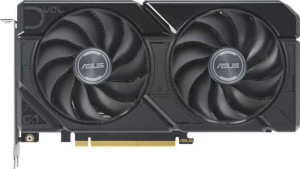
Asus Dual Radeon RX 7600 XT OC Edition specifications and in-depth review

Asus Dual Radeon RX 7600 XT OC Edition

Manufacturer: Asus

The Asus Dual Radeon RX 7600 XT OC Edition is a graphics card built on AMD's RDNA 3.0 architecture, fabricated on a 6 nm process with 13,300 million transistors. It carries 16GB of GDDR6 VRAM on a 128-bit memory bus running at an effective speed of 18,000 MHz, providing up to 288 GB/s of memory bandwidth. The card supports ray tracing, AMD SAM, DirectX 12, and multi-display output for up to four screens, with RGB lighting and a 3-year warranty also included.

The GPU operates at a base of 1,720 MHz and boosts up to 2,781 MHz, yielding 22.78 TFLOPS of floating-point performance alongside a texture rate of 356 GTexels/s and a pixel rate of 178 GPixel/s. Its 2,048 shading units work with 128 texture mapping units and 64 render output units, with Double Precision Floating Point and ECC memory both supported. The card has a 190W TDP, connects via PCIe 4.0, uses air-only cooling, and measures 227.2 mm by 123.2 mm, with display output provided through three DisplayPort and one HDMI 2.1 port.

Pros
  • 16GB of GDDR6 VRAM provides a generous frame buffer that supports memory-intensive rendering and compute workloads
  • At 227.2 mm by 123.2 mm, the card's compact dimensions make it a practical fit for smaller cases and space-constrained builds
  • A 190W TDP keeps power and thermal demands modest, reducing strain on system power supplies and cooling setups
  • ECC memory support adds data reliability for workloads requiring error correction
  • AMD SAM is supported, enabling the CPU to access the full GPU memory pool for more efficient data transfers
  • A 3-year warranty offers a reasonable coverage period for long-term ownership
Cons
  • The 128-bit memory bus limits bandwidth to 288 GB/s, which can constrain throughput in highly parallel or memory-bound workloads
  • Neither DLSS nor XeSS (XMX) upscaling is supported, leaving no software-based upscaling technology available
  • Water cooling is not supported, restricting thermal management options to air-only solutions
  • No USB-C, DVI, or mini DisplayPort outputs are present, limiting compatibility with certain monitor configurations
Who is this for?

This card is a natural fit for users assembling compact or space-constrained desktop builds, where its 227.2 mm by 123.2 mm footprint and 190W TDP keep both physical and thermal demands manageable. The 16GB GDDR6 VRAM allocation makes it well-suited for workloads that benefit from a larger frame buffer, such as content creation tasks or gaming at moderate resolutions where memory capacity matters more than raw bandwidth. The inclusion of ray tracing, AMD SAM, ECC memory support, and a 3-year warranty further positions it as a reliable option for users who want a feature-complete card with long-term ownership confidence and multi-monitor flexibility across up to four displays.

Who is this NOT for?

Users who depend on upscaling technologies will find this card limiting, as neither DLSS nor XeSS (XMX) is supported, removing software-based frame rate enhancement from the equation entirely. The 128-bit memory bus caps bandwidth at 288 GB/s, which makes the card less suitable for highly parallel compute workloads or scenarios where sustained memory throughput is critical. Those who prefer or require liquid cooling for quieter operation or tighter thermal control will find no water-cooling support available, and users relying on USB-C or DVI display connectivity will find no compatible outputs on this model.

Performance:

GPU clock speed 1720 MHz
GPU turbo 2781 MHz
pixel rate 178 GPixel/s
floating-point performance 22.78 TFLOPS
texture rate 356 GTexels/s
GPU memory speed 2250 MHz
shading units 2048
texture mapping units (TMUs) 128
render output units (ROPs) 64
Has Double Precision Floating Point (DPFP)

The GPU has a base clock of 1,720 MHz and a turbo frequency of 2,781 MHz, delivering 22.78 TFLOPS of floating-point performance. Its 2,048 shading units and 128 texture mapping units produce a texture rate of 356 GTexels/s, while 64 render output units achieve a pixel rate of 178 GPixel/s. GPU memory runs at 2,250 MHz, and Double Precision Floating Point (DPFP) is supported.

Memory:

effective memory speed 18000 MHz
maximum memory bandwidth 288 GB/s
VRAM 16GB
GDDR version GDDR6
memory bus width 128-bit
Supports ECC memory

The card comes with 16GB of GDDR6 VRAM running at an effective speed of 18,000 MHz over a 128-bit memory bus, yielding a maximum bandwidth of 288 GB/s. ECC memory support is included, adding error-correction capability for workloads where data integrity matters.

Features:

DirectX version DirectX 12
OpenGL version 4.6
OpenCL version 2.2
Supports multi-display technology
supports ray tracing
Supports 3D
supports DLSS
has XeSS (XMX)
AMD SAM / Intel Resizable BAR AMD SAM
has LHR
has RGB lighting
supported displays 4

The card supports DirectX 12, OpenGL 4.6, and OpenCL 2.2, along with hardware-accelerated ray tracing and stereoscopic 3D. Multi-display technology is present, with support for up to four simultaneous outputs, and AMD SAM is included for improved CPU access to GPU memory. RGB lighting is featured on the card, while DLSS, XeSS (XMX), and LHR are all absent.

Ports:

has an HDMI output
HDMI ports 1
HDMI version HDMI 2.1
DisplayPort outputs 3
USB-C ports 0
DVI outputs 0
mini DisplayPort outputs 0

The card provides four display outputs in total, made up of three DisplayPort connectors and a single HDMI 2.1 port. DVI, mini DisplayPort, and USB-C outputs are not included on this model.

General info:

GPU architecture RDNA 3.0
Thermal Design Power (TDP) 190W
PCI Express (PCIe) version 4
semiconductor size 6 nm
number of transistors 13300 million
warranty period 3 years
Has air-water cooling
width 227.2 mm
height 123.2 mm

The card is based on the RDNA 3.0 architecture, produced on a 6 nm process with 13,300 million transistors, and interfaces with the host system via PCIe 4.0. It has a TDP of 190W, relies on air-only cooling with no water-cooling support, and comes with a 3-year warranty. Physical dimensions sit at 227.2 mm in width and 123.2 mm in height, making it a relatively compact design within its category.
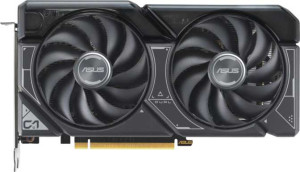
Final Verdict

The Asus Dual Radeon RX 7600 XT OC Edition is a compact, well-specified graphics card that makes a clear case for users who prioritize physical flexibility and memory capacity over raw bandwidth. Its standout attribute is the combination of 16GB of GDDR6 VRAM within a 227.2 mm form factor, which gives it a practical edge in space-limited builds where a larger frame buffer still matters. Ray tracing, AMD SAM, ECC support, and a 3-year warranty round out a feature set that holds up well for everyday rendering and multi-display use cases. Users who need upscaling support or liquid cooling options will find the card's scope limited in those areas, but for those whose requirements align with what it genuinely delivers, the Dual Radeon RX 7600 XT OC Edition is a focused and capable option built on the RDNA 3.0 architecture.

Popular Comparisons

Asus Dual Radeon RX 7600 XT OC Edition
VS
Asus Dual GeForce RTX 4060
Asus Dual Radeon RX 7600 XT OC Edition
VS
Gigabyte Radeon RX 7600 XT Gaming OC
Asus Dual Radeon RX 7600 XT OC Edition
VS
Gigabyte GeForce RTX 4060 Ti Gaming OC 16GB